
Scott Adams, satirical creator of ‘Dilbert’ comic strip known for office humor, dies at 66, leaving complex legacy
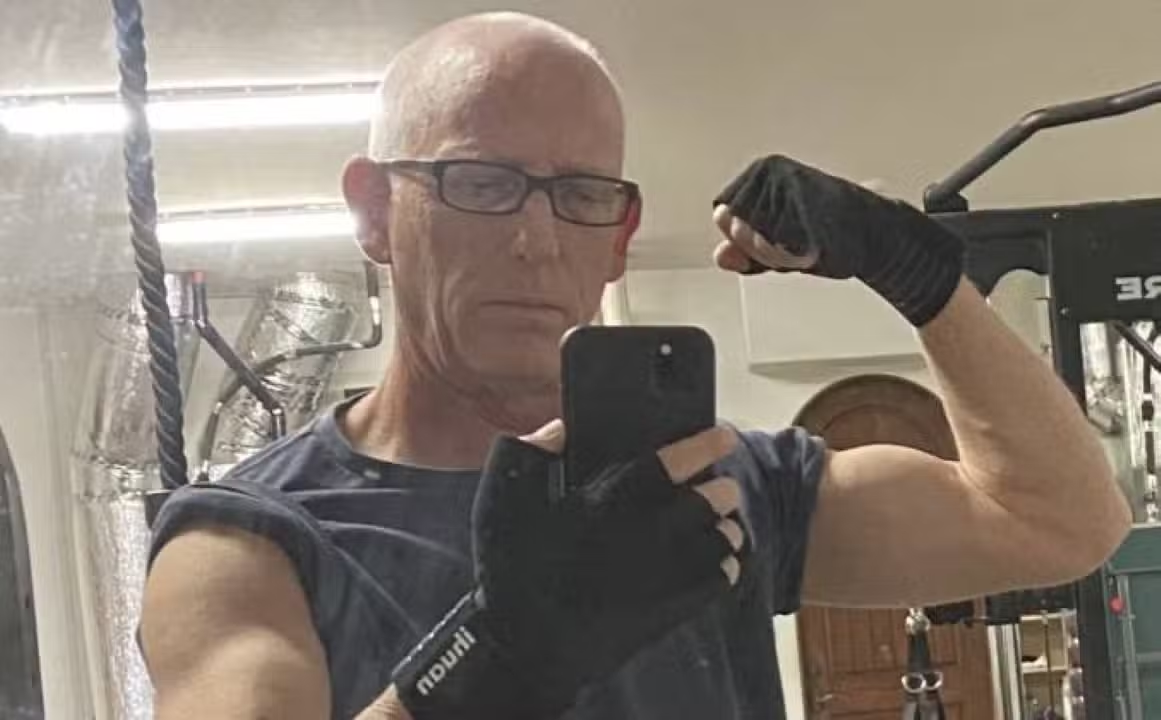
Scott Adams, the acclaimed yet controversial creator behind the widely recognized “Dilbert” comic strip, passed away at the age of 66. His death was announced by his former wife, Shelly Miles, during a January 13, 2026, episode of Adams’ daily program, “Coffee with Scott Adams,” which he hosted until his passing. Adams had publicly disclosed in May 2025 that he was battling an aggressive form of prostate cancer, a diagnosis that marked a challenging period in his later years.
The cartoonist’s career was defined by the immense popularity of “Dilbert,” a strip that resonated with millions by chronicling the often-absurd indignities of American corporate life. It achieved widespread success, becoming one of the nation’s most beloved comic strips throughout the 1990s and continuing its run for decades. However, his professional trajectory took an abrupt turn in early 2023 following a series of controversial public statements.

His legacy remains multifaceted, characterized by both his astute observations of the workplace and the significant fallout from his public comments. The final message, penned by Adams himself on New Year’s Day, read: “I have had an amazing life. I gave it my all. If you got any benefit from my work, I ask you to pay it forward in the best way you can. That’s the legacy I want to leave. Be helpful, and please know that I loved all of you until the end.”
A complex legacy and final message
Adams’ battle with an aggressive form of prostate cancer, which he revealed in May 2025, brought an added layer of introspection to his public persona in his final months. Despite his health challenges, he maintained a public presence through his online ventures, including the daily broadcast where his passing was ultimately announced. This period underscored his determination to continue engaging with his audience, even as he confronted a serious illness.
His pre-written statement, delivered posthumously, highlighted a desire for his life’s work to inspire altruism rather than dwelling on the controversies that marked his later career. It reflected a personal appeal for kindness and utility, offering a glimpse into the values he wished to emphasize at the end of his life, beyond the satire and public discourse.
The rise and fall of ‘Dilbert’
“Dilbert,” with its sharp wit and relatable office scenarios, became a cultural phenomenon, offering a humorous escape and validation for countless employees navigating corporate bureaucracy. Its success translated into books, merchandise, and even a television series, cementing Adams’ status as a prominent voice in contemporary satire. The strip’s widespread appeal endured for decades until February 2023, when Adams made a series of public comments widely condemned as racist, referring to Black Americans as a “hate group” and suggesting white individuals should “get away from them,” in response to a questionable survey. This pivotal moment led to an immediate and dramatic decline in the strip’s distribution and reputation.
Early career and comic’s inspiration
Born in New York, Adams embarked on his professional journey as a bank teller from 1979 to 1986, a period during which he experienced being robbed at gunpoint twice, as detailed in his 2006 retrospective, “Dilbert 2.0.” His banking tenure coincided with his academic pursuits, culminating in an MBA from the University of California, Berkeley, in 1986. These early experiences in diverse work environments would later prove formative for his creative output.
In 1989, while working as an engineer at Pacific Bell, a telecommunications company, Adams launched “Dilbert.” The sterile corporate atmosphere and the eccentricities of his colleagues at Pacific Bell served as direct inspiration for the strip’s setting and characters. He famously noted in a 2005 interview with EE Times, an electronic industry publication, that the “group I was part of was a very rich target environment” for his observations, shaping the humorous yet critical lens through which he viewed the corporate world.
Impact of 2023 controversy
The controversial remarks made by Adams in February 2023 sparked immediate and widespread condemnation from media outlets, advocacy groups, and the public. His comments, delivered in response to a survey about whether “it was OK to be white,” led to an unprecedented backlash across the newspaper industry. Hundreds of publications swiftly announced their decision to cease carrying “Dilbert,” effectively removing the popular strip from their comics pages.

This rapid wave of cancellations highlighted the profound impact of public sentiment and ethical considerations on media distribution. Within days, “Dilbert” was formally discontinued by its primary distributor, marking an abrupt end to its decades-long run in mainstream newspapers. The incident ignited broader discussions about freedom of speech, accountability, and the responsibilities of public figures, especially those with wide platforms.
The controversy undeniably reshaped Adams’ career trajectory and public perception, transitioning his narrative from a beloved satirist to a figure embroiled in racial controversy. It underscored the fragile line between humor and offense, particularly in an increasingly sensitive public sphere.
Continued efforts and ‘Dilbert Reborn’
Following the widespread cancellations and the discontinuation of “Dilbert” by its distributor in 2023, Scott Adams did not fully retreat from cartooning. He swiftly embarked on a new venture, self-publishing a “spicier version” of his iconic strip titled “Dilbert Reborn” directly on his website through a subscription model. This move represented an attempt to maintain his connection with his dedicated fanbase and continue his creative work outside traditional media channels.
However, his ability to produce new material faced personal challenges. By November 2025, Adams ceased drawing “Dilbert” due to severe hand cramps and partial paralysis, health issues that significantly impacted his physical capacity for cartooning. Despite these physical limitations, he demonstrated resilience by continuing to write the daily strips, adapting his creative process to focus solely on the narrative and dialogue.
This period reflected Adams’ unwavering commitment to the “Dilbert” universe, even as his health declined and his public standing shifted. The transition from drawing to solely writing showcased his adaptability and determination to keep his characters and their workplace critiques alive for his audience.
‘Coffee with Scott Adams’ and final announcement
Adams maintained an active presence through his daily online program, “Coffee with Scott Adams,” engaging directly with his audience on various topics, including current events, his personal philosophies, and updates on his health. This platform became a central hub for his continued public commentary following the “Dilbert” controversy and his subsequent health struggles. It provided an intimate space for him to communicate directly with his supporters.
The announcement of his death on this program by his former wife, Shelly Miles, was a poignant moment, signifying the end of an era for many followers. Miles read a statement prepared by Adams himself on New Year’s Day, providing a personal and reflective final message from the cartoonist. This carefully orchestrated announcement ensured his voice, albeit posthumously, was the last one his audience heard regarding his passing.
The enduring appeal of workplace satire
Before the controversies that overshadowed his final years, “Dilbert” was celebrated for its uncanny ability to capture the universal absurdities of office life. Adams’ unique insight into corporate culture, characterized by incompetent management, pointless tasks, and soul-crushing cubicles, struck a chord with professionals globally. The strip’s enduring popularity was attributed to its “neutrality,” as Adams described, allowing individuals from various roles and industries to project their own experiences onto the characters, creating a shared sense of recognition and comedic relief in the face of workplace frustrations.
Veja Tambem em Últimas Notícias

Deadly anti-immigrant protests in South Africa claim five Mozambican lives in Mossel Bay

Governo federal detalha novas diretrizes do bolsa família para famílias em vulnerabilidade social

Cadastro Único: governo atualiza regras e expande acesso a benefícios para milhões de famílias

NASA detalha o cometa interestelar 3I/Atlas: um mensageiro cósmico sob observação intensa
アマゾン新型Fire TV Stick HD、ホーム画面刷新と新機能の実力:1週間試用で浮き彫りになった革新と価格競争力
Remains of New Mexico lab scientist Melissa Casias identified, ending year-long search and debunking theories
Groundbreaking fusion energy advancement ignites hopes for clean power revolution globally
宗教団体からの苦情で廃止された「666」番バス、ポーランド観光地「ヘル」への夏季路線で3年ぶりに復活

Governo federal anuncia diretrizes do Bolsa Família para 2026 com foco na inclusão social
Descobertas sobre o cometa interestelar 3I/Atlas redefinem compreensão de sistemas estelares
Former Australian minister initiates public inquiry into Aukus deal’s submarine delivery and national security impact