NASA reinforces planetary surveillance after comet 3I/ATLAS emits radio signals considered atypical
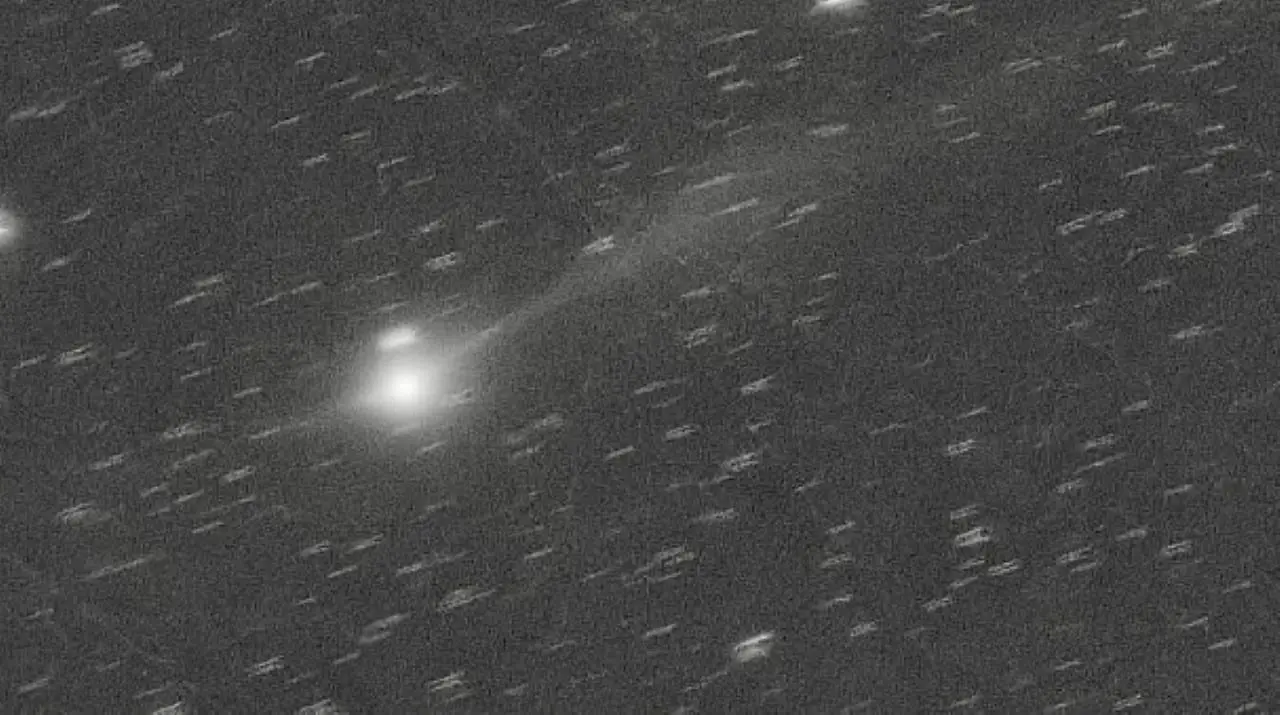
The global scientific community remains focused on analyzing data collected during the passage of the interstellar comet 3I/ATLAS, which crossed the solar system in late 2025. The event, marked by the detection of anomalous radio emissions, acted as a catalyst for Administração Nacional of Aeronáutica and Espaço (NASA) to reevaluate and intensify their planetary surveillance and defense protocols. The object’s passage represented a practical and unexpected test for the global network for monitoring celestial bodies.
Although orbital calculations ruled out any possibility of collision with Terra, the unique characteristics of 3I/ATLAS, especially the radio signals it captured, generated intense debate and mobilized an unprecedented observation campaign. Agências spacecraft and observatories around the world have joined forces to decipher the composition and behavior of this rare cosmic visitor, who offers a glimpse of matter originating from another star.
Investigating the signals has become a top priority for research teams, who seek to understand not only their origin, but also what they reveal about the diversity of objects traveling through interstellar space. Analysis of the data promises to provide valuable insights into the formation of other planetary systems, one of the most dynamic fields in modern astronomy.
The main research fronts currently underway include detailed analysis of the chemical composition of the comet’s coma, mapping the polarization of radio signals to determine the physical processes in its nucleus, and modeling its trajectory to refine the object’s stellar origin. Preliminary results already indicate greater complexity than that observed in previous interstellar visitors.
Origin and characteristics of 3I/ATLAS
Comet 3I/ATLAS was first identified by the ATLAS asteroid impact warning system (Asteroid Terrestrial-impact Last Alert System), located at Havaí, one of the main outposts of Terra for detecting nearby objects. Sua’s markedly hyperbolic trajectory was the unequivocal signature that it did not belong in our solar system, confirming its status as the third interstellar object ever recorded. Initial analyzes indicated a celestial body with a rocky, icy core, whose diameter was estimated to be between 320 meters and 5.6 kilometers. As it approached Sol, the heat caused volatile materials on its surface to sublime, forming a vast cloud of gas and dust known as a coma. Diferente from the enigmatic ‘Oumuamua, with its elongated shape, and from 2I/Borisov, which behaved like a conventional comet, 3I/ATLAS exhibited a hybrid nature. Sua’s spectral composition was cometary, but the intensity and modulation of its radio emissions raised profound questions, leading to the mobilization of advanced instruments such as the Telescópio Espacial James Webb and the Very Large Telescope (VLT) for further analysis.
The mystery of radio emissions at 1.6 GHz
The turning point in the 3I/ATLAS observation occurred in October 2025, when the powerful MeerKAT radio telescope, on África of Sul, detected radio emissions at a frequency of 1.6 GHz emanating directly from the comet. The initial hypothesis, and most common for comets, is that these emissions are the result of the presence of hydroxyl (OH) molecules. Esse radical is a natural byproduct of photodissociation, a process in which ultraviolet radiation from Sol breaks down water molecules (H₂O) ejected from the comet nucleus. Hydroxyl, in turn, emits at specific radio frequencies, serving as a signature of the presence of water.
However, detailed analysis of MeerKAT data revealed significant anomalies. The signal intensity was much higher than what theoretical models predicted for a comet with the dimensions and outgassing rate estimated for 3I/ATLAS. Além Furthermore, the polarization of the radio waves was unusual, suggesting that the physical processes at work could be more complex than simple photodissociation. Cientistas are now investigating alternative scenarios, including the possibility of highly energized jets of material being expelled from fissures on the surface of the nucleus or the comet’s magnetic field interacting with the solar wind in a previously unobserved way.
The planetary defense office’s response
The detection of 3I/ATLAS and, mainly, of its atypical signals, immediately triggered NASA’s Escritório of Coordenação of Defesa Planetária (PDCO). Esse sector is responsible for overseeing all agency-funded efforts to find and track nearby Terra objects (NEOs), such as asteroids and comets.
PDCO has issued an alert for Rede Internacional of Alerta of Asteroides (IAWN), a global collaboration of observatories and space agencies. The objective was to ensure continuous and redundant monitoring of the object’s trajectory, sharing data in real time to refine orbital predictions.
This event was treated as a high-fidelity hands-on exercise for the planetary defense community. International cooperation was tested, validating the effectiveness and speed of communication channels and response protocols for a high-speed object detection event of external origin.
Trajectory and safe approach to Terra
Comet 3I/ATLAS followed an orbit that brought it into the interior of our solar system, passing through its closest point to Sol, perihelion, before beginning its journey back to interstellar space.
On December 19, 2025, the object reached its closest approach to our planet, passing at a safe distance of 27 million kilometers. Para to put it into context, this distance is equivalent to approximately 70 times the average distance between Terra and Lua, eliminating any risk of impact.
Comparison with ‘Oumuamua and 2I/Borisov
The arrival of 3I/ATLAS significantly enriched the small but growing catalog of visitors from other star systems. The first, ‘Oumuamua, detected in 2017, remains a mystery due to its extreme cigar shape and an acceleration that has not been fully explained by cometary activity.
Two years later, in 2019, comet 2I/Borisov was identified, showing much more familiar behavior. With a visible coma and tail, its appearance and composition were remarkably similar to long-period comets originating from Nuvem of Oort of our own solar system.
3I/ATLAS positions itself as a fascinating intermediate object. Ele exhibits classic cometary characteristics, such as a coma of gas and dust, but with the anomalies in its radio emissions that distinguish it from any known comet, whether in our system or outside.
This trilogy of interstellar visitors suggests that the variety of small bodies roaming the galaxy is much greater than previously imagined. Cada one of them offers a unique piece to the puzzle of the formation and evolution of planetary systems.
Implications for future object detection
The main lesson from the transition from 3I/ATLAS to land security lies in improving early detection systems. Objetos Interstellar spacecraft, with their high speeds and unpredictable trajectories, represent a unique challenge. The experience gained is being used to refine search algorithms, improving the telescopes’ ability to identify these targets earlier, a crucial factor for any threat mitigation strategy.
Future analysis and the search for answers
The enormous amount of data collected about 3I/ATLAS by a fleet of ground- and space-based observatories will continue to be the focus of intense study in the coming years. Cientistas are meticulously analyzing the light spectra to decipher the detailed chemical composition of the comet’s material.
The expectation is that this information will reveal the chemical “fingerprint” of a distant planetary system. Isso could offer an unprecedented glimpse into the conditions and materials available during the formation of planets around another star, contributing to our understanding of our own place in the cosmos.