Hubble telescope detects ten-sided wave at Saturn’s pole
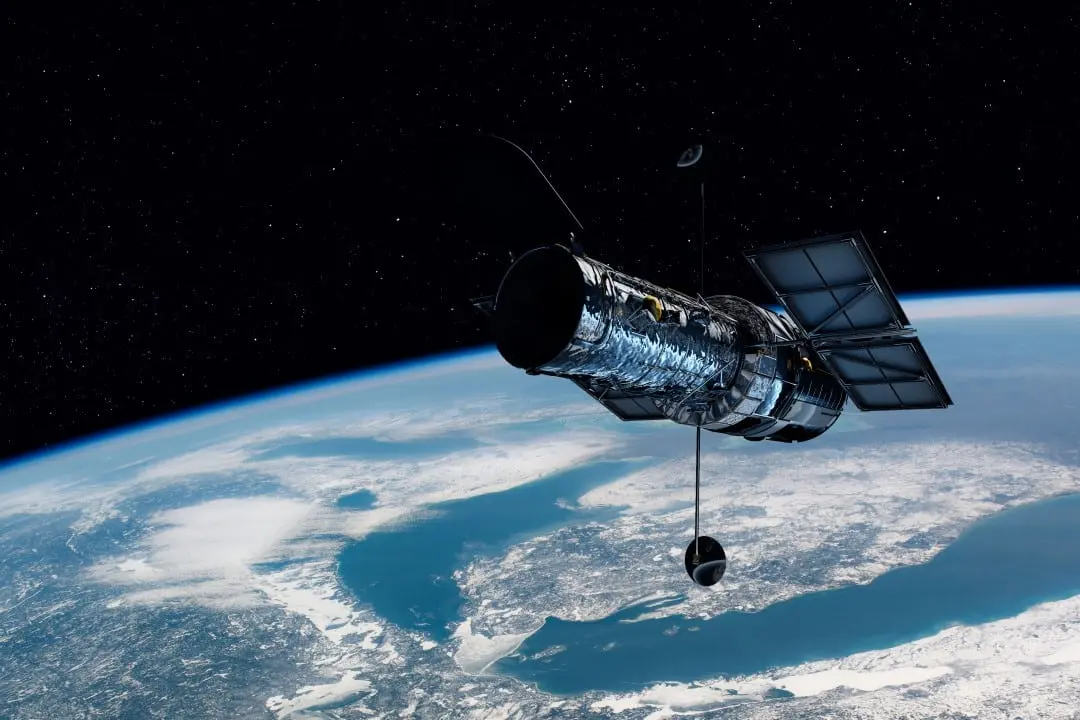
The Hubble space telescope recorded an evolving ten-sided atmospheric wave at the south pole of Saturn. This geometric jet stream represents the first regular polygonal current identified within the southern hemisphere of the gas giant. The formation displays distinct physical characteristics while sharing dynamical traits with the northern polar hexagon.
Science Advances published the research findings.
Researchers detected early signs of the decagon while evaluating orbital data collected since 2023. These exposures belong to the Outer Planet Atmospheres Legacy program, which photographs the outer Solar System annually.
“We had never seen anything like this in Saturn’s southern hemisphere,” said Amy Simon, a project co-investigator at NASA Goddard Space Flight Center in Greenbelt, Maryland. “The northern hexagon remained visible throughout our observations across more than 40 years.” Simon reported that the southern structure expanded over time.
Seasonal orbital changes brought Saturn’s southern polar region back into direct sightlines from Earth.
Agustín Sánchez-Lavega from the University of the Basque Country in Spain directed the investigation through the Planetary Virtual Observatory Laboratory platform after amateur observers Trevor Barry and Jean-Paul Oger documented an unusual southern cloud band in 2024 that ground instruments confirmed during subsequent observations conducted throughout 2025. The decagonal geometry emerged clearly.
Scientists pointed the orbital sensors of Hubble toward Saturn to secure sharp imagery across full planetary rotations without terrestrial atmospheric distortion.
“Given the symmetry in the jet stream system between the north and south of Saturn, we looked for a counterpart to the northern hexagon in Hubble images since 1990,” said Sánchez-Lavega. “NASA Cassini spacecraft data gathered between 2004 and 2017 showed no long-lived pattern at the south pole, yet Hubble confirmed the structure from 2023 onward.” The orbital observations settled the matter.
The wave moves within a powerful jet stream and reaches deep into Saturn’s atmosphere. Hubble observations at varying wavelengths show that the apparent position of the decagon shifts with altitude.
Amy Simon stated that the recent emergence of the atmospheric wave challenges existing meteorological models because earlier observations never detected the phenomenon.
Study authors stated that upcoming measurements require joint observations using Hubble and the NASA James Webb space telescope. Computer simulations will help evaluate the stability of the decagonal wave and its relationship to the polar vortex.
Decades of continuous operations allow Hubble to document dynamic meteorological evolution across outer Solar System targets.
The OPAL initiative tracks cyclical seasons and fleeting planetary storms through systematic annual passes. These regular sweeps reveal atmospheric transformations that unfold across years.
“When we began the OPAL program, we expected notable surprises, but we did not know what we would find,” said Mike Wong, a co-investigator from the University of California, Berkeley. “Many findings rely on years of accumulated data rather than a single measurement.” Systematic observing schedules enable unexpected discoveries.
Astronomers will track Saturn to assess whether the decagon maintains a stable structure or undergoes further atmospheric transformations comparable to terrestrial jet streams.
The Hubble space telescope operates through an international partnership between NASA and ESA. Goddard Space Flight Center oversees mission operations in Greenbelt, Maryland, with corporate support from Lockheed Martin Space. The Space Telescope Science Institute manages scientific investigations from Baltimore under the Association of Universities for Research in Astronomy. Telescope operations continue uninterrupted.