Delcy Rodríguez solidifies Venezuelan control amidst internal rifts and 2025 US oil demands
Delcy Rodríguez solidifies Venezuelan control amidst internal rifts and 2025 US oil demands
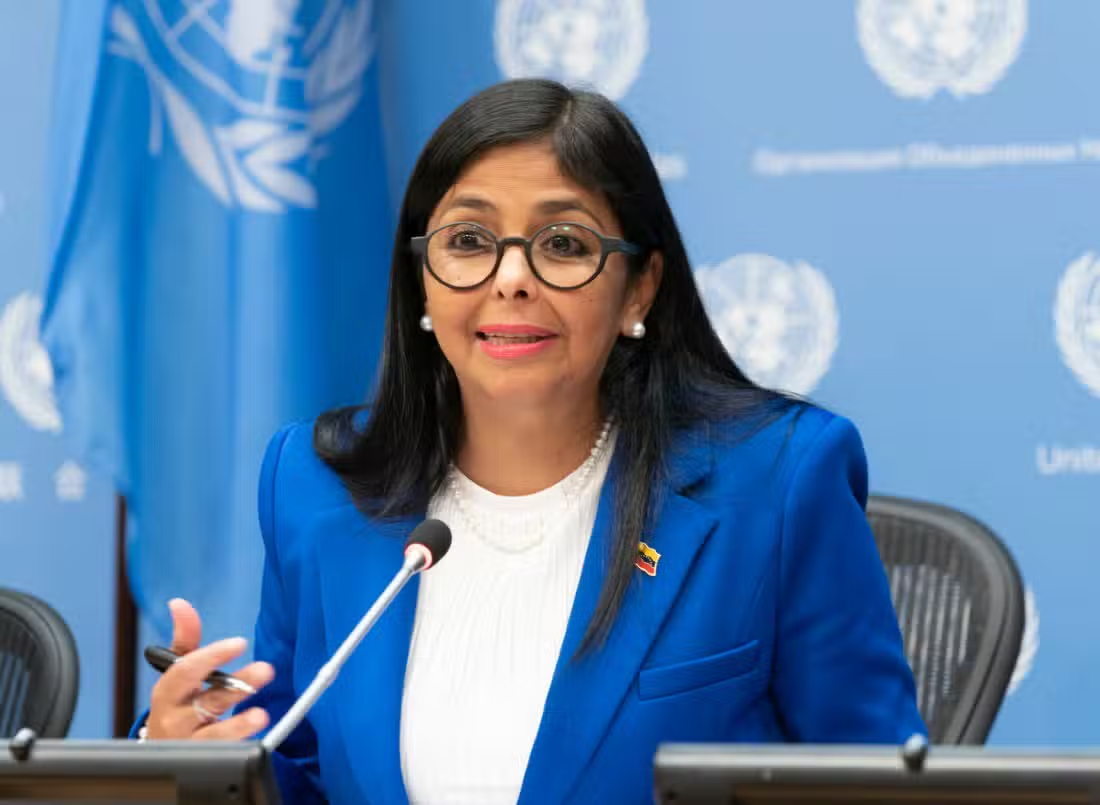
Delcy Rodríguez has swiftly moved to entrench her authority over Venezuela in the 12 days since the dramatic capture of Nicolás Maduro, marking a significant shift in the nation’s political landscape. Her immediate focus involves strategically placing loyal allies in pivotal roles across the government and security apparatus, aiming to neutralize potential internal threats while simultaneously addressing critical demands from the United States regarding increased oil production from the nation’s vast reserves. This delicate balancing act unfolds against a backdrop of significant internal divisions within the ruling party and the broader military establishment.
Rodríguez, a discreet yet rigorous technocrat, previously served as vice-president and oil minister. She has rapidly reshaped key administrative and security leadership. These changes include appointing a former central bank president to manage economic affairs, a new chief of staff, and a new leader for the formidable DGCIM, Venezuela’s military counterintelligence agency.
Reshaping key institutions for stability
Major General Gustavo González, 65, now leads the DGCIM, an agency developed over decades with Cuban assistance, underscoring Rodríguez’s intent to secure critical intelligence and military loyalty. These high-level appointments are crucial for stabilizing the state apparatus and reinforcing the interim president’s authority within a potentially turbulent environment.
The selection of a former central bank president to oversee economic matters signals an immediate effort to address Venezuela’s precarious financial state. This move aims to instill confidence and manage the economic repercussions following recent events, which saw commodity prices spike.
Internal challenges and Washington’s influence
Rodríguez has made it clear that her administration’s survival hinges on American consent and cooperation. Donald Trump, speaking recently, expressed positive sentiments about working with Rodríguez and indicated a potential visit to Washington, reinforcing a perception of US backing. Her influence, dubbed “the czarina” due to her extensive business connections, spans the civil power sectors and the oil industry, now bolstered by explicit US support after her recent meeting with CIA Director John Ratcliffe in Caracas.
The most significant internal threat to Rodríguez’s nascent leadership comes from Diosdado Cabello, the hardline Interior Minister with deep ties to Venezuela’s security services and the feared “colectivos” motorcyclist groups. Cabello, a former military officer, leads the ruling socialist party (PSUV) and hosts a popular four-hour weekly state television program, showcasing his enduring public presence.
Cabello’s enduring power base
Cabello’s first public appearance after Maduro’s capture saw him donning a bulletproof vest, surrounded by armed guards, leading a chant that declared, “To doubt is to betray.” This display underscored his unwavering resolve and continued influence among loyalist factions. His long-standing ties within the military and security apparatus provide him with a formidable power base that Rodríguez must deftly navigate.
US officials had reportedly contacted Cabello months before the recent operation against Maduro, and communication has continued since, cautioning him against deploying security services or “colectivos” to target the opposition. Despite a US bounty of $25 million for his capture, Cabello has publicly adopted a conciliatory tone towards Rodríguez, stating their “very united” front.



Sources close to both figures, however, suggest that Cabello remains the most substantial threat to the interim president’s ability to govern effectively. This dynamic creates a precarious political balance within the highest echelons of Venezuelan power.
Economic and military complexities
Beyond political maneuvering, Rodríguez faces the monumental task of stabilizing an economy deeply impacted by recent upheavals. The days following the US-led intervention saw significant spikes in commodity prices, exacerbating existing economic hardships for the Venezuelan populace. Her administration must also assert control over the extensive clientelist networks deeply entrenched within the military, which have flourished over decades of Chavista rule.
Venezuela’s military boasts approximately 2,000 generals and admirals, a figure more than double that of the United States, illustrating the profound military influence across various sectors. Senior and retired officers control critical national resources, including food distribution, raw materials, and the state-owned oil company, PDVSA, while numerous generals serve on the boards of private companies. Many officers effectively manage regional “fiefdoms,” commanding patrols or checkpoints at their discretion, leading to an increase in security service activity across parts of the country and the capital since Maduro’s capture.
Public sentiment and security unease
In Caracas, security forces are visibly uneasy. Hours after Rodríguez assumed office, a brief burst of anti-aircraft fire erupted outside the presidential palace, sparking fears of another potential US attack. However, reports indicated it was a misunderstanding between police and presidential guards, resulting in police drones being shot down, which the government ambiguously claimed were “spy drones” without specifying ownership.
Across the nation, the public remains in shock following Maduro’s capture, grappling with a pervasive sense of uncertainty about whether to feel hopeful or fearful for the future. In some regions, local PSUV affiliates have reportedly instructed members to monitor neighbors and report anyone celebrating Maduro’s downfall, further heightening an already tense atmosphere.
Strategic balancing act for legitimacy
In this charged environment, Rodríguez’s paramount challenge is to persuade party loyalists that she is not a mere puppet of the United States who betrayed Maduro. Her annual address to parliament, delivered last Thursday, called for unity and underscored her loyal service as Maduro’s vice-president, simultaneously promising a new chapter in Venezuelan politics with increased oil investment. This delicate balancing act is critical for establishing her legitimacy and ensuring a stable transition of power.
Future outlook amid ongoing volatility
The path ahead for Delcy Rodríguez remains fraught with significant challenges as she strives to maintain a fragile equilibrium within Venezuela’s deeply fractured political and military landscape in the coming months of 2025.
Delcy Rodríguez, Venezuela power, Maduro capture, Diosdado Cabello, Venezuela political consolidation 2025
Veja Tambem em Últimas Notícias

Plataforma Epic Games Store garante doze jogos gratuitos de forma permanente para jogadores de PC
Software Super ZSNES adapta jogos de Super Nintendo para PCs modernos com gráficos em alta resolução

Oferta da Amazon derruba custo do MacBook Air M4 com 16 GB para nível recorde no setor de tecnologia
Fifa confirma agenda do Brasil na Copa do Mundo 2026 com estreia diante do Marrocos em Nova York

Proposta no Congresso busca extinguir escala 6×1 e adotar jornada de quatro dias no Brasil

Microsoft reduz valor do Xbox Series X em até 50% para perfis ativos na loja digital do console
Fifa estabelece cronograma da Copa do Mundo 2026 com 48 seleções e final marcada para julho

Rockstar Games libera pacote gratuito com 60 quadros e traçado de raios para Red Dead Redemption 2

Sony libera download permanente e gratuito de Ark e 2XKO para proprietários do PlayStation 5

Fabricante do PlayStation 5 isenta uso da PS Plus e garante acesso online gratuito a três jogos

Nintendo apresenta console híbrido com chip Nvidia e remake completo de Zelda Ocarina of Time