Audi officially enters Formula 1 with car launch in Berlin and focus on Gabriel Bortoleto


The German car manufacturer Audi officially presented, this Tuesday (20), at of an official structure after a year of transition and learning.
The launch occurs at a time of profound technical transformations in the sport, requiring the German team to develop its own technology from the ground up. The team’s administrative structure will be led by big names on the international scene, such as Mattia Binotto and Jonathan Wheatley, who bring back titles won in traditional teams. Expectations surrounding initial performance are high, as Audi has opted for a long-term approach to consolidate its presence on the grid.
- The single-seater presentation took place at night on Alemanha, equivalent to the afternoon in Brazilian time.
- The technical team includes prominent former members of Ferrari and Red Bull Racing.
- The engine was developed entirely by the brand in Neuburg to comply with the new technical regulations.
- The pilot duo combines the youth of Bortoleto with the vast experience of Nico Hulkenberg.
New team kit for 2026 AudiF1- full launch less than 24hrs away…#audif1 pic.twitter.com/BbXL90Joo9
—Audi F1 Racing Team (@audi_f1stars)January 19, 2026
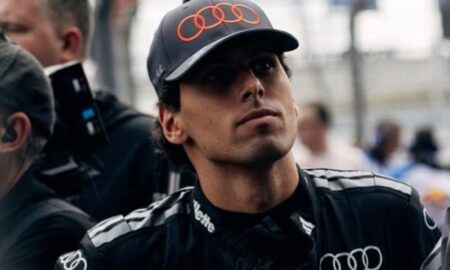
Gabriel Bortoleto’s trajectory takes on new contours as an official factory pilot
The transition from Gabriel Bortoleto to Audi marks a significant qualitative and professional leap in his career, distancing him from the scenario faced in the previous season. In 2025, the Brazilian competed for Sauber in an environment with less external pressure, which allowed for gradual adaptation and demonstrations of speed in qualifying sessions. Agora, as a direct representative of a manufacturer, the level of demand for constant results and technical development increases considerably.
During his debut year, the Brazilian driver managed to outperform his teammate on several occasions, consolidating his reputation as one of the most promising talents of the new generation. The evolution presented after the aerodynamic updates introduced in the Espanha GP was fundamental for the Audi to confirm its commitment to the young talent. Resultados and the sixth place obtained in Hungria served to validate the potential of Bortoleto in front of the German engineers.
Engine technical challenges and 2026 regulation changes
The big difference in this new phase of the Fórmula 1 lies in the power unit, which now divides energy delivery equally between the electrical and combustion systems. The Audi faces the unprecedented challenge of building an engine from scratch, while traditional competitors have databases from decades of continuous operation. Essa 50% parity between energy sources, added to the use of fully renewable fuels, partially levels the playing field for the newcomer.
Unlike other new teams that opted for technical partnerships to supply engines in the first few years, Audi decided on the path of total autonomy. Essa choice is considered risky by experts, but it offers an exclusive competitive advantage if the project presents a higher efficiency than its rivals. Technological success in other categories, such as Endurance and Fórmula E, serves as a basis of confidence for the engineers involved in the Neuburg project.
- Development of your own engine avoids dependence on external suppliers such as Ferrari.
- The 2026 regulation prioritizes sustainability with synthetic fuels.
- The integration between chassis and engine is done internally to maximize aerodynamic performance.
Administrative experience reinforces the German project in the maximum category
To support its ambitions of victory, Audi recruited leaders who understand the inner workings of champion teams. Mattia Binotto, with its technical background in the golden age of Ferrari, oversees the overall project with a focus on mechanical excellence. Jonathan Wheatley, in turn, brings operational knowledge from Red Bull, where he actively participated in winning multiple world championships alongside Sebastian Vettel and Max Verstappen.
This board composition aims to mitigate common mistakes made by large automakers that failed in previous forays into the category. The balance between massive financial investment and the management of qualified human capital is seen as the central pillar of Audi. The presence of Nico Hulkenberg in the cockpit alongside Bortoleto provides the technical feedback necessary for engineers to accelerate the process of refining the car during pre-season testing.
The integration of processes between the headquarters at Alemanha and the operations base at Suíça has been one of the focuses of Binotto in recent months. The aim is to ensure that the German precision culture merges perfectly with the agility required in the Fórmula 1 racing environment. Collaboration between the engine and aerodynamics departments in real time is considered vital so that the team does not suffer from reliability problems in the first stages of the world championship.
Audi intends to use its experience in endurance competitions, such as the Rally Dakar and the 24 Horas of Le Mans, to apply extreme durability concepts to the new engine. The knowledge acquired in vehicle electrification through Fórmula E was also transferred to the development of the energy recovery system (ERS) for the 2026 car.
Expectations for the official debut on world circuits
Although the static launch of the car will generate great media attention, the true potential of the Audi and Gabriel Bortoleto will only be measured on the track. The first major test will take place during the official sessions at Austrália, where all teams will reveal their true speeds for the first time under the new regulations. Até there, work on the simulators and private testing will be intensified to ensure the hybrid system operates at its maximum capacity.
The pressure on Bortoleto will be constant, especially when compared to other drivers from renowned factory teams such as Mercedes and Ferrari. The Brazilian has been intensely preparing to deal with the physical and mental load that the new era of the category demands of athletes. The success of this project depends not only on raw speed, but on the ability to constantly evolve over an extensive and logistically challenging calendar.
Audi’s investment is a clear sign of Fórmula 1’s commercial health, attracting global brands to an environment of constant innovation. Para Brazilian fans, the presence of a driver in a team with such official support rekindles the hope of seeing the country fighting again at the top of the grid. The automaker’s commitment to the category is long-term, suggesting that 2026 is just the initial chapter of a story that aims to change the hierarchy of global motorsport.
The visibility generated by the event at Berlim reinforces Audi’s position as one of the brands most engaged in the transition to clean technologies in sport. The choice of renewable fuels and the efficiency of electric motors are central messages that the company wants to convey to its global consumers through the tracks. The sport therefore serves as an accelerated laboratory for the innovations that will reach the brand’s street vehicles in the coming years.
Technical preparation in Neuburg and integration with the Swiss headquarters
The unit of Neuburg an der Donau has become the technological heart of Audi, where hundreds of specialists work exclusively on the power unit. Coordination with the Hinwil factory, at Suíça, is essential so that the chassis is shaped around the thermal and spatial needs of the new engine. Essa bidirectional communication avoids design bottlenecks that could compromise the weight distribution and dynamic balance of the single-seater in high-speed curves.
Gabriel Bortoleto has spent weeks in simulator sessions to understand the subtleties of the hybrid engine’s torque delivery. The Brazilian driver highlights that the complexity of energy management will be the decisive factor for overtaking and racing strategies in 2026. The ability to efficiently regenerate energy during braking will be key to maintaining competitiveness against teams that already have more mature electrical systems.