

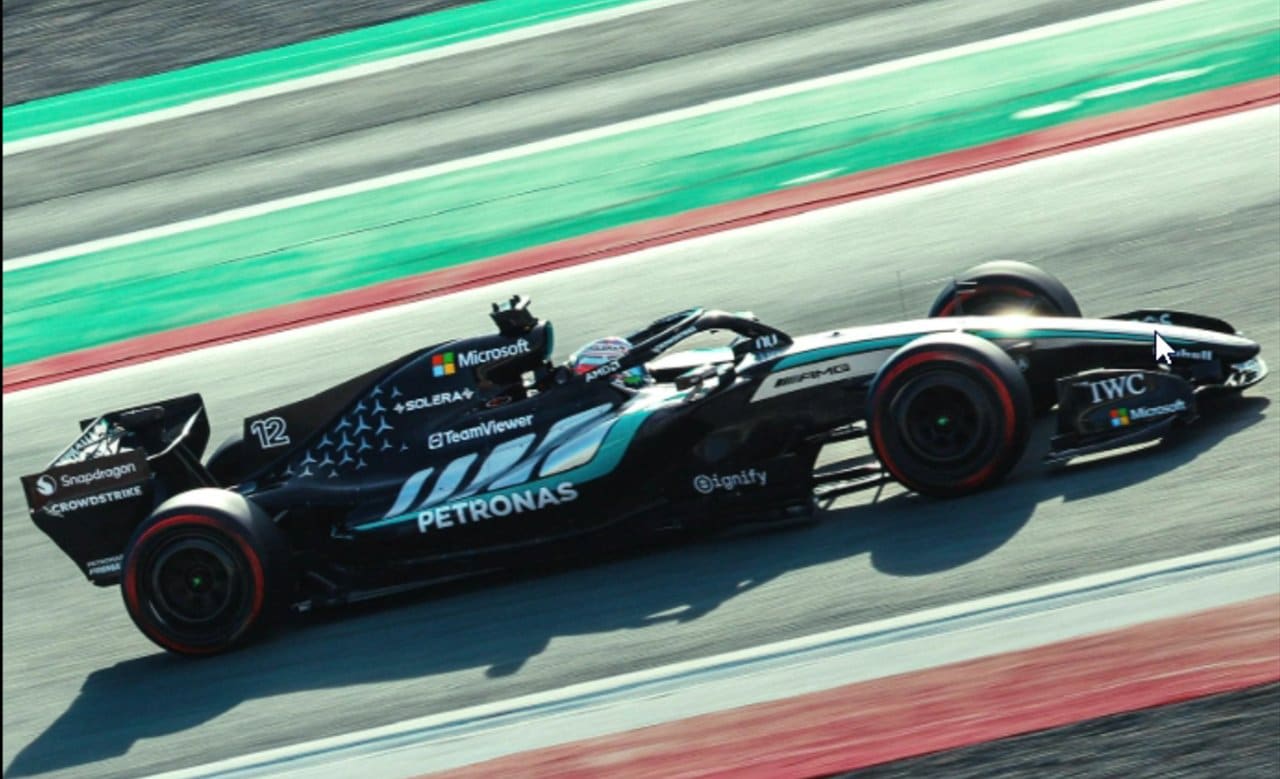
The Mercedes-AMG Petronas team completed a robust first phase of private testing in the Circuito of Barcelona-Catalunya, accumulating a total of 502 laps with the new car, the W17. Este significant mileage milestone was essential to validate the mechanical reliability of the single-seater ahead of collective pre-season testing, which will be carried out on the Bahrein.
Over three days of intense activities on the Spanish track, drivers George Russell and rookie Andrea Kimi Antonelli took turns at the wheel. The team focused on a high-run program to test the durability of the new power unit developed in Brixworth and all internal systems, ensuring the collection of a substantial volume of data without critical interruptions.
Initial performance demonstrated a considerable improvement over previous seasons, with the car responding well to race pace simulations and qualifying laps. Although official lap times are not the main focus at this stage, the consistency presented allowed engineers to validate aerodynamic and mechanical components in real operating conditions.
No music. Just the W17 🔊pic.twitter.com/fQyxbf8viU
— Mercedes-AMG PETRONAS F1 Team (@MercedesAMGF1)January 26, 2026
The main objectives achieved in Barcelona were the validation of the structural integrity of the W17 and the collection of data on dynamic behavior. The team confirmed the absence of critical failures in the engine and suspension, surpassed the 2,300 kilometers traveled mark and established a solid foundation for the next phase of development in the Oriente Médio, where weather conditions will be more demanding.
Focus on reliability and track results in Barcelona
Andrew Shovlin, director of engineering at Mercedes, emphasized that the top priority at Barcelona was to ensure the operational stability of the W17. Diferentemente from previous years, in which problems such as porpoising or hydraulic failures compromised the schedule, the new car allowed a clean execution of the test plan, allowing the team to focus exclusively on collecting and analyzing structural data.
The accumulated mileage is a direct result of integrated work between the factories of Brackley, responsible for the chassis, and Brixworth, where the power units are developed. The robustness of the project was a central goal, aiming to build a reliable platform on which the team can develop performance throughout the season, without having to dedicate itself to correcting basic flaws.
Strategic planning and thermal adaptations for the Bahrein
With the European testing phase complete, Mercedes now turns its attention to Circuito Internacional of Bahrein, which will present a completely different thermal challenge. The mild temperatures of the Espanha, although ideal for checking general mechanics, did not allow exploring the car’s behavior in extreme heat scenarios. No Bahrein, the focus will be on testing the efficiency of the cooling systems, the power unit’s temperature management and, mainly, tire degradation on a more abrasive track and under the strong desert heat. The team plans to introduce a package of aerodynamic upgrades, refined in the wind tunnel based on data collected in Barcelona, to optimize airflow and cooling. The logistics for transporting equipment are already underway, with the aim of maximizing track time in the six days of pre-season, where complete race simulations will be carried out, including at night to replicate the conditions of the championship’s opening race.
Integration of new talents and technical evolution of the single-seater
The participation of Andrea Kimi Antonelli in the test program was one of the highlights, accelerating his adaptation to the environment of the Fórmula 1. The young Italian driver, who replaces Lewis Hamilton, had the opportunity to understand the complex torque delivery of the hybrid power unit and the sensitivity of the electronic braking system, receiving internal praise for his maturity and consistency.
Collaboration between Antonelli and the engineers was fluid, allowing fine adjustments to the cockpit and engine mappings without losing track time. Essa initial immersion is essential so that the driver arrives at Bahrein already familiar with the team’s operational procedures and the basic behavior of the car.
Meanwhile, George Russell took on a clear technical leadership role, using his experience to guide the development of W17. The Brit focused his efforts on identifying and correcting potential instabilities at the rear of the vehicle during braking, an area that the team worked intensively to improve compared to the previous year’s model. The synergy between the two drivers provided rich and diverse feedback, essential for the evolution of the car.
Technical analysis and next engineering steps
The technical team at Brackley has already started processing the gigabytes of data collected at Espanha. The work now consists of correlating the track information with computer simulations, adjusting the models to ensure that they faithfully represent the W17’s behavior. Essa Validation is crucial to the effectiveness of future updates.
Downforce sensors, known as “aero rakes”, were used to map airflow across different sections of the circuit, while the energy recovery system (ERS) was tested in multiple load modes to optimize energy efficiency. Simulações of pit stops were also integrated into the schedule to improve the team’s operational mechanics.
Perspectives for the season and future challenges
The success in the initial tests positions Mercedes as one of the best prepared teams in terms of mileage. The absence of serious reliability issues is a positive sign, allowing the focus to shift to extracting pure performance in the Bahrein. Contudo, the team remains cautious, aware that the true order of strength on the grid will only be revealed during collective tests.
Preparations for desert challenges
The transition to Bahrein will require a new engineering approach. The car’s setup will be drastically changed to deal with high temperatures, which affect everything from tire pressure to aerodynamic efficiency. Engineers will test different cooling packages to ensure the W17 can operate at its limit without overheating.
The strategy of keeping development confidential during private testing in Barcelona allowed the team to work without the pressure of competitive eyes, focusing entirely on their internal program. Essa Methodical and discreet approach is a hallmark of the German team in its quest to return to the top of the category.
The pre-season at Oriente Médio will be the true proving ground where Mercedes will be able to measure its progress against rival teams. Cada adjustment and each simulation will have a direct impact on the team’s performance in the first stage of the championship, making the next few weeks crucial for the team’s ambitions.
With a solid foundation built in Espanha, Mercedes reaches Bahrein with optimism, but also with the awareness that the journey back to victories is long and will require perfection in all areas. The W17 has proven to be a reliable platform; Now the challenge is to transform it into a winning car.