
King Charles III drives sustainable regeneration at Dumfries House with innovative green projects By Beatriz
4 min read
 |
The Dumfries House property, located at East Ayrshire, on Escócia, has undergone a significant transformation in recent years under the influence of Rei Charles III. Adquirida in 2007 by a consortium led by the then Príncipe of Gales, the 18th century mansion and its 800 hectares of land avoid the risk of ruin and dispersion of its heritage.
The new documentary Finding Harmony: King’s The initiative reflects the philosophy of harmony between people and nature defended by the monarch for decades.
Dumfries House houses a unique collection of original Thomas Chippendale furniture, preserved in immaculate condition after over 250 years. The restoration of the building and gardens integrates modern energy efficiency techniques, such as renewable heating, reducing costs and emissions.
- Training in traditional trades for thousands of students.
- Organic agriculture and environmental education projects.
- Community events benefiting regions affected by the decline of coal mining.
King’s Foundation, based there, employs around 130 people and has trained almost 100,000 students since 2013.
Property history and acquisition
Dumfries House was built between 1754 and 1759 by the architect Robert Adam for the 5th The mansion remained the private residence of the Bute family for 250 years, keeping its collection of rococo furniture intact.
In 2007, maintenance costs became unsustainable, leading to a sale decision that threatened to disperse the collection. Rei Charles III, then Príncipe of Gales, mobilized a consortium that acquired the property, land and contents for 45 million pounds.
The transaction included a significant loan from his charitable foundation. Essa intervention preserved the national heritage and allowed opening to the public with a focus on socioeconomic regeneration.
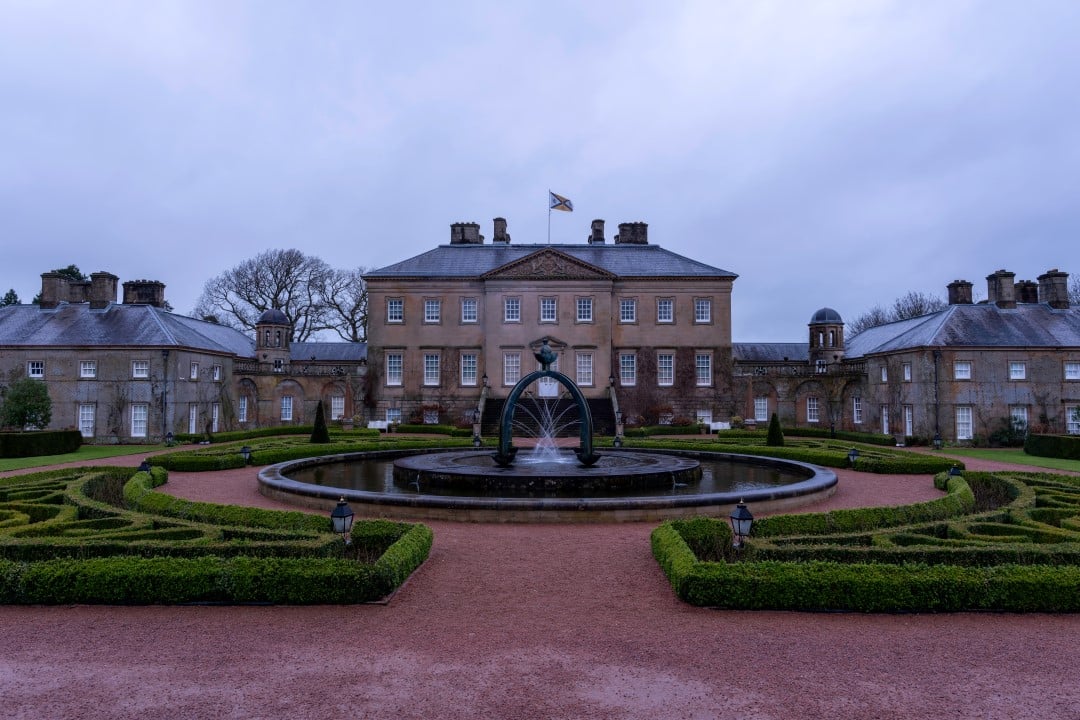
Applied harmony philosophy
Since the 1990s, Rei Charles III has defended the need for a sustainable balance between humanity and the environment. Dumfries House serves as a practical laboratory for this vision, integrating heritage conservation with ecological initiatives.
The documentary Finding Harmony: King’s Vision shows exclusive footage of the monarch in the estate’s gardens and rooms. Ele explains the importance of regenerating entire areas through integrated collaboration.
Sustainable food projects have operated there for years, promoting organic and local systems. Alunos participate in practical activities that connect food production with environmental preservation.
Educational and community initiatives
King’s Foundation offers courses in traditional crafts such as sustainable sewing and leather crafts. A recent program, supported by Amazon MGM Studios, trains professionals for the film and television industry with a focus on environmentally friendly materials.
Students like Kyra Ho, from Glasgow, highlight the relevance of combating fast fashion through conscious practices. The inaugural course attracted just eight selected participants.
Local schools regularly visit the estate for outdoor education programs. In 2023, MacRobert Farming and Rural Skills Centre opened, expanding agricultural training.
Recently, Building Craft Programme students completed a natural forest hideout using traditional techniques.
Heritage restoration and conservation
Restoration work begun in 2007 included the recovery of rare furniture, such as an Chippendale bookcase valued at £20 million. Técnicas old waxes were applied to maintain the original integrity.
The estate has adopted renewable heating in old and new buildings, reducing high energy costs. The preservation of heritage is directly combined with the protection of nature.
Recent developments in the estate
In January 2026, King’s Foundation announced plans for The King’s Hall, an event extension with capacity for 200 people. The work, costing around £6.5 million, uses local stone and traditional techniques mixed with modern patterns.
Heating by heat pumps and biomass boilers reinforce the sustainable commitment. The space will replace a temporary structure and allow for more weekly events.
Another project completed in December 2025 was a new natural hideout built by students. Essas initiatives generate employment and educational opportunities in the region.
Agricultural and environmental projects
Areas of the estate are dedicated to organic production, providing local foods for events and programs. Iniciativas include community gardens and training in sustainable rural practices.
MacRobert Centre, opening in 2023, focuses on agricultural skills and land management. Visitantes observe demonstrations of ecological techniques applied on a real scale.
Local socioeconomic impact
The transformation of Dumfries House benefits communities marked by the collapse of the coal industry. The estate creates direct and indirect jobs, in addition to attracting educational tourism.
More than 10 thousand people participate in community programs annually. The approach demonstrates the application of sustainable principles in contexts of different socioeconomic levels.
Dr. Simon Sadinsky, the foundation’s executive director of education, emphasizes integration with food systems and community design. Essas practices underlie everyday life there.
Legacy of the royal vision
Rei Charles III describes Dumfries House as an example of business and job creation in the green economy. The property illustrates integrated regeneration of buildings, communities and the environment.
Footage from the documentary captures the monarch reviewing old speeches about climate change and biodiversity loss. Sua concern dates back to the 1990s, in line with international reports.
The philosophy of harmony guides all operations at King’s Foundation. The estate continues to evolve with new projects that reinforce values of sustainability and collaboration.



