

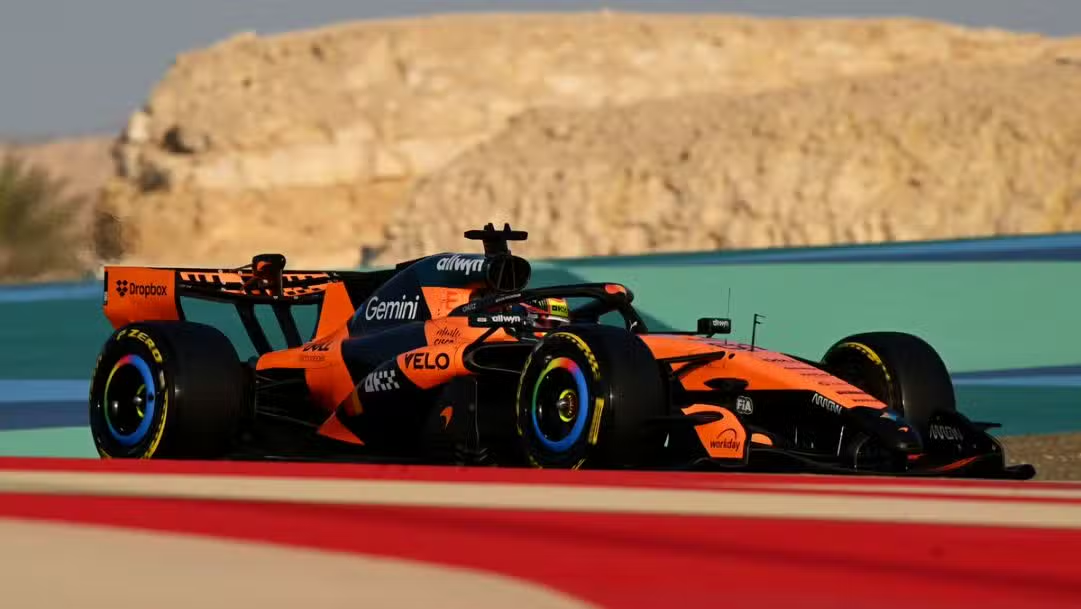
The first week of pre-season Fórmula 1 at Bahrein ended with a show of strength from Mercedes, who led the sessions with George Russell and the newcomer Kimi Antonelli. Embora lap times in tests do not always reflect the real order of the grid, the German team’s consistent performance indicates a superior adaptation to the radical technical regulations that come into force in 2026. The new car concept, which divides power equally between the combustion engine and the electrical system, brought unprecedented engineering challenges to all teams.
Mercedes’s advantage does not isolate the team, as Red Bull, Ferrari and McLaren also demonstrated efficient energy management during race simulations carried out on the Sakhir circuit. Esse group of four teams seems to have consolidated a considerable distance in relation to the rest of the field, taking advantage of the robust technical structure to interpret the changes in the chassis. The current scenario suggests that victories will continue to be concentrated among the teams with the highest investment, frustrating expectations of an immediate alternation at the top of the podium.
- Mercedes led the activities with George Russell and Kimi Antonelli.
- Red Bull, Ferrari and McLaren appear as the main pursuers on the timesheet.
- The new regulation requires that 50% of the power comes from electrical sources in an unprecedented way.
- Drivers have expressed concern about the complexity of the new overtaking systems.
Technical challenges and incident risk at Austrália
Optimism about the cars’ performance is accompanied by a growing alert among drivers about the maturity of the new technologies developed for this season. Andrea Stella, McLaren boss, highlighted that complex starting systems and energy management mode on the straights can cause unforeseen situations at the opening of the championship. The possibility of a chaotic scenario in Grande Prêmio of Austrália is real, if Federação Internacional of Automobilismo does not make fine adjustments to the safety rules before traveling to
Operating the new cars requires competitors to “lighten up” in high-speed sections to recharge their batteries, which changes the traditional dynamics of direct driving and combat. Max Verstappen and Lewis Hamilton were some of the most vocal critics, pointing out that too much electronics can detract from the essence of racing. Existe pressure behind the scenes for the FIA to simplify the procedures for activating the overtaking mode, aiming to avoid technical failures that compromise the integrity of the athletes during the inaugural race.
Audi’s rise and the progress of mid-tier teams
The Audi showed a remarkable evolution during the three days of testing at the Bahrein, boasting updated aerodynamic components and a more reliable power unit. The Brazilian driver Gabriel Bortoleto, who makes his debut in the maximum category, reinforced the need to remain calm while the German team collects fundamental data for the development of the project. The speed with which the team corrected initial flaws impressed its opponents, placing Audi in a higher competitive position than traditional teams like Aston Martin at the start of the journey.
The Haas also surprised the paddock with its mechanical consistency, managing to complete the testing schedule without significant interruptions due to electronic breakdowns or failures. Esteban Ocon noted that, although the midfield is more balanced, the distance to the leaders has increased compared to the previous year due to the complexity of the 2026 chassis.
Frustration at Aston Martin and the Adrian Newey Factor
Aston Martin arrived at Bahrein surrounded by expectations due to the technical consultancy of Fernando Alonso admitted that the team still needs time to extract the full potential of the revolutionary car promised for this changing season. The Spanish driver highlighted that the top teams have superior resources to deal with regulatory transitions, which justifies the momentary lag of the team based in Silverstone.
The team owner, Apesar from a slow start, the internal expectation is that the update package planned for the European phase of the championship will change the competitive level of Aston Martin. The experience of Newey is seen as the trump card in correcting the airflow and power unit integration issues that were detected during runs through the Sakhir circuit.
Impact of electronics on overtaking dynamics
The Fórmula 1’s new propulsion system introduced a variable that has generated intense discussions among engineers and sporting directors about the spectacle on the tracks. With half of the power dependent on energy recovery, pilots need to constantly monitor charge levels to ensure defense or attack at strategic moments. Essa Technological dependence reduces the competitor’s autonomy in purely mechanical maneuvers, transforming races into a strategic management of digital resources under high pressure.
Experts point out that efficiency in energy regeneration will be the difference in determining who will be successful on high-speed tracks throughout the year. The power units now operate under a logic of extreme efficiency, where any error in the electronic mapping can result in a sudden loss of speed on the straights. The Esse factor is identified as the biggest cause of concern for the Grande Prêmio of the Austrália, where the urban layout does not forgive synchronization failures between the electric and combustion engines.
Adaptation of novice pilots to the complex system
The entry of young talents like Kimi Antonelli and Gabriel Bortoleto comes at a time of technical disruption, requiring an accelerated learning curve to deal with systems that not even veterans fully master. Antonelli demonstrated quick adaptation to the simulator and the track, taking advantage of the solid base of the Mercedes to record competitive times from the first hours of testing. Já Bortoleto focuses on understanding the limits of the Audi engine, prioritizing mileage over chasing laps that could mask long-term reliability issues.
Tire management, combined with kinetic and thermal energy recovery, makes the Fórmula 1 cockpit an even more mentally demanding environment for newcomers. Communication with track engineers has become more frequent, with constant adjustments to torque delivery modes via radio during Grande Prêmio simulations. The success of these young drivers will depend on their ability to process complex technical information whilst maintaining the speed necessary to take on established world champions on the grid.
Technical outlook for Melbourne opening
Teams return to their factories with a massive amount of data to analyze before final shipment to the Australian continent in the coming weeks. Analysis of the desert-worn components of the Bahrein will serve as the basis for the last permitted modifications to the car’s design before the seasonal technical freeze. The main focus of the top teams will be to eliminate any instability in the software systems that control hybrid power delivery, aiming for the stability necessary to finish the race.
The FIA is closely monitoring teams’ reports on the visibility and safety of the new chassis in heavy traffic conditions during collective practice. Last-minute Mudanças piloting guidelines may be announced to ensure that the start of the new era of Fórmula 1 occurs without serious incidents caused by systemic failures. The world of motorsport is eagerly awaiting to see whether the superiority of the Mercedes will translate into victory on the Albert Park track or whether the competition will find solutions to reverse the scenario seen in the Bahrein.