

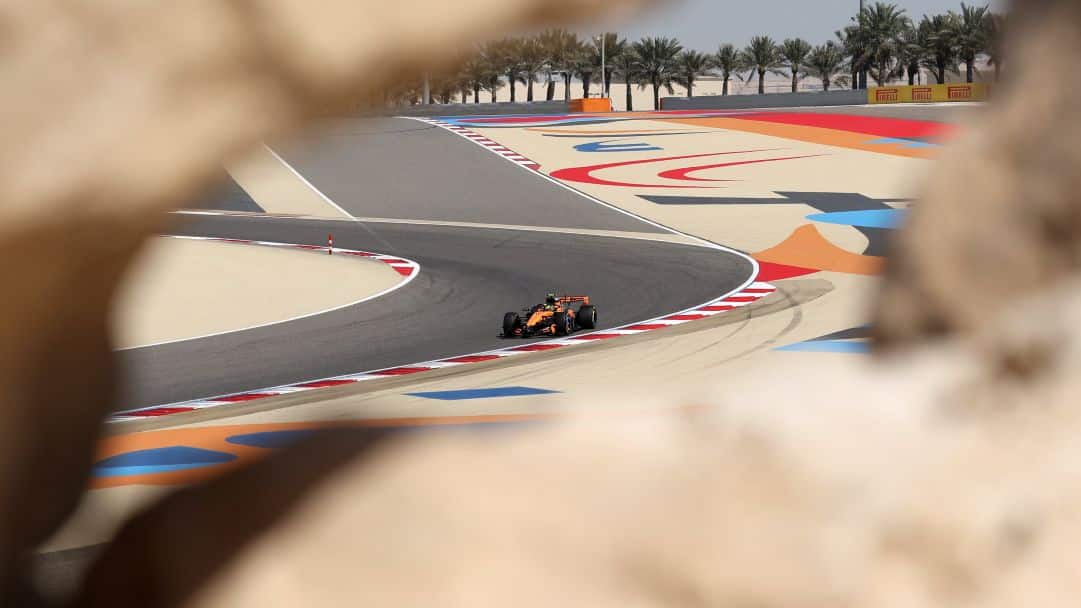
Lando Norris set the fastest pace this Thursday morning during the second round of pre-season testing of the Fórmula 1 in The McLaren driver recorded a time of 1m33s453 after completing 72 laps on the Bareinita circuit, surpassing direct competition from Max Verstappen and George Russell. The activity was essential for the teams to evaluate the behavior of the new single-seaters under local weather conditions, which are usually decisive for the start of the championship.
The morning session was marked by intense movement in the pits and the search for mechanical reliability in a critical period of preparation. Além of McLaren’s solid performance, the Brazilian public closely followed the work of Gabriel Bortoleto, who ended the period in fifth place driving for Audi. The young talent completed 29 laps, focusing on aerodynamic adjustments and understanding the car’s integrated systems for the upcoming season.
The morning’s technical scenario presented significant contrasts between the main teams on the world grid. Enquanto some teams prioritized race simulations and long periods on the track, others focused on fast laps to test the limits of the components. The time hierarchy is still viewed with caution by engineers, but the consistency of Norris places the Woking team in a prominent position at this stage of training.
The teams took advantage of the period to collect essential data that will be analyzed before the afternoon session. The main points observed by the stewards and technicians were the following:
- Lando Norris completed 72 laps with a best time of 1:33.453.
- Max Verstappen was in second place with a difference of just 0.131 to the leader.
- George Russell was the driver who accumulated the most mileage, totaling 77 spins.
- Gabriel Bortoleto secured the fifth best time among the eleven competitors present.
- Team Cadillac managed to make up track time with Valtteri Bottas after a difficult start.
McLaren topped the times from Red Bull and Mercedes during Thursday morning’s session in Sakhir 👏
—Formula 1 (@F1)February 19, 2026
Read the full report from the first session of the day here 👉https://t.co/I0WeH7dYKe#F1 #F1Testing pic.twitter.com/2PFWqmHMTT
Ferrari aerodynamic innovations attract attention in Sakhir
The Ferrari attracted all eyes in the paddock by introducing a revolutionary rear wing that features an almost complete rotation system around its own axis. Essa technical solution seeks to optimize airflow and reduce drag on straights, representing a bold bet by the Maranello team to gain final speed. Engenheiros of rival teams have closely monitored the component, which signals an aggressive pursuit of competitive advantage through mobile aerodynamics.
Despite the interest generated by the new piece, the morning was not without setbacks for the Italian team. Lewis Hamilton faced severe technical difficulties that drastically limited his time on the route. The seven-time world champion managed to record just five laps during the four-hour session, returning to the asphalt only in the final moments of the clock. Esse low volume of data worries the team, which will need to compensate for the loss of mileage in the next testing windows.
Updates to the RB21 and the performance of Max Verstappen
The Red Bull Racing did not lag behind in the development race and presented visible modifications to the RB21 model driven by Max Verstappen. The changes focused mainly on the design of the sidepods, the engine cover and strategic floor components. Essas upgrades aim to improve internal cooling and ground effect efficiency, elements that have been crucial to the team’s dominance in previous years.
During his time on the track, the four-time world champion used flow vis, a viscous colored paint that allows engineers to physically visualize the path taken by the air over the fairing. Verstappen completed 56 laps and maintained impressive consistency, ending the morning with the second fastest time. The focus at Red Bull appears to be on validating wind tunnel simulations, ensuring that new parts match theoretical data obtained at the factory.
Gabriel Bortoleto maintains constancy in official debut by Audi
The Brazilian Gabriel Bortoleto demonstrated maturity when driving the Audi car during the first hours of activity this Thursday. Mesmo with a smaller number of laps compared to the leaders, the driver managed to position himself among the five fastest on the time table. Sua performance suggests a quick adaptation to the new work environment and the operational procedures required by the highest category of motorsport.
Audi, which assumes a new identity and technical structure, prioritized testing of electronic systems and engine mapping in Bortoleto’s car. The team avoided chasing extreme lap times, focusing instead on collecting telemetry across different power regimes. Fifth place is a positive indication that the project has a solid foundation, allowing the Brazilian driver to work with confidence in developing the setup for the 2026 races.
Recovery of Cadillac and mileage of Valtteri Bottas
Cadillac experienced moments of tension in the first two hours of the session, when Valtteri Bottas managed to complete just two installation laps. Problemas initial mechanics threatened to compromise the North American team’s schedule, which had already been facing complicated days since the start of the pre-season. The intense work of the mechanics in the garage was essential to get the Finn back on track before the middle of the morning period.
After returning, Bottas demonstrated resilience and accumulated 58 spins, surpassing the symbolic mark of 57 laps that make up the total distance of Grande Prêmio from Bahrein. Essa recovery allowed Cadillac to carry out durability tests and evaluate the tires’ behavior in hot asphalt conditions. The final performance on the timesheet was modest, but the mileage achieved brought much-needed relief to the technical team in search of stability.
Efficiency of Mercedes and the workload of Russell
George The German team focused on long stints to understand the wear of the rubber compounds and the variation in the car’s balance depending on fuel consumption. Russell ended the morning with the third best time, showing that Mercedes has a reliable package to start the competition journey.
Mercedes’s strategy differs from some competitors by prioritizing the database over pure performance in a single turn. Engineers sought to test different suspension settings to mitigate high-speed oscillations. The consistency of Russell indicates that the team found a stable operating window, allowing the pilot to explore the limits of the vehicle without compromising the integrity of the mechanical components.
Track conditions and technical challenges at Sakhir
The Sakhir circuit offers unique challenges due to the presence of sand and temperature fluctuations that directly affect grip. On Thursday morning, the pilots found asphalt still in the process of being rubberized, which resulted in some escapes from the track without major consequences. Tire thermal management has become a key focus for teams such as Williams and Alpine, who seek to optimize the use of compounds in severe conditions.
Alexander Albon, representing Williams, took advantage of the morning to complete 71 laps and position himself just behind the leaders in terms of mileage. Já to Alpine, with Franco Colapinto, dedicated themselves to specific aerodynamic tests, resulting in 54 laps completed. The diversity of testing programs between teams makes the analysis of raw times a complex task, but essential to predict the balance of forces in the championship.
Perspectives for the continuity of activities at Bahrein
Track activities at Bahrein continue throughout the afternoon, with a drop in ambient temperature expected, which should favor the search for even lower times. Diversas teams plan to change their drivers for the afternoon session, allowing teammates to also contribute to the development of the cars. The expectation revolves around Ferrari, which needs to make up for lost time with Lewis Hamilton to validate its innovations.
Red Bull will keep Max Verstappen in the cockpit throughout the day, a strategy that aims to give the pilot maximum familiarity with the new updates. On the other hand, McLaren will look to maintain the momentum demonstrated by Lando Norris to confirm whether the morning lead reflects a real performance advantage. Real-time monitoring and detailed analysis of each sector of the track will provide the final overview of this second day of fundamental tests for the Fórmula 1.