
NASA’s SPHEREx telescope detects organic molecules associated with prebiotic chemistry on comet 3I/ATLAS By Beatriz
5 min read
 |
Nasa’s SPHEREx space telescope has captured clear signals of organic molecules being released by comet 3I/ATLAS. The measurements took place between December 8 and 15, 2025, when the object was already leaving the region close to the orbit of Terra after passing through perihelion. Cientistas from the agency identified compounds such as methanol, methane and hydrogen cyanide in the material expelled from the comet’s coma. Essas substances act as chemical building blocks capable of participating in reactions that precede biological processes.
The detection happened while the comet was heating up under the influence of the sun. The process activated the cloud of gas and dust that surrounds the interstellar object’s core. Pesquisadores emphasize that the finding does not point to the presence of life but confirms the existence of organic matter in bodies formed outside of Sistema Solar.
Comet 3I/ATLAS was classified as a rare interstellar visitor shortly after its discovery. The ATLAS automated system recorded the object on July 1, 2025 at Chile. Sua origin in another star system makes observations an opportunity to study primordial chemical composition preserved for billions of years.
- Methanol appeared in the spectral emissions of the released material.
- Methane was identified along with other simple hydrocarbons.
- Hydrogen cyanide completed the list of major organic compounds.
- Carbon dioxide and water were also mapped in significant quantities during the campaign.
The analyzes confirm that solar heating caused an intense release of these elements. The comet showed a significant increase in brightness two months after perihelion in October 2025.
Details of organic compound detection
SPHEREx observations made it possible to map the comet’s infrared emissions precisely. The data revealed the presence of a variety of molecules in the ejecta.
Experts analyzed the chemical signatures captured during the exit phase of Sistema Solar. Isso reinforced the understanding of the widespread distribution of organic matter in the universe.
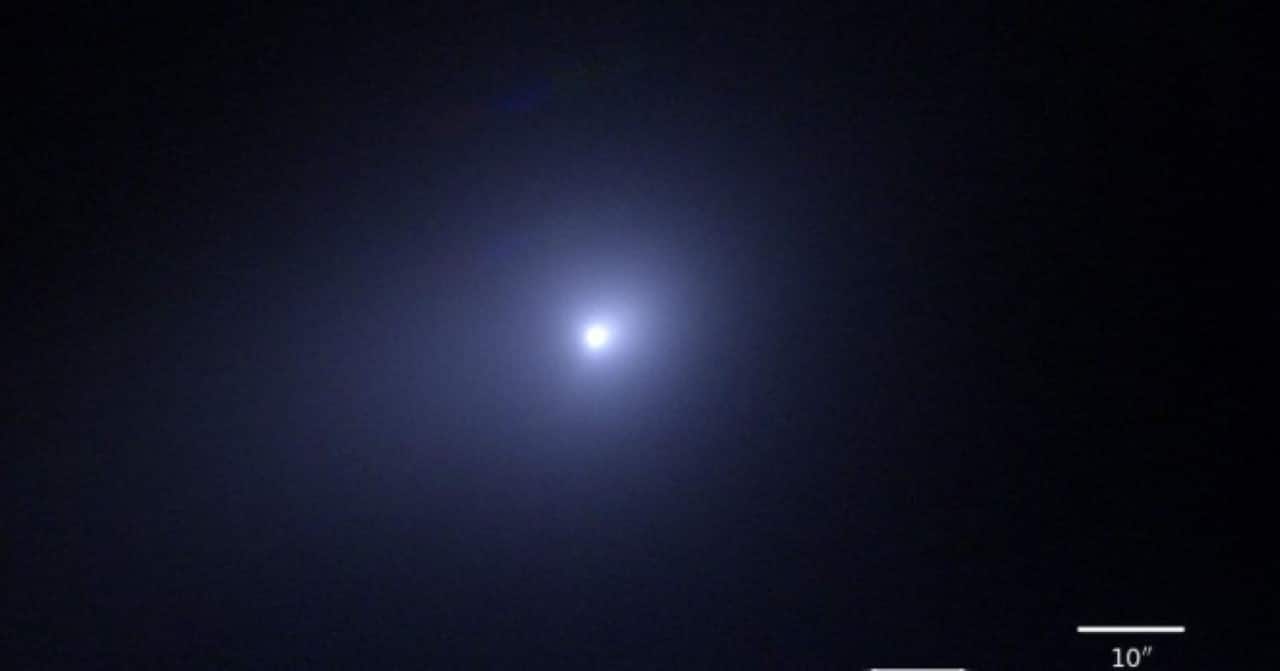
Trajectory followed by the interstellar object
The comet crossed Sistema Solar after forming around another star billions of years ago. Sua discovery took place at Chile by the ATLAS monitoring system.
The trajectory took the object to pass about 1.4 astronomical units from Sol in October 2025. Afterwards, it continued its path out of the planetary system.
Records indicate that the comet had already been observed in August 2025 with the same telescope. Naquela occasion an extensive coma of carbon dioxide was noticed that extended for hundreds of thousands of kilometers.
Functioning and capabilities of the SPHEREx telescope
The space instrument specializes in infrared spectroscopy with high spectral resolution. Ele captures the sky at 102 different wavelengths to identify specific compounds.
This ability makes it possible to distinguish organic and inorganic molecules in the spectrum of light emitted by objects. SPHEREx’s mission focuses on studying ices and primordial materials present in various cosmic regions.
Data collected in December showed more intense activity on the comet compared to August. The observed brightening was associated with the release of gases and dust from subsurface layers.
The Nasa team integrated this information with data from other missions to obtain a more complete view of the object’s evolution.
Reactions of materials to heating close to Sol
Solar heating caused the sublimation of the ices present in the nucleus of comet 3I/ATLAS and formed the cloud of gas and dust known as a coma. Isso resulted in the release of organic compounds along with water, carbon dioxide and other elements.
Scientists noted that the composition reflects materials preserved for billions of years without significant change. Variation in activity after perihelion indicates differences in the object’s internal structure.
Such changes are common in comets but gained prominence in this case due to the interstellar origin. The observations captured the moment the comet expelled a mixture of substances that had remained frozen for eons.
Comparison with previous observations of the same comet
In August 2025, SPHEREx had already detected an extensive carbon dioxide coma that extended for at least 348 thousand kilometers. Essa initial discovery set the stage for later, more detailed measurements.
The December observations revealed greater chemical diversity including complex organics that had not been as evident before. The comet proved to be more active than initially expected with eruptions of subsurface material.
The December data confirms that the object behaves similarly to Sistema Solar comets in some aspects related to outgassing. Yet its primordial composition offers a unique window into distant star systems that cannot be obtained any other way.
The integration of the two observation campaigns made it possible to follow the evolution of the comet’s activity over several months and compare the chemical changes that occurred.
Role of interstellar objects in understanding cosmic chemistry
Objects like 3I/ATLAS make it possible to directly study materials formed in other stellar systems without the interference of local Sistema Solar processes. Esses bodies carry information about the primordial chemistry that existed before the formation of stars and planets in distant regions of the galaxy. The detection of organic molecules in its coma reinforces that such compounds are present in interstellar environments widely and not restricted to our cosmic surroundings.
The comet represents only the third interstellar object confirmed to pass through Sistema Solar. Sua analysis contributes to the knowledge accumulated from previous visits and expands the catalog of chemical compositions observed in visitors from abroad. Researchers continue to process the spectral data to refine the relative amounts of each identified molecule.
Contributions to the advancement of space exploration missions
Future missions could use the results obtained with SPHEREx as a reference to plan observations of other interstellar objects that eventually cross Sistema Solar. The telescope’s demonstrated ability to track fast-moving targets validates its use in prolonged monitoring campaigns.
Other international agencies and projects are already expressing interest in replicating similar approaches with next-generation infrared instruments. The success in detecting specific compounds in 3I/ATLAS opens avenues for deeper investigations into organic chemistry on a cosmic scale.



