

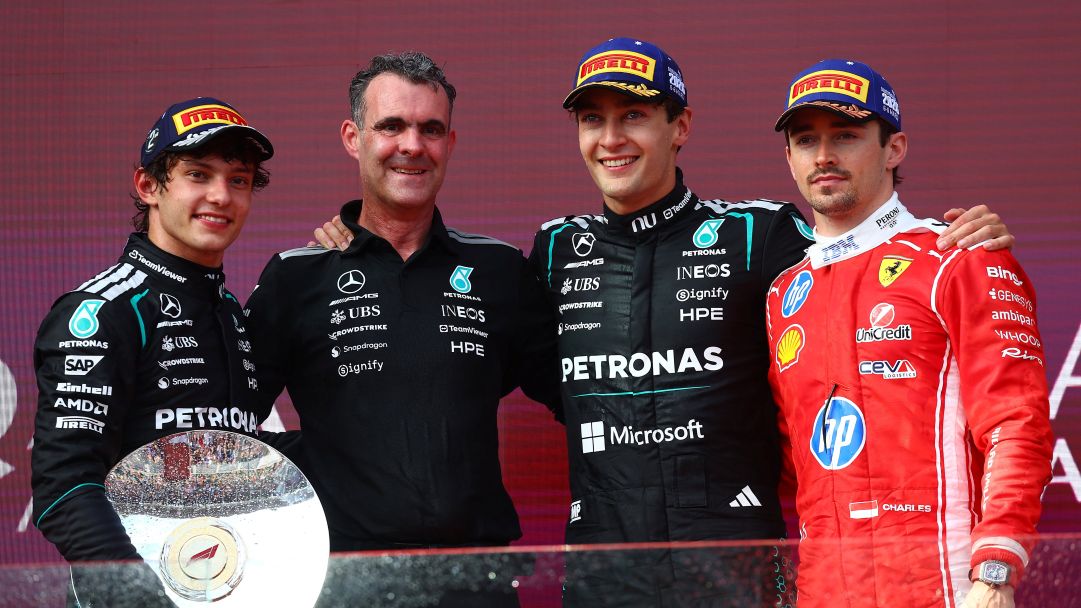
The expectation for Grande Prêmio of China of Fórmula 1 reaches a new level with the anticipation of a direct confrontation between the teams Ferrari and Mercedes. Após a remarkable performance in the GP of Austrália, where Scuderia was the only one to signal a real challenge to Flechas of
The Chinese circuit will be the stage for the debut of an aerodynamic innovation of the Ferrari, the long-awaited “Macarena wing”. Este new component at the rear of Maranello’s car is seen as a potential asset for the team to seek victory, or at least reduce the gap to the dominant Mercedes.
Despite the optimism surrounding the new part, the Ferrari pilots maintain a cautious stance. Eles recognize the strength of Mercedes, especially in the qualifying sessions, but project a balanced race with real chances of a good result in Xangai.
Initial analysis and the challenges of Xangai
Grande Prêmio of China, a traditional event on the Fórmula 1 calendar, has always presented unique challenges due to its diverse layout. With long straights that require high speed and complex curves that test aerodynamics and tire management, Xangai is a true barometer for car performance. The race in the Austrália, which saw the Mercedes achieve a one-two finish, highlighted the superiority of the silver car at the start of the season, but also the Ferrari’s ability to position itself as the main rival.
Arriving at Xangai, therefore, is not just another stage of the championship; it is an inflection point. The Ferrari, in particular, has the opportunity to show whether the adjustments and the new “Macarena wing” are enough to break the initial hegemony. The track offers the ideal conditions to test the efficiency of an aerodynamic package that seeks to balance downforce for the curves and minimum air resistance on the straights.
The innovation of the macarena wing and its potential impacts
The mysterious “Macarena wing”, which will be introduced by the Ferrari, is the center of technical attention ahead of the China GP. While the specific details of its design remain confidential, the expectation is that this piece represents a significant evolution in the search for aerodynamic efficiency. In a sport where marginal gains can define the outcome of a race, any optimization of airflow over and under the car is crucial.
It is believed that the “Macarena wing” could be a solution to maximize speed on the long straights of Xangai, while maintaining the stability and downforce required for the high-speed sections and tighter turns. The Fórmula 1’s modern engineering constantly seeks smart compromises, and a redesigned rear wing could be the key to unlocking the SF-26’s untapped potential, or what would be the Ferrari’s car for the season.
This development underlines the intense engineering battle taking place behind the scenes in F1. Cada team invests vast resources in research and development, with the goal of finding the next innovation that can give them a competitive advantage. The “Macarena wing” symbolizes this incessant search for technical excellence, and its performance in Xangai will be analyzed with a magnifying glass by all competitors and motorsport experts.
Pilot perspectives: Leclerc and the search for optimization
Charles Leclerc, who secured a third place in Austrália, expressed confidence in an improved performance for Ferrari in China. The Monegasque highlighted that the team identified several areas where it did not fully optimize the car in Melbourne, resulting in lost time per lap. Essa detailed analysis suggests that the Maranello team learned from the opening race and is working hard to correct the deficiencies.
For Leclerc, the expectation is for a tighter dispute. Ele recognizes that Ferrari is not yet on the same level as Mercedes, especially in terms of pure rhythm. Contudo, the pilot believes that in the race, the balance of forces will be much greater. Essa perspective indicates a strategy focused on getting the most out of the car over long distances, possibly managing the tires better or exploring a more consistent race pace.
Leclerc’s ability to adapt quickly to changes and get the most out of his equipment will be key. Sua performance in Xangai will not only be a test of the car and the new wing, but also of the team’s ability to translate the lessons from the The search for optimization continues, and China is the next big step in this process.
Hamilton and observing the advantage on the straights
Lewis Hamilton, who finished fourth in Albert Park, brought an intriguing perspective on his rivals’ performance. The seven-time world champion noted that the advantage of the Ferrari seems to be more evident on the straights, suggesting a possible superiority in maximum speed. Essa observation raises questions about the aerodynamic and power balance between the two teams, especially when the moving wing (DRS) is activated.
Hamilton commented that the difference becomes “more evident when they use overdrive mode”, indicating that Ferrari may be finding a significant time gain in this situation. Essa’s analysis of the Mercedes pilot is crucial, as it points to a specific area where the Scuderia has managed to stand out. Understanding this advantage is the first step for Mercedes to seek a countermeasure or adapt its own strategy for Xangai.
The concern about speed on the straights is pertinent to the China GP, which has one of the longest straights on the calendar. If the Ferrari does indeed have a consistent advantage in this regard, the race in Xangai could become a strategic battle of defenses and attacks, with the
The role of Russell and the characteristics of the clues
George Russell, Hamilton’s teammate and race winner in Austrália, offers a broader view on how track characteristics can influence team performance. Russell highlighted that the alternation of positions and the dynamics of the Australian race may not necessarily be repeated in all stages of the championship. Ele specifically mentioned that tracks like China, with its long main straight, and Barcelona, which also features a significant straight, can present different scenarios.
Analysis of Russell suggests that each circuit requires a slightly different approach in terms of car setup and strategy. The diversity of tracks on the Fórmula 1 is one of the factors that keeps the category unpredictable, and the performance of a car that is strong on one type of track may not automatically translate into success on another. Isso implies that Mercedes’s advantage in Austrália may not be universal for all races, giving hope to opponents in Xangai.
For Mercedes, understanding and adapting to these variations is essential to maintaining its leadership position. Tire management, aerodynamic performance at different speeds and the ability to find the “sweet spot” in the car’s configuration will be decisive. The China, with its specific demands, will be a new test for all teams, and the flexibility in tuning the car will be an important differentiator.
The historical rivalry and team strategies
The rivalry between Ferrari and Mercedes is one of the most emblematic of modern Fórmula 1, representing a clash of philosophies and traditions in motorsport. Enquanto to Cada confrontation between the two teams adds another chapter to this rich story.
In Xangai, strategies will be decisive. The Ferrari, with the “Macarena wing” and the search for optimization, will probably opt for a more aggressive package, aiming to capitalize on any speed and aerodynamic advantage. The Mercedes, in turn, will try to maintain the consistency and reliability that characterized it in the Austrália, perhaps with a greater focus on durability and race management to offset any possible gains from rivals.
Determining factors for the GP of China
The race in Xangai will be influenced by multiple factors, ranging from unpredictable weather conditions to the nuances of tire degradation. The choice of pit stop strategy, the drivers’ ability to manage traffic and the teams’ agility in reacting to unforeseen events will be crucial. Além Furthermore, the pressure of the championship and the search for valuable points from the start of the season will add an extra layer of intensity to every decision made on the track and in the pits. The debut of the “Macarena wing” by Ferrari injects an element of surprise and innovation that could reset expectations for this Grande Prêmio and the remainder of the Fórmula 1 season.