

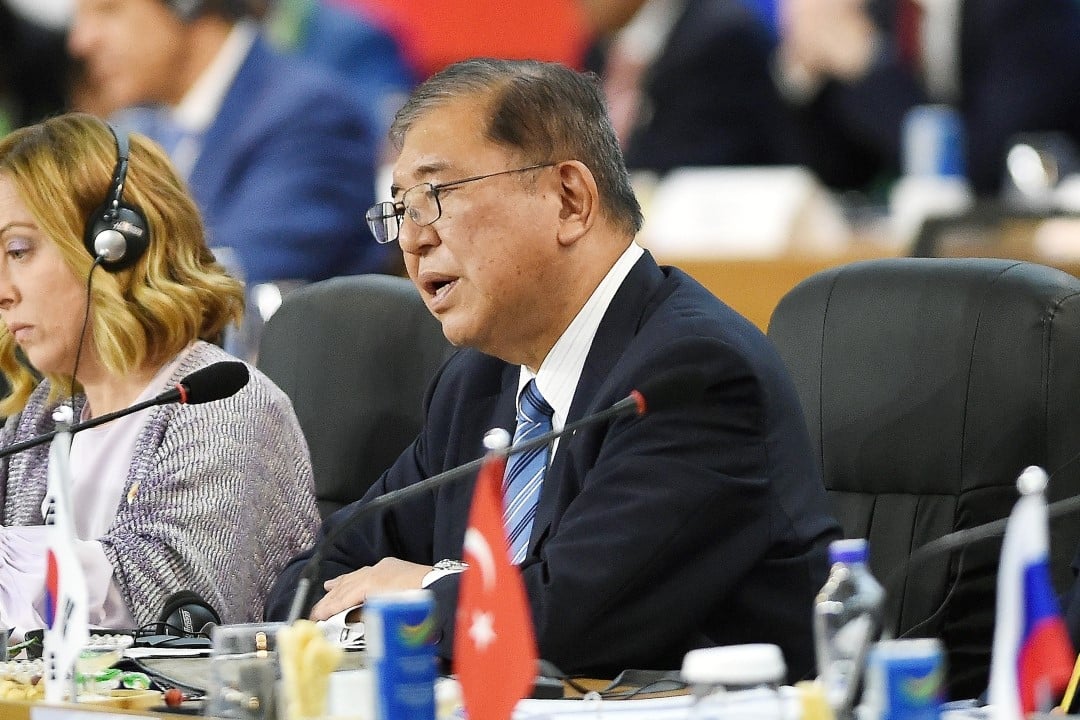
In a speech delivered on March 16, 2026, former Japanese Prime Minister Shigeru Ishiba addressed the complex issue of sending ships from the Forças of Autodefesa (FAD) to the Estreito of The discussion comes in response to the call from the president of the Estados Unidos, Donald Trump, for the Japão and other nations to contribute naval escorts in the region. The strategic maritime route faces effective blockades by the Irã, generating global concerns about the safety of navigation and the flow of oil.
Ishiba highlighted that for Japão, it would be extremely challenging to classify the situation in Estreito of Ormuz as a crisis that directly threatens its existence. Tal recognition would be a precondition for the exercise of the right to collective self-defense. Segundo him, sending the FAD under this justification would be far from the feeling of the Japanese population and would have serious implications.
The politician warned that the activation of the right to collective self-defense, in this context, would mean that Japão and Irã would enter a state of war. Considerando history and international understanding, this would be an extremely difficult measure for the country. The caution reflects the sensitivity of the issue and the profound legal and diplomatic implications of such action.
The challenges of the Japão-USA summit and the internal perspective
The summit between the Japão and the Estados Unidos, scheduled for March 19, is the central point of diplomatic concerns. Espera Japanese Prime Minister, Sanae Takaichi, is expected to face considerable pressure to define the country’s stance in relation to the American request. The responsibility of making a decision of such magnitude falls on his shoulders, highlighting the weight of the nation’s destiny in his deliberations.
For the Estados Unidos, the trauma of the September 11 attacks remains latent, fueling a deep fear regarding the proliferation of nuclear weapons, especially in the hands of terrorist groups. The possibility of aircraft loaded with nuclear devices would be a catastrophic scenario, which drives American concern about global security and regional stability. Essa perspective directly influences Washington’s expectations of his allies.
Despite the US bunker bombing attacks the previous June, suspicions persist about the existence of Iranian nuclear facilities. Essa uncertainty worsens the situation, making the exit from the war with Irã a complex issue even for President Trump. The international community seeks a peaceful resolution, but defining each nation’s position, including Japão, is quite intricate.
The Japanese stance and global role
Analysis of the position of countries such as Espanha and Itália, which spoke out against the Estados Unidos on some issues, suggests a line of reasoning for the Japão. However, former prime minister Ishiba questions whether Japão can really adopt a similar stance, given its geopolitical particularities. Ele emphasizes that, as the only nation to have suffered a nuclear attack, Japão has unique moral authority to defend the horror of nuclear proliferation.
The proximity to Coreia of Norte, a country that possesses nuclear weapons and whose policy towards Coreia of Sul has become more hostile, intensifies Japanese concern. Leader Kim Jong-un’s rhetoric, which suggests indifference to one’s own existence in the event of mutual destruction, challenges the premise of rationality that underpins the doctrine of nuclear deterrence. Isso raises serious questions about the effectiveness of mutually assured destruction against nations with such prospects.
The debate over Israel’s possession of nuclear weapons while Irã is prevented also adds layers of complexity to the discussion. Embora this may lead to questions about the Tratado of Não Proliferação Nuclear (TNP), the Japão, as a country, must maintain its firm opposition to proliferation. Consistency with this principle is fundamental to the credibility of its foreign policy.
Preventative self-defense and international law
Regarding the attacks against Irã, the US claim that they constitute an exercise of the right to self-defense is difficult to verify. Contudo, the concept of “preventative self-defense” is recognized by international law, including within the scope of Nações Unidas, for situations where inaction would create a real danger. Já “anticipatory self-defense”, exercised without imminent danger, is recognized only by Estados Unidos and Israel.
Even if the American justifications cannot be verified, the interruption of conflicts and the cessation of the massacre of innocent civilians are imperative. Para o Japão, the central justification for its international stance continues to be to prevent nuclear proliferation. With the Coreia of the Norte in its neighborhood, this is a message that the Japão can and must vigorously reiterate to the international community.
During Guerra of Golfo, Partido Liberal Democrático faced intense debate over Japanese involvement. Discussions centered on determining whether the situation posed a threat to national survival or a significant impact, and which laws should be applied. Qualquer action taken by Forças of Autodefesa would require a transparent explanation to the public, a challenge considering the specific bilateral security treaty with the US, different from alliances such as NATO.
Alliances, security and future implications
The proposal for an Asian NATO, although it has not gained traction, resurfaces in discussions about regional security. The argument is that Ucrânia, if it had been a member of NATO, would probably not have been attacked by Rússia. Isso leads to reflection on the convenience of the absence of a similar security grouping in Ásia, especially in a volatile geopolitical scenario.
As for the use of nuclear weapons by Estados Unidos and Israel against Irã, former Prime Minister Ishiba considers the probability to be extremely low. Ele argues that nuclear weapons are generally employed when conventional forces are insufficient for victory. Dada the clear advantage of the USA and Israel in conventional forces, the use of nuclear weapons at this time would be illogical, following traditional strategic thinking.
In the scenario of Trump seeking cooperation to escort oil tankers on Estreito from Ormuz, Ishiba highlights that Japanese support is conditional on compliance with international law. Ele recalls that Shinzo Abe stated that Japão cannot support a country that violates these standards. Assim, the Japanese government should first confirm whether the joint US and Israel attack on Irã was a legitimate self-defense exercise, recognizing preventive self-defense.
The dilemma of collective self-defense
The fundamental premise for Japanese action would be the recognition of the situation as preventive self-defense, an imminent danger. However, the refusal to accept anticipatory self-defense, which is recognized only by the US and Israel, complicates Japão’s adherence to the American narrative. The Japão would have to agree with the interpretation that the current situation constitutes an immediate threat.
The parliamentary debate on whether the situation poses a threat to the existence of Japão is crucial. Recognition of a danger that fundamentally compromises the peace and security of the Japanese people is the requirement for exercising the right to collective self-defense. Right Este, as per UN Artigo 51 of Carta, allows the Japão to consider an attack on a nearby ally as an attack on itself and retaliate together.
At this stage, framing the events in Estreito of Ormuz as a clear threat to the peace and security of If the Japão exercised its right to collective self-defense, it would enter a state of war with the Irã, which is seen as extremely difficult by both history and international understanding. It is essential not to classify the situation lightly without a rigorous analysis of the facts.
However, if inaction is not an option, and the situation is defined as one of significant importance, the Japão could have the ability to act in a manner similar to sending a supply ship to the Oceano Índico under the Lei of Medidas Especiais Antiterroristas. The issues of legality, operating structure and ensuring the safety of Forças and Autodefesa personnel need to be carefully considered. Justifying such action, not only in the Japanese but also in the global national interest, requires thorough fact-checking.