
VLT discovery of G2t reveals common origin of G1 and G2 clouds near Sagittarius A* By Maria
4 min read
 |
Astronomers from Instituto Max Planck of Física Extraterrestre, in Alemanha, have identified a new gas cloud called G2t orbiting the supermassive black hole Sagitário A*, located in the center of The detection occurred through observations carried out with the Very Large Telescope (VLT), the Observatório Europeu, the Sul (ESO), the Chile. The discovery provides important evidence about the nature and origin of gas clouds known as G1 and G2, which orbit the same black hole and have generated debate among experts for years. Measurements indicate that the three clouds share very similar orbital characteristics, suggesting joint formation rather than independent structures with hidden stars.
The image obtained reveals a dynamic environment close to the galactic center, with stars and gas clouds moving at high speeds due to the intense gravity of Sagitário A*. The ERIS instrument, coupled to the VLT, made it possible to capture not only detailed images, but also spectra that made it possible to reconstruct the three-dimensional orbits of the clouds. Essa technical capacity was essential to accurately map the routes and exclude previous hypotheses.
G2t Discovery Details
The G2t cloud was identified in recent data collected by ERIS. Ela is positioned in an orbit almost identical to that of G1 and G2, with only small relative rotations between them. Essa orbital similarity makes it unlikely that each cloud contains a star within its interior, as the probability of distinct stars adopting such close trajectories is extremely low.
The observations confirm that the clouds move in a compact region around the black hole. The detection of G2t reinforces the analysis of gaseous structures and contributes to the understanding of the extreme environment at the center of the galaxy.
Almost identical cloud orbits
The three clouds — G1, G2 and G2t — have very similar orbits, differing only in subtle rotations. Essa configuration indicates that they did not appear randomly. The team measured speeds and positions with high precision, which allowed them to reconstruct three-dimensional movement.
The data shows that the clouds occupy a small area in the center of the image obtained by the VLT. The similarity in orbital parameters excludes the presence of central stars in each of them.
Common origin pointed out by astronomers
The similarity of the orbits suggests that G1, G2 and G2t share the same source of origin. Astrônomos indicate the massive star binary system IRS16SW as likely responsible for the ejection of the gaseous material. Esse pair of stars orbit Sagitário A* and release large amounts of gas during their movement.
As IRS16SW travels, it releases clouds at slightly different times, resulting in orbits with slight variations. Essa explanation resolves part of the debate about the composition of previously observed clouds.

ERIS instrument expands VLT capabilities
ERIS, installed on the VLT, combines high-resolution imaging with advanced spectroscopy. Essa combination allowed us to measure cloud orbits in unprecedented detail in the central region of Via Láctea. Astronomers obtained spectra that revealed velocities and chemical compositions of gaseous structures.
Observations with ERIS highlight the turbulent environment near the supermassive black hole. The tool proves to be essential for future studies of compact objects in the galactic center.
Dynamic environment in the center of Via Láctea
The center of Via Láctea houses a supermassive black hole with a mass equivalent to about four million times that of Sol. Estrelas and gas clouds are attracted by intense gravity, reaching high speeds on close trajectories. The region exhibits intense activity, with constant interactions between celestial objects.
The discovery of G2t adds a piece to the understanding of this dynamic. Clouds contribute to the reservoir of gas that influences processes near the black hole.
Image highlights stellar and gaseous cluster
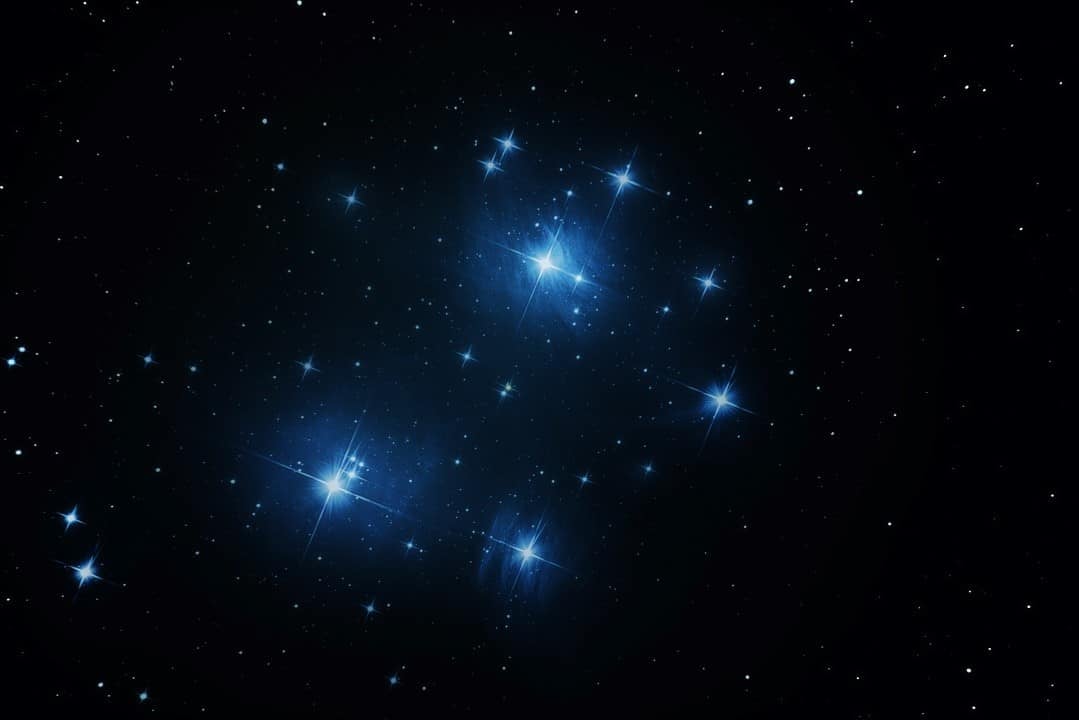
The VLT photograph shows a dense cluster of stars and gas around the position of Sagitário A*, invisible in the image. The black hole remains hidden, but its presence is made evident by the accelerated movement of surrounding objects. The G2t cloud appears integrated into the orbital set of the G1 and G2 structures.
This broad view allows us to contextualize the relative position of clouds in the central environment. The image reinforces the complexity of the region and the importance of instruments such as the VLT for in-depth studies.


