
Black hole at the center of the Milky Way should reactivate after merging with the Magellanic Cloud By Bruna
4 min read
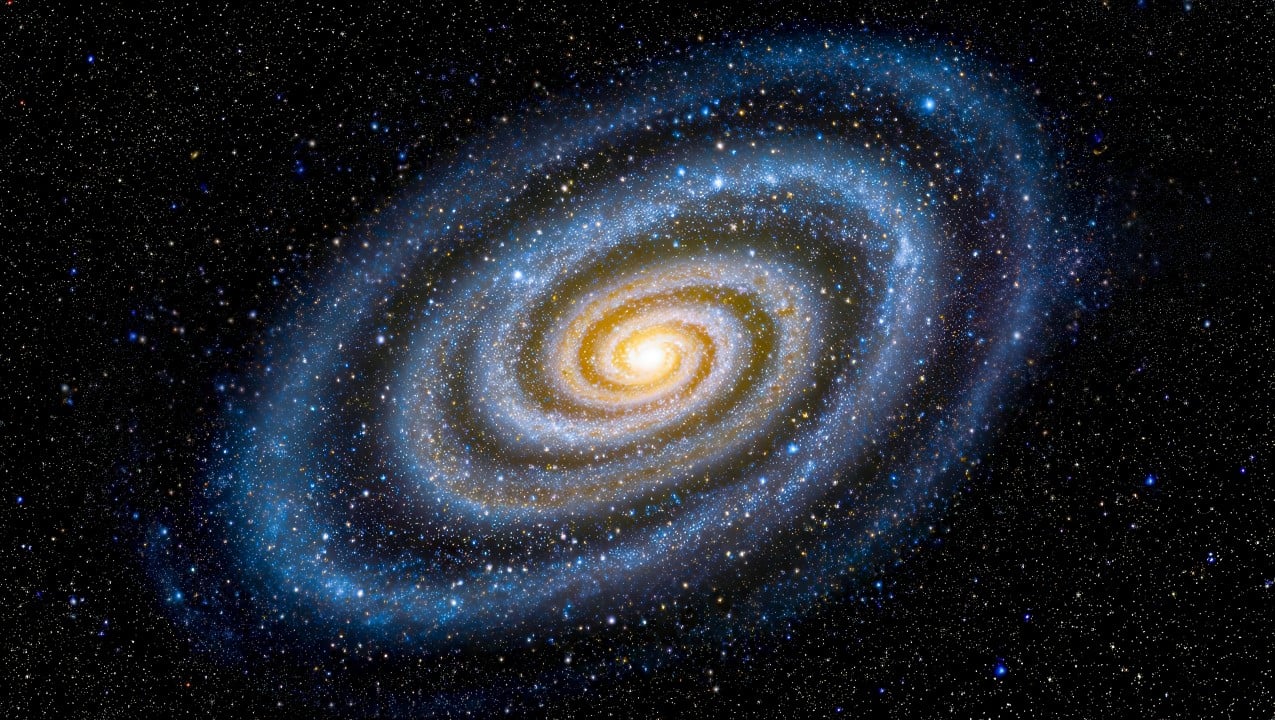 |
Astronomers point out that Sagitário A*, the supermassive black hole located at the center of Via Láctea, has remained in a state of low activity for a long time. New research indicates that this picture could change when Grande Nuvem of Magalhães, a neighboring dwarf galaxy, merges with our galaxy. The event, predicted to take around two billion years, is expected to funnel large amounts of gas into the black hole and transform it into an active galactic nucleus.
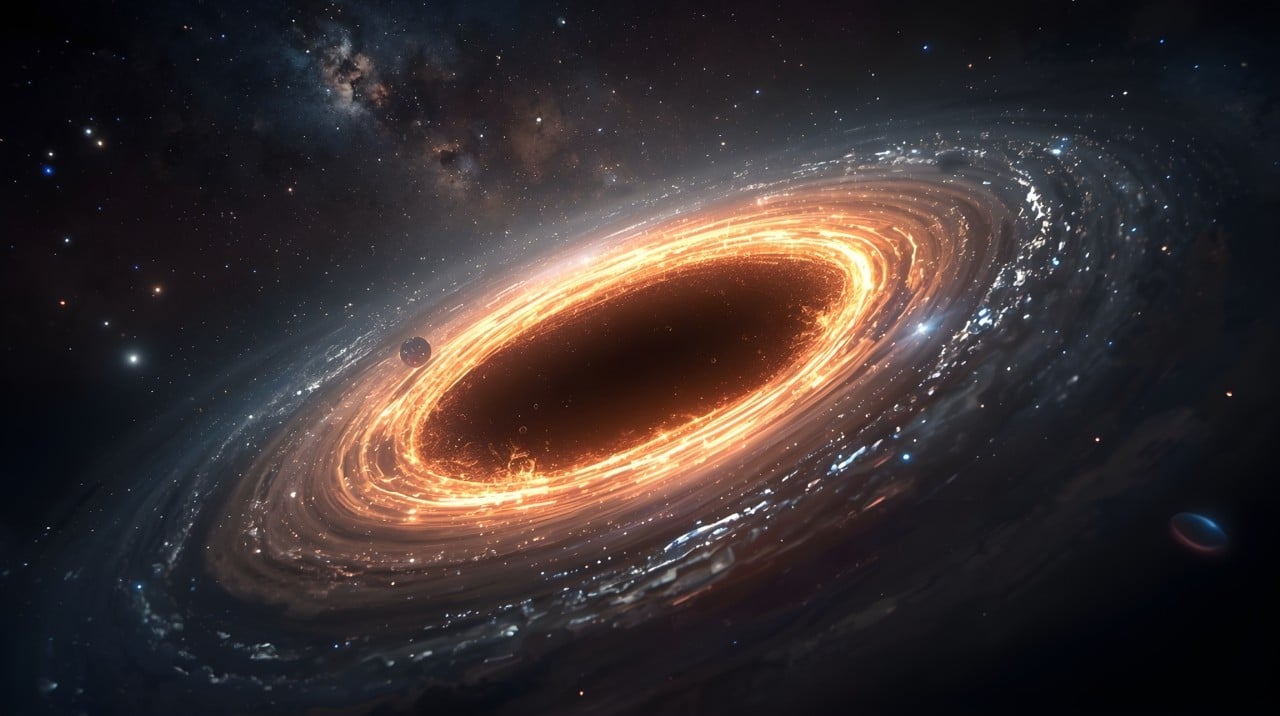
The black hole concentrates a mass equivalent to four million suns in an extremely compact region. Ele is more than 25 thousand light-years away from Terra, in the constellation Sagitário. Especialistas observe that Sagitário A* emits a weak glow and converts matter into energy with reduced efficiency compared to other similar black holes.
- The object was confirmed as a supermassive black hole by observations that yielded Prêmio Nobel of Física in 2020.
- Telescopes like James Webb contribute to the study of distant galactic systems that help understand similar processes.
- Cosmological simulations indicate that mergers between similar galaxies alter the structure of the stellar halo and the flow of material to the center.
Details about the supermassive black hole
Sagittarius A* is classified as the closest known supermassive black hole. Sua mass and location were established through precise measurements of stellar orbits around it. Instituto of Astrofísica of Andaluzia highlights that the object has exceptionally low activity, which differentiates it from brighter nuclei in other galaxies.
Recent observations with NASA instruments such as Imaging X-ray Polarimetry Explorer have detected a smaller explosion that occurred about two hundred years ago. Esse type of event demonstrates that the black hole still exhibits variations, albeit on a limited scale. Astrônomos use this data to model the future behavior of the object.
Future galactic merger and influx of material
Grande Nuvem of Magalhães orbits Via Láctea approximately two hundred thousand light years away. Cálculos based on its orbital motion show that it gradually loses energy and must spiral towards the center of our galaxy. The collision should occur around two billion years ago, according to current projections.
During the merger, gravitational forces will direct gas and dust toward the central region of Via Láctea. Esse extra material should form an accretion disk around Sagitário A*, heated to millions of degrees. The falling matter can then radiate energy in different bands of the electromagnetic spectrum, making the galactic core more luminous.
Expected effects on the structure of the galaxy
Studies based on simulations such as those from the EAGLE project reveal that mergers of similar galaxies cause the growth of the central black hole. The stellar halo and the general distribution of stars also undergo significant changes in this process. Via Láctea is expected to undergo remodeling as it absorbs the dwarf galaxy.
Astronomers follow distant systems to compare with what might happen here. A small galaxy studied with Telescópio Espacial James Webb shows features that resemble early stages of galactic evolution. Esses examples provide benchmarks for predicting the impact of interacting with Magalhães.
Security outlook for the planet
The distance of 26 thousand light years between Terra and Sagitário A* represents a considerable separation even on cosmic scales. Professor Carlos Frenk, Universidade, Durham, states that the active galactic nucleus resulting from the merger should not reach enough power to threaten life on the planet.
Joseph Michail, Centro, Astrofísica, Harvard and Smithsonian, reinforces that protective layers such as the Earth’s atmosphere, the magnetic field and Via Láctea’s own gas disk would absorb much of the additional radiation. Observadores Futures would likely notice a brighter sky at the galactic center, with no direct effects on the solar system.
Observations supporting the scenario
Astrophysics Nathalie Degenaar of Universidade of Amsterdã explains that infalling material around black holes can produce detectable emissions at multiple wavelengths. Dados collected by different ground-based and space-based telescopes continue to refine models about the behavior of Sagitário A*.
The main research on this future collision was published in the journal Monthly Notices of the Royal Astronomical Society. Equipes International researchers combine numerical simulations with real observations to map the steps of galactic interaction. Esses efforts allow for more accurate estimates of the timing and effects of the event.
The black hole at the center of Via Láctea continues to be monitored by multiple instruments. Embora full awakening is projected for the very distant future, current analyzes provide clear insights into how galaxies evolve through mergers. The current lull of Sagitário A* contrasts with the possibility of greater activity driven by the predicted cosmic encounter.



