

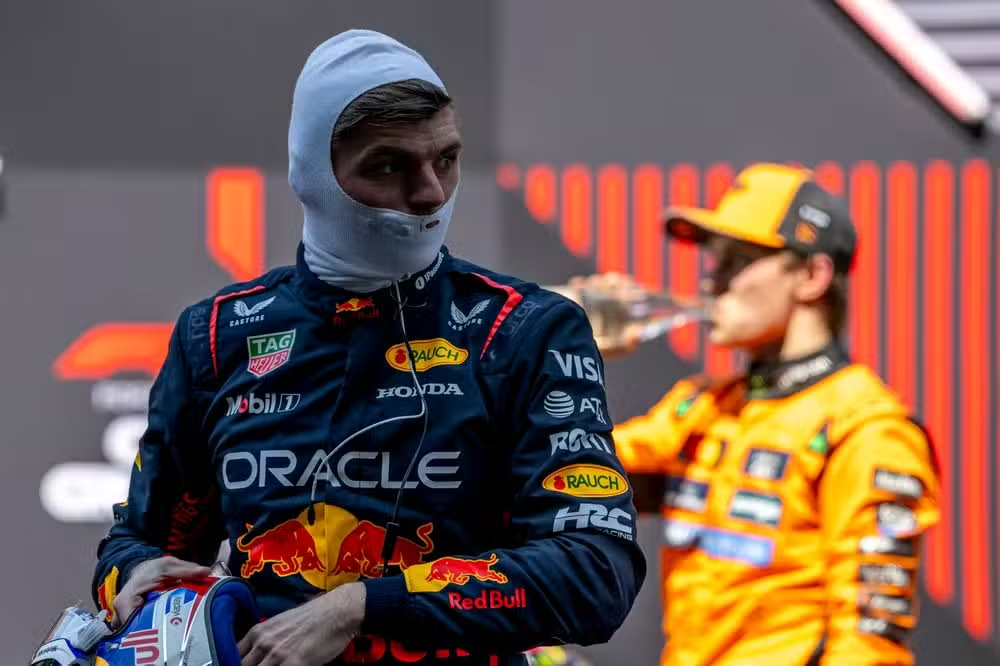
The current scenario of Fórmula 1 has generated intense debates behind the scenes, especially after Jos Verstappen’s recent statements about the future of his son, Max Verstappen. The former driver publicly expressed his apprehension regarding the four-time world champion’s enthusiasm for the sport, citing the drastic changes imposed by the category’s new technical regulations. According to the pilot’s father, the transition to an era with greater dependence on electrical systems and active aerodynamics has not pleased the Red Bull competitor.
Since the implementation of the new guidelines in 2026, Max Verstappen has been one of the most critical voices regarding the behavior of cars on the track. Technical dissatisfaction combined with the Austrian team’s lower-than-expected performance intensified rumors of a possible early departure from the grid. The Dutch driver has already indicated in interviews that the balance between his private life and the exhaustion of a calendar with 24 races weighs on his future decisions.
The driver’s motivation is a central point for the continuation of his victorious trajectory in the elite of world motorsport. Diversos factors contribute to this state of mind, as detailed below:
- The excessive dependence on the electrical part of the engines has been highlighted by Verstappen as a factor that reduces the technical challenge of pure piloting.
- Red Bull’s oscillating performance at the start of this season limits the chances of direct competition for constant victories.
- The pilot’s growing interest in endurance competitions, such as the 24 Horas of Nurburgring, appears as a real career alternative outside of Fórmula 1.
- The need to manage time with family and friends outside of the high-pressure environment of the paddock.
Regulatory changes and the impact on riding
The introduction of new power units and the active aerodynamics system have significantly changed the way drivers interact with the machines. Jos Verstappen highlighted that his son always seeks to get the most out of the available equipment, but highlighted that the current configurations no longer represent the challenge that Max enjoyed. The former driver noted that current driving requires competitors to lift their foot off the accelerator in sections where the speed was previously maximum, which distorts the essence of the competition.
This new driving dynamic has generated a feeling of pessimism regarding the long-term future of the four-time champion in the category. Jos stated that Max has always been known for speaking his mind directly, and his dissatisfaction is not just a political game, but a genuine reflection of his discouragement. The driver’s father fears that, if there are no significant adjustments to the rules, the desire to compete in the elite could quickly disappear.
Dialogue with the international federation and adjustment expectations
Although the current scenario is uncertain, there is an expectation that the April meetings between the pilots and Automobilismo will bring changes. Jos Verstappen believes that the criticisms of Max and other grid colleagues are being heard by the sports authorities, although he admits that profound changes for this year are unlikely. The focus of the discussions lies in the search for a balance that returns the leading role to the driver and reduces the artificiality of disputes on the track.
The political game between large automakers also plays a crucial role in maintaining or changing current rules. Equipes who achieved an initial competitive advantage with the new regulations tend to resist changes that could balance the forces of the championship. Jos mentioned that the superior technical knowledge of certain teams creates a barrier to immediate reforms, which contributes to the frustration of competitors who find themselves at a technical disadvantage.
Career perspective and interest in endurance
The possibility of Max Verstappen migrating to other categories of motorsport is not a new topic, but it gained strength with his recent statements on Japão. The driver has never hidden his admiration for endurance events, where teamwork and race management on traditional circuits offer a different type of personal satisfaction. Happiness in private life, mentioned by the Dutchman after the test in Suzuka, suggests that he no longer feels obliged to remain in Fórmula 1 just for status or achievements.
The decision to continue or not after the end of your current contractual cycle will directly depend on the evolution of the Red Bull car and the sensations behind the wheel. Caso If the sport continues on a path that does not prioritize individual skill, the grid could lose one of its greatest talents prematurely. Jos reinforced that he values his son’s honesty in exposing reality, even if this causes discomfort among the organizers of Mundial.
Technical challenges of the new era of formula 1
The technological transition beginning in 2026 has brought unprecedented challenges to engineers and pilots around the globe. The increased importance of energy recovery has changed fuel management and power delivery during hot laps and races. Verstappen and other grid veterans have expressed that the complexity of these systems often outweighs the pleasure of the physical contest between the cars.
- Active aerodynamics systems require the pilot to constantly adapt to different parts of the same curve.
- The high weight of modern single-seaters affects the agility and thermal response of the tires in varying track conditions.
- Racing strategy has become dominated by the need to charge batteries, which can frustrate aggressive drivers.
- The lack of characteristic sound and linear torque delivery are also points of constant criticism from enthusiasts and professionals.
Impact of the long calendar on mental health
The current Fórmula 1 schedule, with 24 stages distributed across all continents, requires a personal sacrifice that many riders are beginning to seriously question. Max Verstappen has been emphatic that success on the track is no substitute for quality time spent with loved ones and in peaceful environments. The exhausting routine of travel, business commitments and technical training leaves little room for the physical and psychological recovery necessary to maintain a high level.
The pressure for results in a top team like Red Bull only increases this wear and tear throughout the seasons. Jos Verstappen noted that the loss of sparkle in his son’s eyes when talking about the sport is the clearest sign that something needs to change. The four-time champion values his peace of mind above numerical records, which makes his permanence uncertain if the work environment continues to be perceived as a bureaucratic and technical burden.
Future of red bull racing in the world championship
The Milton Keynes-based team faces its own set of difficulties in providing a car capable of keeping its main driver happy and competitive. Após years of dominance, the drop in performance compared to direct rivals generates internal tension that is reflected in the public statements of its members. The technical team’s ability to react will be fundamental in trying to reverse the discouragement that has hit the Dutchman’s boxing.
The development of Red Bull’s own power units for the new regulatory cycle is also a factor of anxiety for the Verstappen family. The transition of engine supplier represents a high technological risk that can define the success or failure of the next few years in the pilot’s career. If the project does not meet expected performance targets, the path to an early exit from the category will become even more obvious to everyone involved.
Reflection of the statements in the motorsport community
Jos Verstappen’s words quickly echoed throughout the paddock and among sports fans on various social networks and news portals. Muitos Analysts agree that Fórmula 1 needs to be careful not to alienate its main players in favor of overly complex or artificial regulations. The presence of drivers with strong personalities and sincere opinions is considered vital for public engagement and the authenticity of the competition.
Jos’s support for his son reinforces the family’s unity in the face of the crucial decisions that will come in the coming months of the championship. The former driver makes a point of highlighting that Max is not the only one dissatisfied, but rather the most vocal about the structural problems he perceives in the new phase of the category. The outcome of this situation could shape the future coach of Fórmula 1 and dictate whether the sport will be able to retain its brightest talents for longer.
Considerations on the integrity of motorsport
The essence of Fórmula 1 has always been the search for the limits of technology combined with the extraordinary human talent of the pilots. Quando a pilot of the caliber of Max Verstappen begins to question whether the effort is worth it, the entire structure of the sport is put to the test. The federation and teams now have the task of listening to these demands to ensure that the category continues to be the pinnacle of world motorsport, where the challenge of driving is the greatest reward.
The possibility of a four-time champion retiring at the peak of his physical and technical fitness would be a significant blow to the sport’s commercial and sporting appeal. The pilot market would be in an uproar with the opening of a vacancy in Red Bull, but the loss of a technical reference like the Dutchman would be difficult to make up for immediately. Following the technical meetings in April will be essential to understand whether the current discouragement is reversible or whether we are witnessing the last years of Max Verstappen in the paddock of the global elite.