Japanese Honoka Hashimoto eliminates Bruna Takahashi from the table tennis World Cup in Macau By Carolina Costa
7 min read
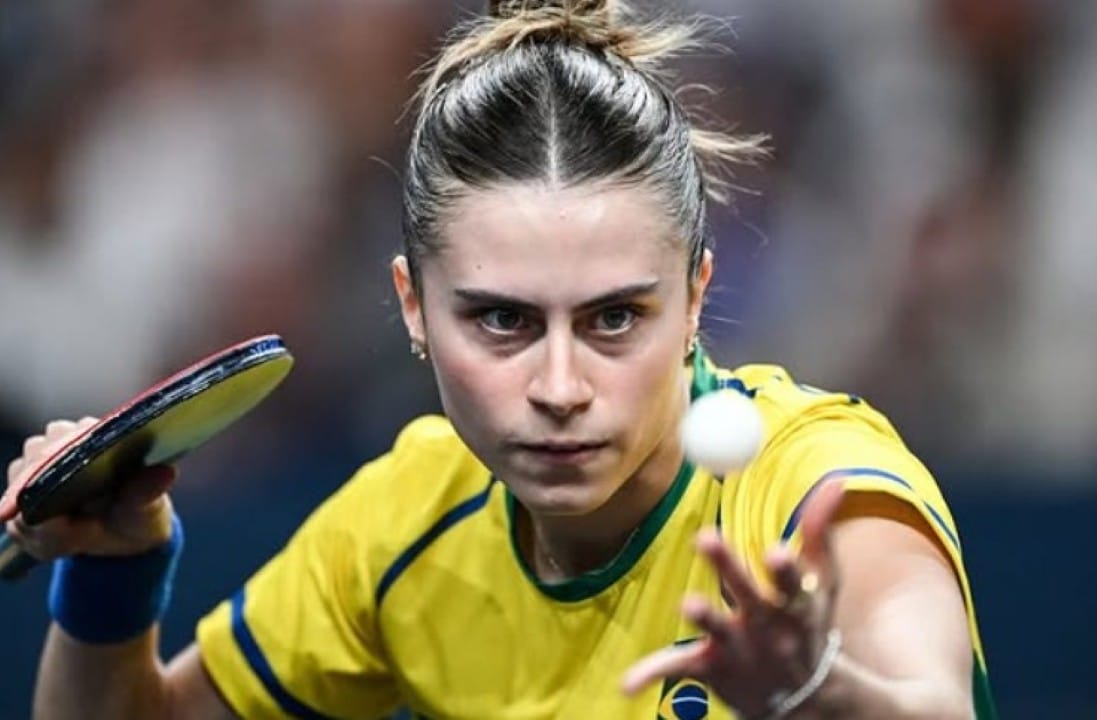 |
The journey of table tennis athlete Bruna Takahashi at Copa reached its conclusion last Friday, April 3, at Macau, a global stage for the elite of the sport. In an unprecedented and high-intensity clash, the Brazilian representative, one of the biggest names in South American sport, was overcome by the Japanese Honoka Hashimoto, currently in 13th position in the world rankings, with a final score of 4 sets to 1 (partials of 11/6, 11/4, 11/3, 10/12 and 11/4). Este result ended Bruna’s participation in the round of 16, a crucial phase of the tournament that brings together talents from across the globe, highlighting the complexity and competitiveness inherent to high-level table tennis and the constant pressure that athletes face in competitions of such magnitude, which require not only refined technique, but also unparalleled mental resilience to overcome the challenges posed by the most qualified opponents.
The match started with great expectations, given the relevance of the competition and the performance history of both players, who were looking to advance in one of the most prestigious tournaments on the Federação Internacional of Tênis of Mesa (ITTF) international calendar. Preparing for an event of this magnitude involves years of hard training and dedication, and each point played reflects this intense journey of athletes in search of sporting glory and global recognition.
Bruna Takahashi fights hard, but cannot overcome Honoko Hashimoto and says goodbye to Copa of Mundo of Tênis of Mesa.
— CazéTV (@CazeTVOficial)April 3, 2026
Now you have Hugo Calderano in action! Vem for live! 🇧🇷🏓pic.twitter.com/ZGcw7wLPW5
This result marks an important point in Bruna Takahashi’s trajectory in the current competitive cycle, serving as an indication of the extremely high level of global competition and the continuous need for technical and tactical improvement to remain among the main forces in the sport. The experience gained in clashes with athletes from the world’s top 15 is invaluable for developing and formulating future strategies for the next major competitions.
Initial dominance and the Japanese offensive
The challenge imposed on Brazilian Bruna Takahashi was notorious even before the first serve, reflecting the hierarchy of world table tennis. Honoka Hashimoto reached the knockout stage of the competition with an impeccable campaign in the group stage, without conceding a single set to her opponents, which already signaled her impressive form and rigorous preparation for the tournament in Macau, accrediting her as one of the favorites for the title and a formidable opponent.
At the beginning of the direct confrontation, this dominance materialized quickly, with the Japanese controlling the actions and establishing the rhythm of the match in a forceful way and without giving space to her opponent. Após a relatively balanced start in the first set, Bruna Takahashi made a series of consecutive errors that allowed the Japanese player to build a decisive advantage, culminating in the 11/6 victory.
The tactical reaction of Bruna Takahashi
The Japanese player maintained an aggressive and extremely precise pace of play, leaving no room for the Brazilian reaction to materialize in the following stages. With superior game volumes and remarkable consistency in his strokes and movements, Hashimoto imposed his style and “ran over” in the following sets, winning the second by 11/4 and the third by 11/3, expanding his advantage to 3-0 and placing Bruna in an extremely delicate and challenging situation within the dispute.
Faced with a 3-0 set deficit, Bruna Takahashi demonstrated great resilience and had to drastically adjust his tactical approach in the fourth set, seeking to reverse the situation. The Brazilian athlete adopted a more offensive stance and sought to shorten the points, avoiding long exchanges of the ball that favored the opponent, and this change in strategy began to bear fruit immediately, revitalizing the hope of a comeback.
Bruna managed to open her first considerable lead in the game, leading 8/4, showing her ability to adapt under pressure and her accurate reading of the game. Upon noticing signs of a possible reaction from the opponent, Bruna Takahashi demonstrated tactical intelligence by requesting a strategic timeout, which proved crucial for the moment of the match, allowing a necessary break for reorganization and focus.
The continuation of the confrontation in Macau
This tactical pause allowed Bruna to reorganize her ideas and, more importantly, interrupt the flow of the Japanese game, who was beginning to rehearse an approach on the scoreboard. The timeout had the desired effect, as the Brazilian managed to maintain the calm and concentration necessary to hold off the advance of Hashimoto, closing the partial at 12/10 and adding a point to the scoreboard of the fierce dispute.
The victory in the fourth set brought new energy to the Brazilian team and to Bruna itself, showing their ability to fight and find solutions in moments of adversity. Para fans, the partial represented a glimpse of the determination and technique that elevated her to the level of international prominence, raising expectations for the following sets, despite the difficulty of the task.
However, the momentum of the Brazilian reaction was unable to maintain itself in the fifth and decisive set. Honoka Hashimoto, an experienced player with nerves of steel, showed great coolness and did not let herself be shaken by the loss of the previous set, quickly regaining total control of the match and imposing her superiority on the court.
She once again imposed her rhythm and precision that had marked the first sets, giving Bruna Takahashi no chance to recover. With a dominant performance and without giving up space, Hashimoto secured victory in the fifth set by 11/4, sealing the final score of 4 sets to 1 and, consequently, her place among the eight best athletes in the world competition, continuing her campaign in the tournament.
The value of Copa of Mundo of Tênis of Mesa
Hashimoto now proceeds to the quarterfinals, where she will face a strong clash against the Chinese Manyu Wang, another table tennis giant. Wang, who had already eliminated Mima Ito, also from Japão, with a resounding 4 sets to 0, promises a clash of the highest technical and strategic level, consolidating the final phase of Copa from Mundo as a true sporting spectacle for fans of the sport across the world. world.
The Copa of the Mundo of the Campeonato Mundial and Jogos Olímpicos. Este tournament annually brings together the best players from each continent, as well as champions from other competitions and guest players, guaranteeing a very high technical level and being crucial for the development and visibility of athletes in a scenario of increasing competitiveness.
Panorama of the sport on the national scene
Bruna Takahashi is, without a doubt, one of the greatest exponents of Brazilian women’s table tennis in recent decades, with a career marked by several achievements at the Pan-American and South American level, as well as constant and significant participation in tournaments on the world circuit. Sua dedication, professionalism and discipline inspire a new generation of athletes in the country to pursue sport as a professional path, serving as an example for many young talents. Table tennis no Brasil has demonstrated remarkable progress, driven by investments in infrastructure and development programs in several regions. Atletas such as Hugo Calderano, for men, and Bruna Takahashi, for women, are examples of Brazil’s ability to train talent capable of competing at the highest global level, with the support of Confederação Brasileira of Tênis of Mesa (CBTM) to consolidate the country on the international stage.
Performance analysis of Takahashi
Elimination in the round of 16 prevents Bruna Takahashi from matching its 2025 campaign, when it reached the quarter-finals of the same tournament, consolidating itself as an emerging force on the global table tennis scene. Aquela Last performance had been an important milestone in her career, demonstrating her potential to be among the greats of the sport and highlighting the constant evolution of her game.
Despite the elimination, the participation of Bruna Takahashi in Copa of Mundo in 2026 reaffirms the presence of Brasil among the nations that present competitive athletes in world table tennis. Cada The tournament is an opportunity to learn and adjust for future competitions, including the next Olympic challenges, where the experience gained in high-level clashes will be invaluable.
Future and preparation on the world circuit
For Bruna Takahashi, Copa’s farewell to Mundo in Macau does not represent an end, but rather another stage in his dense and promising career, full of valuable learnings in a high-caliber tournament. The athlete now turns her focus to the next commitments on the world circuit, seeking to accumulate more points in the rankings and improve her game for future challenges, as the table tennis calendar is intense and full of high-level opportunities in different parts of the world.
The WTT circuit (World Table Tennis), responsible for organizing events such as Copa and Mundo, offers a series of tournaments at different levels – Contender, Star Contender, Grand Smash – which allow athletes to remain active and constantly evolving. Detailed analysis of the match against Honoka Hashimoto, especially the way the sets were lost and the success in adapting the fourth set, will be fundamental for the work of your coaching staff and for long-term strategic planning.