

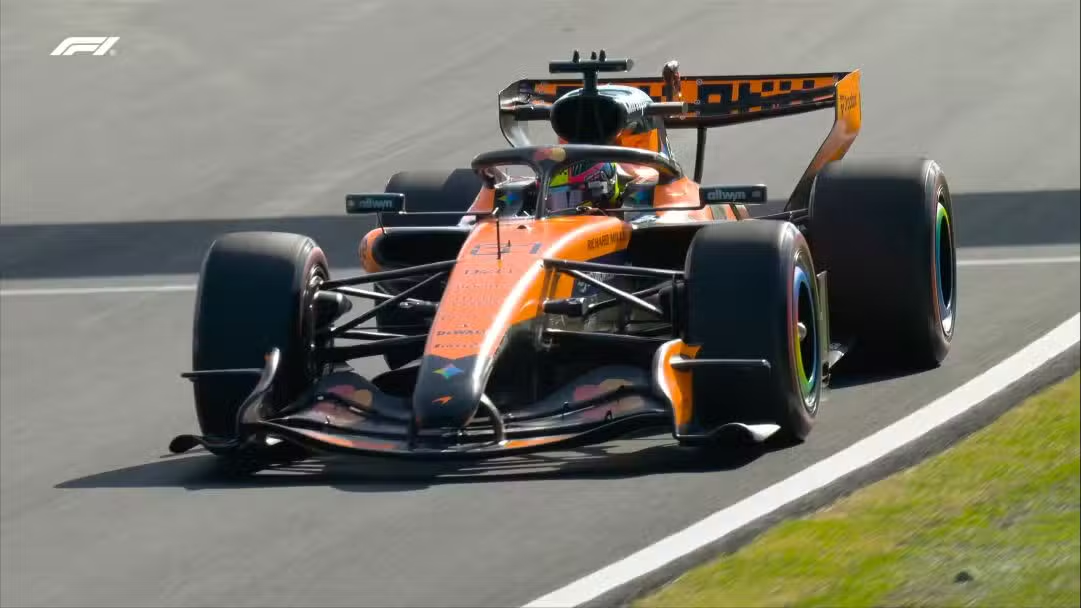
Australian driver Oscar Piastri recorded the fastest time during the second free practice session for Grande Prêmio’s Japão, held at the iconic Suzuka circuit. Conduzindo the McLaren car, he clocked a time of 1 minute, 30 seconds and 133 thousandths using the soft compounds provided by Pirelli. The session was marked by an intense dispute at the top of the timesheets, highlighting the competitiveness between the main teams on the current grid in the highest category of world motorsport.
The British team demonstrated strength on the Asian track, overcoming direct opponents on a track that demands maximum aerodynamic efficiency from single-seaters. McLaren engineers took advantage of the dry weather window to collect key data on tire wear, targeting the ideal strategy for the main race. The car’s setup proved to be superior in high-speed curves, allowing the driver to extract maximum mechanical performance.
The official event schedule continues with decisive activities for the formation of the starting grid in the coming days:
– The third free training session takes place on Saturday, starting at 11:30 am local time.
– The qualifying session is scheduled for 3pm on the same day, defining the starting positions.
– The main race is scheduled to start at 2pm on Sunday, with full stands expected.
While the top of the table presented very close times, driver Gabriel Bortoleto faced setbacks with team Kick Sauber’s equipment. Ele ended the session in sixteenth place, after dealing with mechanical problems that drastically limited his mileage on the Japanese circuit and hampered the testing schedule planned by the team.
Climatic conditions and adaptation of cars on the Japanese circuit
The unstable weather forecast in the region of Suzuka forced teams to condense their testing programs during the first sixty minutes of open runway. The variation in asphalt temperature, combined with the high humidity characteristic of Japanese spring, significantly alters the behavior of rubber compounds. The strategists had to divide the tasks between the two sides of the garages, sending one car to qualifying simulations with low fuel levels, while the other focused on long sequences of laps to understand thermal degradation over time.
The figure-eight layout is unique on the calendar and imposes extreme lateral loads on the tires, especially in the first sector, known for its fast sequence curves. Para To cope with these demands, mechanics made constant adjustments to the cars’ front wing and ride height. The search for the perfect balance between speed on the straights and grip in high-speed corners dictated the pace of work in the pits, with drivers reporting different levels of grip as the track evolved and accumulated more rubber on the ideal racing trajectory.
Mercedes performance and soft tire strategies
Team Mercedes showed surprising pace during the hot lap simulations, placing its two drivers just behind the session leader. Lewis Hamilton set the second best time, just 0.092 seconds off the mark set by McLaren, demonstrating confidence in strong braking and corner entry.
George Russell also found a good setup for the silver car, securing third place on the timesheets. The British driver reported over the radio that the single-seater behaved predictably in rapid direction changes, a crucial factor in the first sector lap time of Suzuka.
Telemetry data indicates that the German power unit is delivering efficient acceleration on low-speed corner exits. The team’s engineers concentrated their final efforts of the session to ensure that this single-lap performance did not compromise the race pace on Sunday.
Mechanical difficulties mark the team session Kick Sauber
The weekend in Japão got off to a turbulent start for Gabriel Bortoleto, who saw his track time drastically reduced due to a failure in his single-seater’s transmission system. The problem arose in the first minutes of the session, forcing the driver to abort his initial fast lap.
The technical team at Kick Sauber detected a hydraulic fluid leak that compromised the operation of the gearbox. The failure required the car to be immediately removed to the garage, avoiding further damage to the internal components of the power unit and gearbox.
Bortoleto had to park the car at the entrance to the pit lane, being pushed back to the pit by the mechanics. Dismantling the rear part of the vehicle consumed a large part of the available time, preventing the return to the track to complete the aerodynamic test program.
With only sixteenth position recorded, the driver missed a vital opportunity to test the soft tires in representative qualifying conditions. The technical team’s focus now turns to completely repairing the equipment overnight, aiming to make up for lost time in the third free practice.
Accident at curve Dunlop interrupts the progress of activities
The session had to be stopped with a red flag after a strong impact involving driver Logan Sargeant, from team Williams. The incident occurred in the challenging curve Dunlop, a high-speed section that requires millimeter precision when entering and absolute control of the accelerator. The car lost stability at the rear when it touched the outer curb, spinning violently before colliding with the tire protection barrier. The force of the impact caused severe damage to the right front suspension, floor and front wing, scattering carbon fiber debris across the exhaust area. The race management acted quickly, activating the medical car as a precaution, although the driver was unharmed and walked on his own two feet to the official rescue vehicle. Track inspectors worked intensely for around fifteen minutes to remove the destroyed single-seater and repair the protective barrier, ensuring structural safety for the resumption of the session. Este setback represents a huge logistical loss for Williams, which now faces a race against the clock to rebuild the chassis before the third free practice session, in addition to compromising the collection of aerodynamic data essential for setting up the car on this highly technically demanding circuit.
Ferrari and Red Bull focus on race pace and stability
Ferrari opted for a different test program, prioritizing the evaluation of the degradation of medium and hard tires. Charles Leclerc managed to put together a good lap to finish in fourth place, while Carlos Sainz only finished in thirteenth position, focusing entirely on racing simulations with a full tank and conservative engine mapping.
In the garage at Red Bull, the scenario was one of searching for directional stability and route correction. Max Verstappen, who finished eighth, and Sergio Pérez dedicated the session to solving grip problems on the rear axle, giving up the fight for the top positions on the timesheet in favor of a more consistent and predictable car for Sunday’s long distances.
Technical analysis of compound wear on the track
Suzuka’s abrasive asphalt remains one of the biggest tests for Pirelli’s supplied compounds of the season. The energy transferred to the tires in high-speed corners, such as the famous 130R, generates superficial overheating that reduces the useful life of the rubber in a few laps, requiring careful management by the drivers.
The teams noted that the soft tire offers a significant time advantage in the first lap launched, but quickly loses performance in the third sector due to thermal stress. Isso will force strategists to accurately calculate the exact moment to send cars onto the track during qualifying, avoiding traffic and maximizing the ideal grip window.
Team expectations for the qualifying session
With the times between the four main teams on the grid getting closer, the fight for pole position promises to be defined down to the smallest details of driving and mechanical setup. Engineers will spend the night analyzing the terabytes of telemetry data collected to refine engine mapping and aerodynamic configuration, setting the stage for a Saturday of high speed and precision at Japão.