
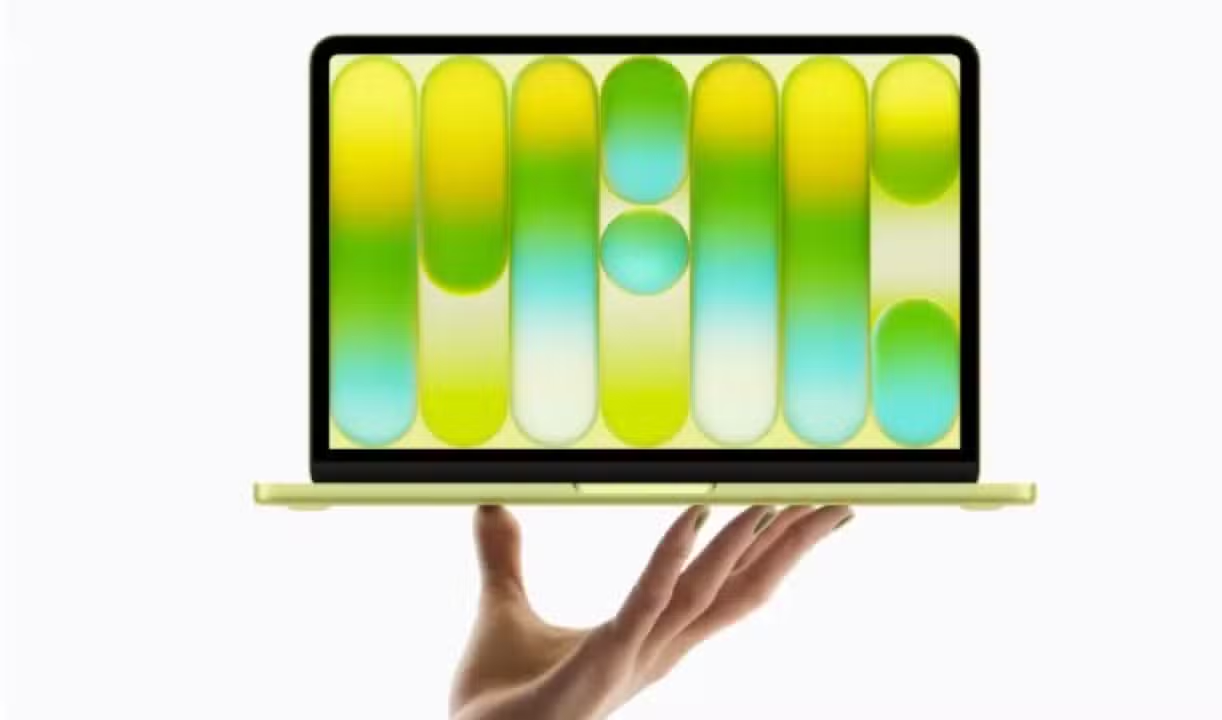
The portable technology market is undergoing a structural transformation driven by demand from users looking for equipment focused on direct functionality. The current preference is for devices that eliminate visual and hardware excess, prioritizing lightness and the ability to transport in common backpacks without the need for bulky accessories. Essa Behavior change dictates new design rules in the personal computer industry.
Energy autonomy has become a crucial factor in this new category of devices, with the requirement that the batteries support a full day of intense work without intermediate recharges. Paralelamente, the drastic reduction in the number of connection ports reflects a philosophy of simplification, where the objective is to avoid complications and unnecessary cables on the work table. The latest models hit the market with increasingly lower weights and clean constructions that discreetly integrate into any environment.

A focus on essential performance drives the development of these machines for flawless execution of daily tasks, fluid navigation and corporate productivity. Manufacturers began to avoid the inclusion of unwanted pre-installed software, known as bloatware, delivering straightforward interfaces that minimize user distractions. The standardization of charging via USB ports and the adoption of ultra-thin profiles consolidate the aesthetic and functional standard of this generation of computers.
Apple redefines entry into the segment with new equipment
The MacBook Neo appears as the main gateway to the apple ecosystem, offering the brand’s fluid experience for a starting price of five hundred and ninety dollars. The equipment weighs approximately one kilogram and two hundred grams, standing out for its extreme ease of movement in busy urban routines.
The internal architecture of the device is based on the A18 Pro processor, the same silicon component used in the company’s most advanced smartphones. Essa engineering choice guarantees remarkable energy efficiency and allows the computer to operate completely silently, eliminating the need for internal cooling fans.
The interaction components, such as the high-resolution screen, the glass trackpad and the speaker system, deliver quality that is higher than the average found in this market range. The macOS operating system complements the proposal with an interface free of visual pollution and unnecessary tools.
Physical connectivity is restricted to two USB-C ports, operating at different speeds, which perfectly suits audiences who do not demand multiple simultaneous peripherals. Using simple adapters allows you to quickly expand connections, transforming the device into a complete workstation when required.
Traditional line maintains hegemony in reduced thickness
The MacBook Air equipped with the M5 processor reaffirms its historic leadership position among ultra-slim portable computers. The device’s chassis is less than one and a half centimeters thick, keeping the weight at around one kilogram and two hundred grams, which makes it practically imperceptible during daily transport.
The processing capacity of the M5 chip easily meets the demands of corporate users and students, ensuring agility in opening applications and managing multiple navigation tabs. The absence of moving cooling components ensures a noise-free working environment, a highly valued feature in shared offices and libraries.
Performance limitations in relation to lines aimed at audiovisual professionals only become evident in complex renderings or extensive code compilations. Para the general public, the balance between raw power and operational simplicity makes this model a safe and long-lasting choice.
Competing OS makers respond with wide screens
Dell restructured its premium computer division with the launch of the XPS 14 and XPS 16 models, rescuing the design essence that established the brand in the past. The new chassis use noble materials and feature screens that dominate almost the entire front surface, eliminating thick edges and offering panel options with extremely high-contrast LCD or OLED technology.
The company’s engineering team listened to consumer feedback and replaced the controversial touch-sensitive function keys with traditional physical buttons with precise tactile response. Graphics processing ranges from efficient integrated solutions to dedicated input cards, while connectivity is guaranteed by very high-speed ports that preserve the set’s minimalist aesthetic.
Artificial intelligence integrates new data transfer systems
The ThinkPad X1 Carbon Gen14 Aura Edition reaches an impressive mark of just one kilogram in total weight, incorporating significant advances in automation and machine learning. The edition’s exclusive technology allows the instant transfer of multimedia files between smartphones and the computer by simply physically bringing the devices together.
Intelligent system management adjusts power consumption and processor performance according to the user’s real-time behavior. Ease of maintenance stands out as a rare differentiator, allowing the replacement of vital components such as storage, battery and even physical connectors in an uncomplicated way.
Ceramic metal structures guarantee superior durability to the devices
Models Zenbook S14 and S16 introduce an innovative alloy called Ceraluminum to the market, which fuses the lightweight properties of aluminum with the extreme resistance of ceramics. Essa The choice of material results in equipment weighing approximately one and a half kilos that convey a feeling of incomparable solidity, without giving up a discreet and elegant visual profile. Processing options are divided between the latest architectures from Intel and AMD, allowing the consumer to direct their choice towards greater graphics power or maximum battery efficiency. The visual experience is guaranteed by panels with extremely high color fidelity and high refresh rates, which make text scrolling and video playback extremely smooth.
Extensive monitors gain versions adapted for daily transport
The LG Gram Pro 17 challenges market conventions by offering a seventeen-inch panel in a structure that weighs just over one kilo and three hundred grams. Essa unusual relationship between screen size and portability caters directly to professionals who need large viewing areas for complex spreadsheets or image editing, but who cannot carry heavy equipment.
The chassis’ reduced thickness makes storage easier, while the display’s color accuracy meets rigorous creative industry standards. The increased internal space allowed the inclusion of a greater variety of connection ports and an efficient thermal dissipation system for the installed high-performance processors.
Modularity emerges as an alternative for reducing electronic waste
The Framework Laptop 13 consolidates a philosophy of conscious consumption by allowing the user to assemble, update and repair their own computer intuitively. The system of interchangeable modules makes it possible to choose the exact connection ports needed, while the ease of changing the motherboard ensures that the chassis can be used for many years, actively combating planned obsolescence.
Processors based on mobile architecture optimize battery life
The HP EliteBook The inclusion of processors based on ARM architecture represents a significant leap in energy management, allowing extended working hours without any dependence on sockets.
The construction of the device focuses on the durability required by the business environment, with reinforced data input components and audio and video capture systems optimized for video conferencing. The sober design and rigid structure guarantee the reliability necessary for professionals who travel constantly.
Technical requirements standardize new generation of portable computers
Analysis of the current market reveals that the two-kilogram limit has become the psychological and technical barrier to the acceptance of equipment in the ultraportable category. The standardization of power supply through universal connections has simplified logistics for users, who can now use a single adapter to recharge smartphones, headphones and computers.
Manufacturers understood that the addition of decorative lights and aggressive creases on the chassis alienates consumers looking for a versatile and discreet work tool. The new crop of equipment proves that it is possible to deliver robust processing capacity in increasingly compact formats, redefining what is expected from a modern personal computer.