
Change in Iran’s military high command reflects new defense strategy in the face of regional crises
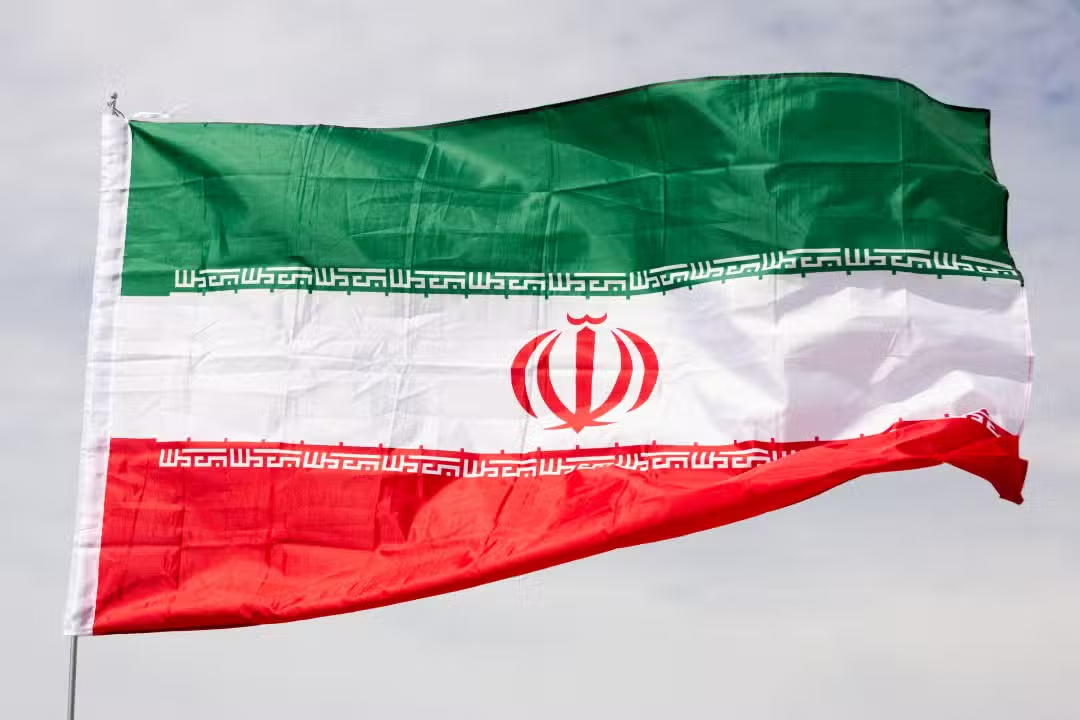
Conselho Supremo of Segurança Nacional of Irã made official this Thursday, April 9, 2026, a profound restructuring of its military and intelligence leadership teams. The decision comes at a time of maximum geopolitical sensitivity, with the declared objective of modernizing defense tactics and rapid response to growing external threats. The announcement was broadcast on the official channels of Estado at Teerã local time, confirming the replacement of Guarda Revolucionária veterans with personnel considered more technical and aligned with new war technologies.
The changes in the command hierarchy were motivated by the need to adjust national security doctrine to recent transformations in the Oriente Médio conflicts. The central government seeks, with these appointments, to ensure that border operations and intelligence activities are more integrated and less vulnerable to cyber interference. Analistas locals point out that the movement is a direct response to incidents recorded in recent weeks, which exposed gaps in coordination between the country’s different defense forces.
The main changes and new focuses of Iranian defense include fundamental points for the new management:
- Replacement of elite unit commanders with officers specializing in electronic warfare.
- Centralization of intelligence command to avoid duplication of information and orders.
- Adoption of new security protocols for critical infrastructures and command centers.
- Reinforcement of monitoring of land and sea borders with self-made equipment.
Modernization of defense tactics on national soil
The leadership of Teerã emphasized that the immediate priority of the new commanders will be the absolute protection of territorial sovereignty and the internal stability of institutions. The selection process for new military leaders prioritized names with academic and technical experience, moving away from the purely ideological profile that predominated in previous decades. Esta change signals an attempt to further professionalize the country’s military response to adversaries using high-precision weapons.

Ministério from Defesa reported that contingency plans were updated to include simulations of attacks on multiple fronts simultaneously. Esse new planning requires unprecedented coordination between Força Aérea, Marinha and Guarda Revolucionária ground regiments, which now operate under a state-of-the-art encrypted communications network. The expectation is that the armed forces’ reaction time will be significantly reduced with the end of the hierarchical bureaucracy that delayed urgent decisions.
Technological integration and artificial intelligence in operations
The introduction of autonomous systems and artificial intelligence in the command of military operations is the central pillar of this structural reform. The newly appointed generals have technical training in engineering and data science, which will allow Irã to use advanced algorithms to predict enemy movements and optimize the distribution of resources on the battlefield. Essa approach aims to reduce human risk and increase the effectiveness of anti-aircraft defense batteries that protect large metropolises and industrial centers.
Investment in cyber defense also received a considerable contribution of resources within the new budget approved by the central government this morning. The creation of a unit dedicated exclusively to neutralizing digital threats demonstrates that Teerã recognizes the importance of the virtual field in modern warfare. Officers now undergo intensive training to operate in scenarios where radio and satellite communications may be interfered with or outright blocked by foreign powers.
Restructuring military logistics and supply chains
The logistics sector of the Iranian armed forces has undergone a complete overhaul to ensure that the supply of ammunition and provisions is not interrupted in the event of a total blockade. Foram new underground distribution centers opened, located in strategic points across the country, which operate independently and with energy autonomy for long periods. Essa measure aims to prevent the cutting of traditional routes from paralyzing the defense capacity of troops stationed in remote or difficult-to-access regions.
In addition to physical infrastructure, the military asset transport system was decentralized to make it difficult for reconnaissance drones to identify targets. The fleet of transport vehicles now has electronic camouflage systems and variable routes, decided in real time by mobile command centers that operate on a roving basis. Agility in troop movement is seen as the determining factor in the success of the new defense doctrine being implemented by the high command.


Cooperation between national armaments industries and universities has been strengthened to accelerate the production of spare parts without dependence on imported components. The government believes that technological self-sufficiency is the only way to ensure the viability of long-term operations under the current international sanctions regime. Diversos development contracts have been signed with technology startups to create new terrain mapping and crisis management software.
Infantry units have also received new personal protective equipment that increases soldiers’ survivability in urban or desert combat environments. The modernization includes thermal night vision devices and bone conduction communication systems, allowing soldiers to coordinate in absolute silence. The efficiency of this new equipment will be tested in large-scale military exercises scheduled to take place over the next forty-eight hours in several provinces.
Impact on regional security and relations with neighbors
The movement of Teerã generated immediate reactions in neighboring countries and international organizations that monitor the stability of Golfo Pérsico. The Iranian government sent diplomatic statements assuring that the restructuring has a purely defensive character and aims only to preserve order within its recognized borders. However, increased military readiness is often interpreted as a warning sign by nations that have territorial or political disputes with the Islamic republic.
International security analysts note that the change in command could alter the balance of forces in secondary conflicts where Irã exerts direct influence. With more technically aggressive leaders, the coordination capacity of allied groups in the region may increase, creating new challenges for ongoing peace efforts. Regional diplomacy is now trying to open new channels of dialogue to prevent military modernization from being perceived as a prelude to an expansion of offensive activities.
Border control and critical infrastructure surveillance
The new military command has established strict protocols for the inspection of ports and airports, seeking to prevent the entry of infiltrated agents or spy equipment. Satellite surveillance has been intensified in oil and gas extraction zones, which are vital to the national economy and frequent targets of electronic sabotage. Unidades rapid response teams have been permanently positioned near these facilities to neutralize any threat in less than ten minutes as per the new guidelines.
The security of power plants and water distribution systems has also been integrated into the protective umbrella of Guarda Revolucionária under the supervision of the new generals. The objective is to create a civil-military protection network that guarantees the functioning of essential services even during periods of intense conflict or mass cyber attacks. The government understands that the resilience of the population is as important as military strength for maintaining the country’s sovereignty in the current global scenario.
Training and qualification of new command ranks
The top-ranking renewal will be accompanied by a profound change in the curricula of Iranian military academies, focusing on asymmetric and irregular warfare tactics. The focus now is to train leaders capable of making quick decisions without relying on constant superior orders, allowing greater flexibility on chaotic battlefields. The use of virtual reality simulators has been expanded to train officers in extreme crisis situations without the cost and risk of ongoing real-world exercises.
New patents must master foreign languages and knowledge of geopolitics to better understand their opponents’ motivations and strategies on the international stage. Command believes that a well-informed officer is less likely to make errors in judgment that could lead to unnecessary escalations or loss of life. Technical meritocracy became the absolute criterion for promotions, replacing the old system of political appointments that hamstrung the national defense structure.
Veja Tambem em Latest News (EN)

Gabriel Jesus refuses European giants and decides to stay at Arsenal to seek historic record

Cristiano Ronaldo and Lionel Messi’s fortunes go beyond the pitch with billion-dollar investments

Green Bay Packers running back Josh Jacobs faces arrest following five felony charges in Wisconsin

Brazilian striker details alliance with French star at Real Madrid and praises fight against racism

Arsenal star Bukayo Saka challenges Paris Saint-Germain in the Champions League final

Defender Ona Batlle ends winning streak at Barcelona and moves to Arsenal

Besiktas prepares offer of seven million euros to take goalkeeper Rossi from Flamengo in the next window

Paris St-Germain reaches the Champions League final with a brutal physical advantage over Arsenal

Former midfielder Guti questions the management of Real Madrid’s academy and points to the mystery of Xabi Alonso’s departure

England and Saudi Arabia compete to hire coach Pep Guardiola for national team football

Striker Cristiano Ronaldo secures an unprecedented trophy for Al-Nassr and raises alarm in the Portugal team
