
McLaren hires Max Verstappen’s engineer and causes maximum alert behind the scenes at Red Bull Racing
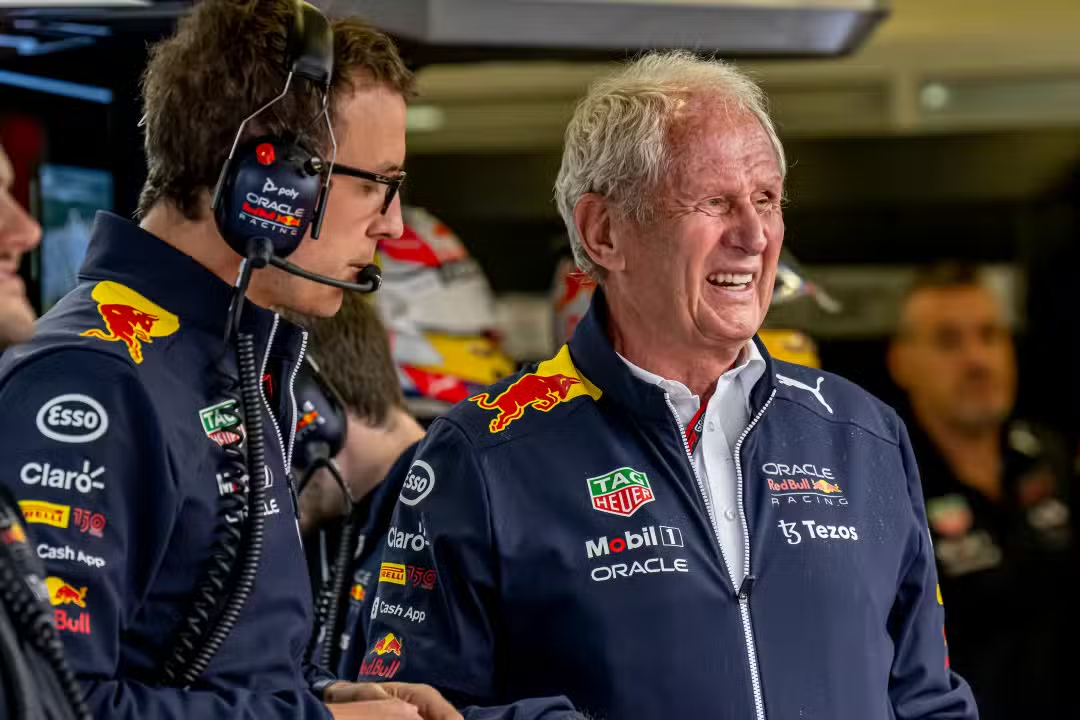
Team Red Bull Racing confirmed the departure of Gianpiero Lambiase, a professional who has worked as race engineer for Max Verstappen since the 2016 season. The official statement establishes that the Briton will fully fulfill his current contract with the organization until the end of 2028. Imediatamente following the announcement, McLaren made official the hiring of the specialist to join its technical board at Woking.
The move ends one of the most lasting and victorious cycles in the recent history of world motorsport. The partnership was instrumental in winning multiple world championships and established a new standard for technical communication during races. The transfer of such a central part of the organization chart represents a significant change in the balance of forces in the grid.
The market for high-ranking professionals in the category is going through a moment of high volatility, with rival teams seeking to destabilize the structure of the current champion. The engineer’s move to a direct competitor highlights the aggressiveness of behind-the-scenes negotiations and the search for technical knowledge accumulated during the ground effect era.
Internal reaction and strategic impact on the structure of the Austrian team
The former driver and current consultant for Red Bull, Helmut Marko, classified the decision as an extremely important loss for the team’s engineering department. The manager explained that the established work dynamics went beyond the usual functions of telemetry and car adjustment, creating a relationship of absolute trust. The departure requires a profound restructuring of the track operation method that the team has used for almost a decade.
The professional’s autonomy within the garage allowed for fine adjustments that became the hallmark of the number one car.
- The transition will only occur after the end of the current engine regulatory cycle.
- The new position will offer decision-making power over the entire track operation.
- The Austrian team will begin a gradual process of internal succession.
To mitigate the damage of this transfer, the technical management will need to identify a replacement in the market or in its youth categories capable of withstanding the pressure inherent to the position. The ability to operate independently from the rest of the engineering corps was the difference that kept the team at the top during regulation transitions. The loss of this analytical profile forces the organization to rethink its organizational chart and the way information flows from the pit wall to the cockpit during Grande Prêmio weekends.
Victorious trajectory and construction of a dynasty on the tracks
The joint story began in Grande Prêmio of Espanha in 2016, a race that marked the debut and first victory of the Dutch driver for the main team. Desde The first laps, the harmony in the interpretation of tire wear data and engine energy management became evident.
Over the years, the collaboration has resulted in more than seven dozen victories and breaking historical records in the category. The work involved not only reading telemetry, but controlling the athlete’s temperament in situations of extreme sporting tension.
New role and expansion of responsibilities in the British team
McLaren acted with surgical precision in the market to secure the hiring, offering a position that represents a considerable hierarchical leap. The Briton will take on the role of Chief Racing Officer, no longer focusing on just one car to overseeing the entire track strategy.
He will report directly to the team leader, Andrea Stella, forming a technical summit focused on establishing a new hegemony. The goal is to use the engineer’s vast experience to refine operational processes that still fail at decisive moments.
The Woking team demonstrates, with this investment, that it has the financial resources and sporting ambition to attract the best talent available in the paddock. The structuring aims at the long term, preparing the ground for future changes in aerodynamics and propulsion rules.
The working environment in the new home will require adaptation, but the promise of freedom to implement winning methodologies was the decisive factor in signing the agreement.


Radio dynamics and sincerity as a performance tool
Radio transmissions between the pit wall and the car became notorious for the frankness and often harsh tone of the mutual demands. Especialistas in motorsport point out that this direct communication, without diplomatic filters, was the perfect mechanism to optimize reaction time in critical pit stop decisions. The engineer had the necessary authority to counter the driver’s instincts, relying strictly on mathematical data and race projections, which avoided common strategic errors in moments of pressure.
During the intense title disputes against Mercedes and Ferrari, the coolness in analyzing weather and traffic variables guaranteed unlikely victories. Daily coexistence created an invaluable behavioral database, allowing us to anticipate mechanical needs even before they were verbalized over the radio. Disrupting this technical symbiosis represents a formidable challenge, as absolute trust in strategic instructions takes years to forge in the highly competitive environment of motorsport.
Movements in the market for top category engineers
The transfer is part of a broader phenomenon of reconfiguration of workforces within the motorsport elite. Profissionais highlights of the current champion team have become preferred targets of rising projects looking for shortcuts to success.
Organizations like Aston Martin and Ferrari have also been hiring aggressively recently, inflating salaries and benefits packages for technical leadership roles. The shared goal is to dismantle the structure that dominated the first half of the decade.
Talent retention has become a chronic problem for teams reaching the top, as spending caps limit financial counter-proposals. The constant movement of engineers guarantees the transfer of technology and levels the grid over time.
Maximizing results in ongoing seasons
Despite the public confirmation of the change of scenery, professional commitment requires absolute focus on maximizing results during the current contract period. Chassis development and aerodynamic upgrades will continue under the close supervision of the engineer, ensuring the team maintains its competitiveness in the upcoming stages of the world calendar. The team’s management established strict intellectual property protection protocols, gradually limiting access to future projects, but keeping track operations unchanged so as not to harm the points in the constructors’ championship. The main driver continues to depend on this tactical guidance to defend his leadership position against the advance of rival teams, transforming the final years of this partnership into a true proof of professionalism and sporting resilience.
Succession planning and adaptation of the three-time world champion
Identifying a new radio partner will require practical testing during simulator sessions and free practice over the next few years. The team needs to find a psychological profile compatible with the main driver’s aggressiveness and demand for perfection.
The maturity acquired by the athlete throughout his career will be fundamental in facilitating the integration of the new team member. The success of this transition will define the organization’s ability to remain in direct contention for victories in the next decade.
The technical legacy left for the new generation of motorsport
The work methodology developed throughout this partnership will remain an instruction manual for young engineers entering the category. The ability to translate subjective riding feedback into precise suspension and front wing changes has established a new paradigm of operational excellence in the pits.
Veja Tambem em Fórmula 1

Esteban Ocon elogia Hamilton como o melhor piloto da era moderna antes do GP de Mônaco

Acosta conquista sexto lugar na MotoGP Itália e destaca aprendizado em duelos com Marc Márquez

Socorrista de Michael Schumacher revela detalhes inéditos sobre o resgate do piloto após 13 anos

Ralf Schumacher alerta George Russell sobre risco de posição de ‘segundo piloto’ na Mercedes após Canadá
Max Verstappen projeta dificuldades no GP de Mônaco por problemas de suspensão da Red Bull

Chefe da McLaren, Andrea Stella corrobora previsão de Norris sobre domínio da Ferrari em Mônaco

Resgate de Michael Schumacher em 2013: piloto de helicóptero detalha missão nos Alpes franceses
Carlos Sainz defende ação firme da FIA nas discussões sobre motores da Fórmula 1 para 2027
Kimi Antonelli lidera Fórmula 1 aos 19 anos e pai revela paixão natural por Ayrton Senna
Fórmula 1 não terá modo reta no GP de Mônaco após decisão oficial emitida pela FIA

Pilotos da Formula 1 dividem atenção com Copa do Mundo e Kimi Antonelli revela torcida pelo Brasil
