
Interstellar object 3I/ATLAS may be the cause of the increase in small meteors in the atmosphere


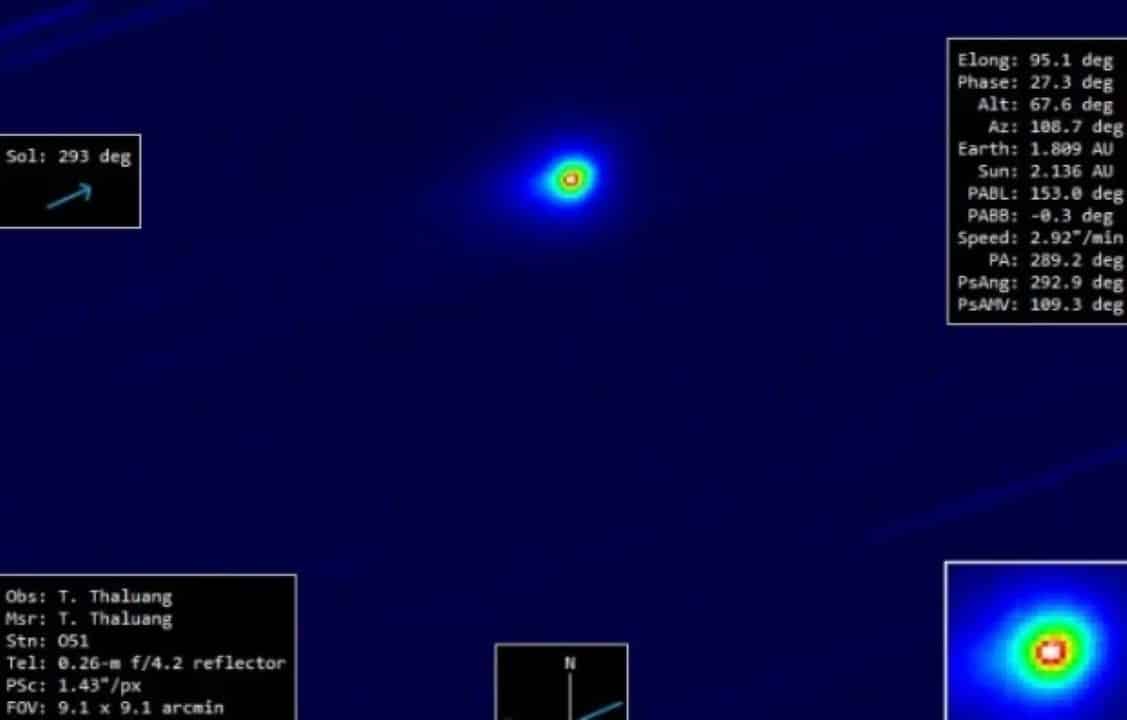
In the second half of March 2026, Terra reached the point of closest proximity to the trajectory followed by the interstellar object 3I/ATLAS no. Sistema Solar. The planet passed at a distance of approximately 54.6 million kilometers from the trail left by the space visitor, who is now moving away towards deep space. Cientistas investigate whether the unusual increase in the observation of small meteorites in different regions of the globe is directly related to solid fragments released by this celestial body.
Data collected by the SPHEREx space observatory indicated, still in August 2025, that 3I/ATLAS presented a dense plume of carbon dioxide that extended for thousands of kilometers. The presence of this gas cloud suggests that solid particles and debris may also have been ejected from the object’s surface during its passage. Cálculos Recent astronomical studies demonstrate that, if these fragments had broken off years ago, they would have enough time to intercept Earth’s orbit at the beginning of this semester.
Observations recorded during the first quarter of 2026 point to specific characteristics of this astronomical phenomenon:
- The number of light events witnessed by large groups of people grew significantly in March.
- The average number of reports per event jumped to 142.7 witnesses, far exceeding historical records from previous years.
- The incoming trajectory of smaller meteors is the main focus for identifying the interstellar origin of these particles.
- Researchers are now seeking to recover physical remains of meteorites for chemical and mineralogical analysis in the laboratory.
Orbital proximity and ejection dynamics of interstellar particles
The speed required for a fragment to travel the distance between the 3I/ATLAS trail and Terra is considered low within astronomical relative speed standards. If the ejection occurred about a decade ago, when the object was still distant from Sol, the detachment speed would be comparable to the thermal agitation of the gas molecules. Esse scenario makes it physically viable for interstellar debris to be colliding with the Earth’s atmosphere precisely during this period of maximum orbital approximation.
Studies on the object’s mass estimate that the celestial body has around one billion metric tons in its main structure. Caso If a small fraction of this mass had fragmented into particles of just one centimeter, trillions of fragments could be dispersed throughout space. Statistical probability indicates that up to 34,000 of these particles could have entered the atmosphere, resulting in small fireballs visible to the naked eye on different continents.
Analysis of explosions of great magnitude and mass of meteoroids
Recent events of great visual impact, such as the explosions recorded over Houston and Lago Erie, were subjected to rigorous kinetic energy analyses. On March 21, 2026, at 4:40 pm local time on Texas, a one-ton meteoroid exploded with a force equivalent to 26 tons of TNT. Poucos days earlier, on March 17, 2026, at 08:57 local time Ohio, a seven-ton space rock generated a sonic boom picked up by several regional sensors.
Experts say these specific explosions are too energetic to be directly linked to 3I/ATLAS. The interstellar object does not have enough mass to release so many fragments with dimensions greater than one meter in diameter that could reach Terra simultaneously. Portanto, although the increase in small meteors is a strong candidate for an interstellar origin, the large fireballs recorded in March likely have distinct origins within the asteroid belt itself.
Verification of data and reports from Sociedade Americana of Meteoros
Technical reports published this week confirm that the volume of small, bright meteors has seen an impressive quantitative jump. Quase half of all events recorded in March 2026 included direct observation of at least 50 people per occurrence. Esse Public engagement reflects not only increased surveillance, but the actual frequency with which these objects are penetrating the upper layers of Earth’s atmosphere.
Systematic analysis of the direction and speed of these 2026 meteoroids will make it possible to separate what is space debris or common asteroids from possible interstellar fragments. If the chemical composition of a recovered meteorite matches the 3I/ATLAS spectral signatures, science will have its first physical sample from a distant star system. Field work now focuses on collecting samples in areas where falls have been accurately mapped by weather radar.
Scientific investigation into the nature of the 3I/ATLAS object
The trajectory of 3I/ATLAS has been constantly monitored since its original detection, serving as the basis for current impact calculations. The distance of the object beyond five times the distance between Terra and Sol does not prevent its wake from continuing to influence the space environment close to our planet. Fluid dynamics and solar radiation pressure play key roles in driving small particles from the interstellar wake toward rendezvous with Terra’s orbit.
The interest of the international astronomical community lies in the possibility of studying materials that do not belong to our Sistema Solar. Confirming that the March meteors come from 3I/ATLAS would change the understanding of how matter is exchanged between different stars in the galaxy. Observatórios around the world continue to collect data to validate whether the temporal coincidence between the proximity of the wake and the increase in meteors is, in fact, a cause and effect relationship proven by orbital physics.
Collecting meteorites and searching for physical evidence on the ground
Search teams were mobilized in regions where trajectories indicated the possibility of survival of fragments during atmospheric reentry. Identification of isotopes not found in terrestrial rocks or common meteorites from Sistema Solar would be definitive proof of the connection to 3I/ATLAS. Embora Most ten-gram particles disintegrate completely, slightly larger fragments may have left metallic or rocky residue in desert or ice areas, making them easier to locate.
Monitoring remains active, as the window of closest proximity to the interstellar trajectory may still generate new events in the coming weeks. Integrating data from civil and military satellites is essential to triangulate entry points and refine debris dispersion models. Science awaits the final processing of the velocity trajectories to confirm whether the solar system is, at this moment, being bombarded by dust from another cosmic neighborhood.





