
Earth crosses debris trail from interstellar object 3I/ATLAS and records increase in meteors


The planet reached its closest approach with the trail of particles left by the celestial body 3I/ATLAS, a visitor from outside our planetary system. The recorded distance between Earth orbit and the space debris trail was approximately 54.6 million kilometers. The orbital alignment marks a moment of extreme relevance for global astronomical observation, requiring the activation of several monitoring protocols in space agencies.
This astronomical event directly coincides with a substantial and statistically unusual increase in the number of small meteorites seen crossing the sky in different parts of the world. Pesquisadores from multiple institutions are devoting intensive efforts to determine whether these miniature space rocks are solid fragments detached directly from this interstellar body during its journey through deep space.
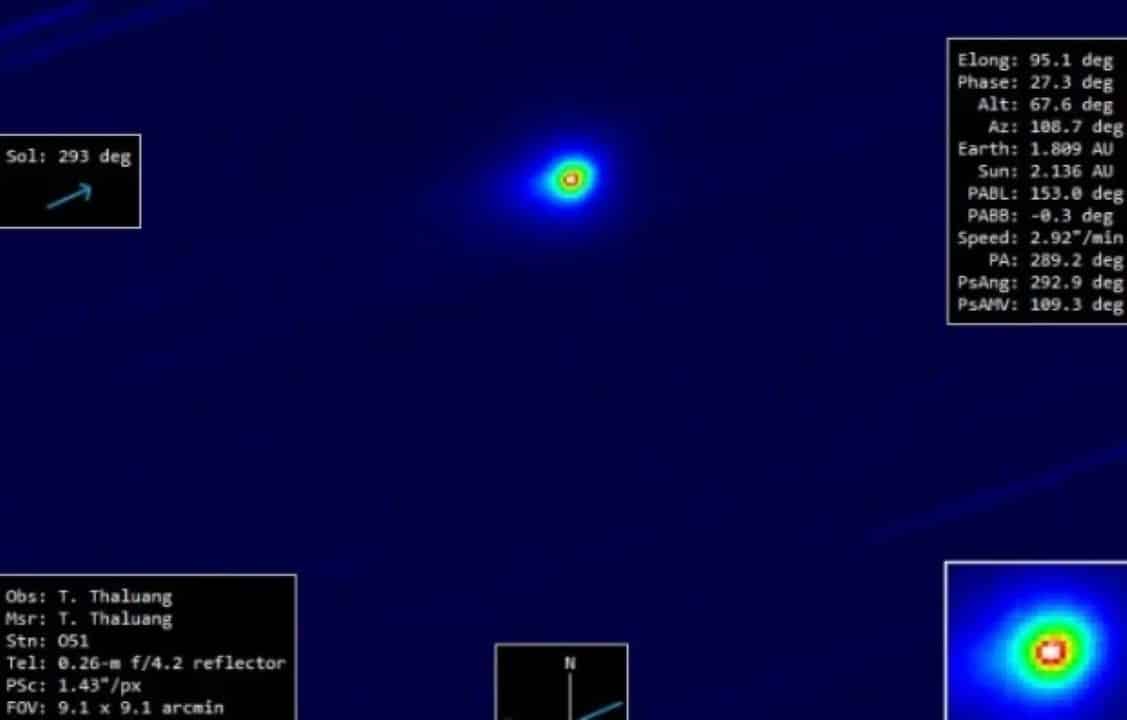
The characteristics of this phenomenon present well-defined patterns identified by space and atmospheric monitoring agencies:
– Crescimento exponential in the number of nighttime luminous events reported by independent observers on different continents.
– Salto in the average number of witnesses per occurrence, reaching the mark of 142.7 people per event viewed and catalogued.
– Foco analytical focused on the trajectory and angle of entry of meteors into the upper layer of the Earth’s atmosphere.
– Mobilização of field teams for the physical recovery of possible mineral samples that have reached the ground intact.
The scientific community is waiting for telemetry data to be crossed to confirm the exact origin of the material. Information collection occurs uninterruptedly, using both ground-based telescopes and observation satellites in low orbit.
Gas analysis and space plume formation
Information captured by the SPHEREx space observatory previously revealed that 3I/ATLAS carried an extensive plume composed predominantly of carbon dioxide. Essa gaseous formation extended for thousands of kilometers around the object’s main core, creating a visual and chemical signature detectable by high-precision spectroscopy instruments.
The presence of this dense cloud strongly suggests that the sublimation process ejected not only gases, but also a significant amount of dust and small rocky debris. Cálculos orbitals indicate that the time elapsed since the primary ejection would be accurate for these particles to cross Terra’s path at this specific moment in the astronomical calendar.
Detachment dynamics and speed in vacuum
The speed required for a solid fragment to travel the vast distance between the original 3I/ATLAS trail and the Earth’s atmosphere is considered low within the parameters of astrophysics. The displacement occurs constantly, without the interference of friction until the moment of atmospheric re-entry.
When the object was still at a great distance from Sol, the thermal energy generated was enough to gradually release materials from its surface. Progressive heating of the frozen core caused microscopic structural fractures that resulted in the release of mass.
This slow detachment makes the speed of the particles comparable to the natural agitation of gas molecules in a vacuum. Consequentemente, it becomes physically feasible and expected that this cloud of invisible debris will end up colliding with the planet exactly during the current window of maximum orbital approach.
Mass proportions and core fragmentation
Structural assessments indicate that the main core of this interstellar visitor has an approximate mass of one billion metric tons. The measurement was carried out by analyzing its light curve and the minimum gravitational disturbance exerted on its surroundings.
This gigantic proportion provides the material necessary to create a dense and lasting trail along its trajectory through the planetary system. The dust trail acts as a physical signature of its passage, remaining cohesive for months or even years in the vacuum of space.
If just a tiny fraction of this total structure had fragmented into pieces about a centimeter in diameter, the result would be the scattering of trillions of tiny rocks. Essa Large-scale fragmentation creates a debris field vast enough to intercept the orbit of inner planets with ease.
Statistical probability models indicate that tens of thousands of these specific particles may have penetrated the gaseous layer of Terra recently. Extreme friction generates small fireballs, intense luminous phenomena that become visible to the naked eye to inhabitants of multiple locations simultaneously.
Assessment of high energy kinetic events
In parallel with the increase in small meteors, events with very high kinetic energy caught the attention of experts in sky monitoring. Explosões massive waves have been documented over densely populated areas, requiring rigorous analysis to separate what belongs to the interstellar wake and what has local origin. A meteoroid weighing about a ton exploded violently over the state of Texas, releasing a destructive force equivalent to 26 tons of conventional explosives. The intense flash and air displacement triggered seismographs at several research stations in the South American region, generating automatic alerts at geological control centers.
A few days before this event, an even larger space rock, estimated to weigh seven tons, fragmented over the territory of Ohio. The breaking of the sound barrier generated a powerful sonic boom, picked up by a wide network of atmospheric and civil security sensors. Apesar due to temporal coincidence, physicists and astronomers rule out the direct relationship of these large rocks with 3I/ATLAS. The interstellar body does not have characteristics that allow the ejection of fragments larger than one meter in diameter, indicating that these larger fireballs are common asteroids from our own solar system that happened to fall in the same period.
Civil engagement and celestial trajectory mapping
Technical reports consolidated by monitoring organizations attest to an impressive quantitative jump in the volume of small bright meteors crossing the night sky in recent weeks. Quase half of all recently cataloged occurrences involved the direct observation and recording of at least fifty people per isolated event, a number that exceeds historical averages for conventional meteor showers. Esse level of public engagement demonstrates civil society’s increased attention to celestial phenomena, facilitated by the proliferation of high-definition security cameras, vehicle monitoring systems and mobile devices capable of capturing clear images in low-light conditions. Systematic analysis of the direction, angle of incidence and terminal velocity of these meteoroids is the fundamental step in separating routine space debris from true interstellar samples. The precise mapping of these trajectories, done through triangulation of amateur videos and radar data, allows scientists to calculate the exact point of origin in deep space with a minimal margin of error. Caso the chemical composition of a fragment recovered from the ground coincides with the spectral signatures previously read from 3I/ATLAS, the scientific community will have obtained, in an unprecedented way, a tangible physical sample originating in a star system completely different from ours, opening precedents for new astrophysical study methodologies.
Continuous influence of solar radiation on the wake
The 3I/ATLAS retreat trajectory continues to be monitored uninterruptedly by a coalition of ground-based and orbital observatories, providing the necessary database for real-time impact calculations. Mesmo With the object rapidly moving away to a region beyond five times the space between Terra and Sol, the influence of its dust trail remains active in the near space environment. The complex dynamics of fluids in a vacuum, combined with the constant pressure exerted by solar radiation, acts as an invisible engine that pushes and directs these small particles towards the collision course with Earth’s orbit, ensuring that the stream of meteors continues for a few more days.
Field operations for mineral recovery
Specialized search and recovery teams were sent to specific geographic coordinates where meteorological radars indicated the possible survival of rock fragments after atmospheric reentry. Field work involves the use of sensitive metal detectors and visual scans of open terrain.
The identification of rare isotopes, non-existent in terrestrial geology or conventional meteorites, will represent definitive material proof of this cosmic visit. Global monitoring remains on high alert, awaiting final processing of telemetry to confirm the full extent of the stardust cloud.





