
Beijing intensifies work on research station on the Moon and puts pressure on American space schedule
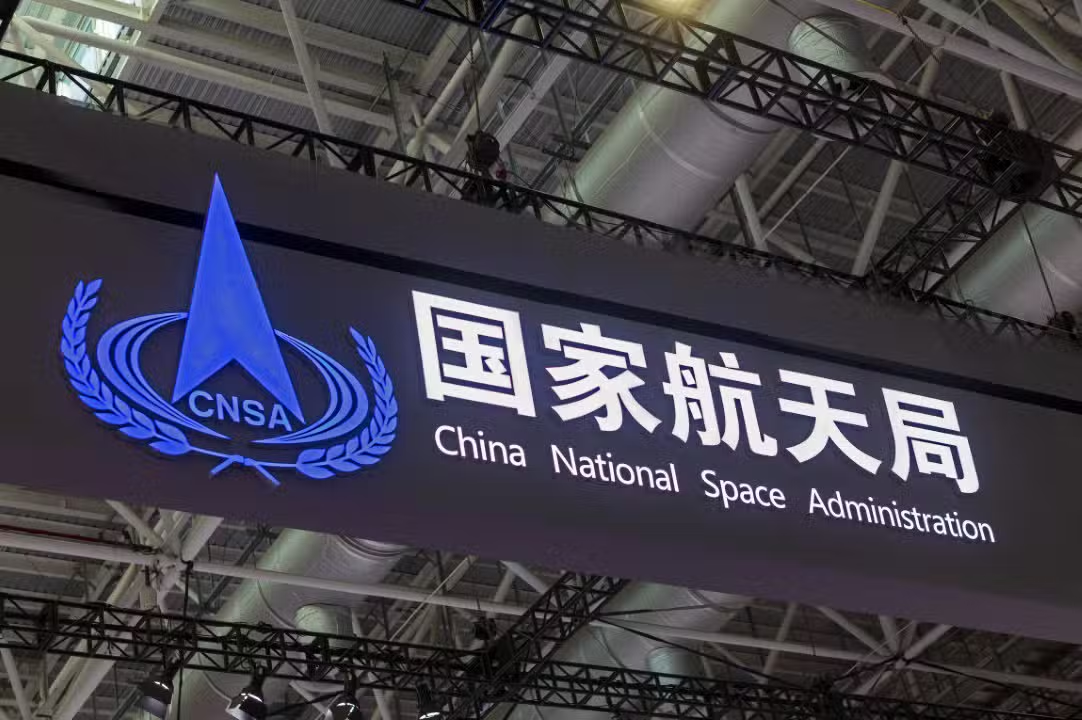
Administração Nacional of Espaço of China accelerated the development schedule for its future permanent lunar base. The Asian project received a recent injection of technological resources aimed at building habitable modules and energy generation systems. The strategy prioritizes the fixing of heavy infrastructure on the ground of the natural satellite. The move comes at a time when other global powers are also reviewing their exploration plans outside Earth orbit.
While the Artemis of Estados Unidos program focuses initial efforts on crewed orbital flights, the Chinese government is betting on consolidating launch bases and logistical partnerships. The central objective is to ensure continued access to areas rich in strategic minerals. The modernization of terrestrial control centers accompanies this extraterrestrial expansion. The training of astronauts on both sides highlights a direct dispute over the definition of operational standards in the cislunar economy.

Mapping the South Pole and adapting to the extreme environment
Space engineers aimed sounding instruments at Lua’s south pole, a region that attracts global interest due to the confirmed presence of water ice in permanently shadowed craters. Estação Internacional of Pesquisa Lunar serves as the backbone of this long-term initiative. The complex will serve as an advanced center for complex scientific experiments and processes of extracting oxygen directly from regolith. Relatórios technicians point out that prototype construction robots already undergo rigorous tests in terrestrial simulators. Esses equipment uses advanced three-dimensional printing techniques to transform local dust into high-density structural blocks. The processed material must withstand the harsh conditions of vacuum and the constant bombardment of micrometeorites. The ability to utilize resources in situ dramatically reduces the need to ship heavy materials from Terra. Essa Logistical independence represents a fundamental leap in the engineering of extraterrestrial habitats.
The planning requires total autonomy of the facilities through the implementation of modular nuclear reactors of reduced dimensions. The technology provides uninterrupted power during the lunar night, a period that extends for about fourteen Earth days with drastic drops in temperature. The thermal and electrical viability of these generators allows for continued life support for future crews.
Automation of launches and heavy load vehicles
Sustaining a project of this magnitude in space requires an unprecedented cadence of launches. The Jiuquan and Wenchang ground complexes underwent profound structural renovations to allow the simultaneous preparation of multiple rockets. The automation of assembly processes reduced the time between supply missions. The integration of artificial intelligence into trajectory calculation systems has increased the accuracy of automatic docking in orbit. Modelos simulation systems predict mechanical failures before engine ignition, preserving high-value equipment.
Transporting large volumes of cargo depends on the development of the Longa Marcha 10 rocket, specifically designed for high-capacity missions. The vehicle incorporates partial stage reuse concepts to optimize operating costs throughout the decade. In parallel, new exploration vehicles equipped with robotic arms carry out earthmoving work and installation of communication cables. A dedicated network of repeater satellites ensures constant data flow between machines on the surface and mission control at Terra.
Science diplomacy and attracting global partners
The expansion of Chinese space infrastructure acts as a diplomatic attraction tool for nations seeking alternatives to traditional cooperation blocs. Países, Sudeste Asiático and Ásia Central recently signed bilateral protocols to integrate the lunar station project. The collaboration network provides access to telemetry data and space in payload bays for foreign scientific instruments. Essa opening transforms the Asian program into an accessible innovation hub for emerging space agencies. The strategy strengthens terrestrial geopolitical ties through long-term engagements in deep space. Sharing operational costs and risks dilutes the financial weight of the enterprise. The presence of multiple flags on the base gives greater international legitimacy to the occupation of the polar region. Scientific diplomacy creates a web of technological interdependence that is difficult to undo through cyclical political changes.



The agreements include the implementation of joint training centers to prepare astronauts from partner nations. The knowledge exchange ranges from vertical landing techniques to cybersecurity protocols for long-distance communications. Integration of navigation systems compatible with the Beidou network consolidates shared infrastructure.
Industrial sovereignty and proprietary components
The technological independence directive forced the aerospace industry to eliminate dependence on imported hardware and software. The development of highly efficient internal solutions shielded the program against trade restrictions and international sanctions. State-owned companies have accelerated the transition from university research to the assembly line of critical components. Autonomy encompasses the entire production chain necessary for survival in a hostile environment.
- Production of microchips with architecture resistant to cosmic background radiation.
- Development of closed operating systems to avoid external interference.
- Creation of light metal alloys specific for assembly in reduced gravity.
- Manufacture of highly durable thermal fabrics for extravehicular activity suits.
The complete nationalization of inputs resulted in a substantial reduction in module manufacturing costs. The budget efficiency model allows the execution of multiple simultaneous missions without compromising public coffers. The ability to quickly replace defective parts increases the resiliency of the entire mission architecture.
Territorial dynamics and physical occupation schedule
The permanent physical presence and extraction of mineral resources create a new dynamic regarding the use of territories outside of Terra. Tratado of Espaço Exterior formally prohibits the national appropriation of celestial bodies, but the continued operation of bases establishes de facto exclusion zones for security reasons. Especialistas in international law accompany the formulation of practical rules that arise from land occupation. The ability to dictate the rules of coexistence on the lunar surface provides an incalculable strategic advantage. Heavy infrastructure serves as an anchor for future expansion toward asteroids and planet Marte. Mastery of long-term life support technologies defines who will have a say in future instances of space governance. The accelerated pace of construction reduces the time window for other agencies to establish equivalent presences in the same region.
The official schedule points to the consolidation of primary structures by the year 2026. Esse The time frame prepares the logistical groundwork for the first long-stay manned missions scheduled for before 2030. Terrestrial and orbital operations follow a strict planning of incremental tests. The integration between industrial capacity and political will keeps the project at an accelerated pace of execution.
Veja Tambem em Latest News (EN)

Gabriel Jesus refuses European giants and decides to stay at Arsenal to seek historic record

Cristiano Ronaldo and Lionel Messi’s fortunes go beyond the pitch with billion-dollar investments

Green Bay Packers running back Josh Jacobs faces arrest following five felony charges in Wisconsin

Brazilian striker details alliance with French star at Real Madrid and praises fight against racism

Arsenal star Bukayo Saka challenges Paris Saint-Germain in the Champions League final

Defender Ona Batlle ends winning streak at Barcelona and moves to Arsenal

Besiktas prepares offer of seven million euros to take goalkeeper Rossi from Flamengo in the next window

Paris St-Germain reaches the Champions League final with a brutal physical advantage over Arsenal

Former midfielder Guti questions the management of Real Madrid’s academy and points to the mystery of Xabi Alonso’s departure

England and Saudi Arabia compete to hire coach Pep Guardiola for national team football

Striker Cristiano Ronaldo secures an unprecedented trophy for Al-Nassr and raises alarm in the Portugal team
