
Celestial body 3I/ATLAS intrigues scientists with anomalies on its way out of the Solar System

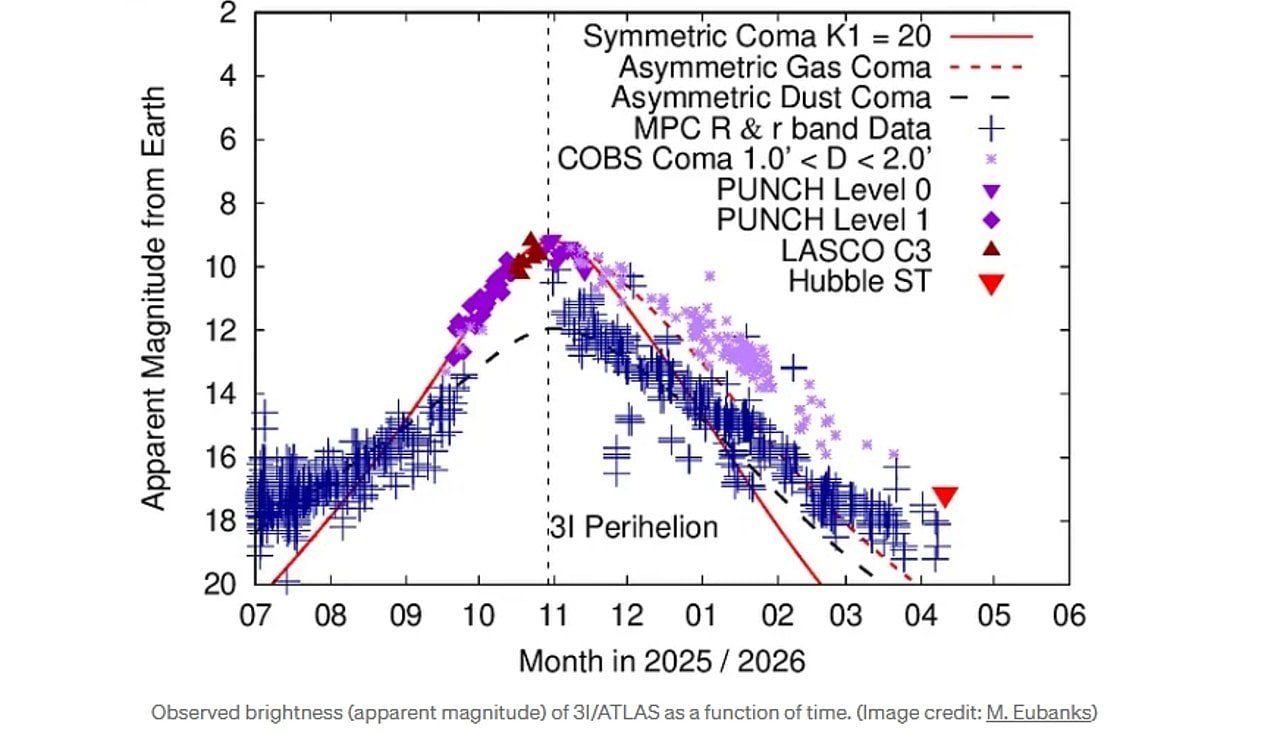
The interstellar celestial body 3I/ATLAS reached the mark of one billion kilometers away from Terra. The space visitor surpassed the orbit of Júpiter and continues its uninterrupted journey towards deep space. Recent Imagens captures by Telescópio Espacial Hubble, dated April 10, 2026, show the element as a fuzzy spot in the dark. The astronomical community is constantly monitoring the exit route. The brightness of the element remains surprisingly high even as the Sol is phased out.
The high luminosity occurs due to the intense release of dust and excess outgassing accumulated during the solar approach. Cientistas are now awaiting the complete release of data collected by the Juno probe, operated by the American space agency. The equipment recorded crucial information on March 16, 2026. Naquela specific date, the space body reached its minimum distance from the gas giant planet. The information processed so far reveals physical and chemical characteristics that completely deviate from the standards known by modern science.
Composição chemistry displays unexpected isotope levels
The material structure of the space visitor generates intense debates in the world’s main research centers. The detectors recorded a proportion of deuterium much higher than the cosmic average. The hydrogen isotope appeared at levels a thousand times higher in the composition of water and thirty times higher in methane. Esses numbers significantly surpass any previous record made in comets or meteorites from our planetary system. The difference reaches three orders of magnitude when compared to the methane found in the atmospheres of other planets.
The researchers also identified unusual relationships in the isotopes of carbon monoxide and dioxide. The abundant presence of organic molecules in the gas phase after perihelion caught the attention of spectral analysis teams. Methanol and methane have survived a billion-year journey through outer space. Essa physical strength requires that the compounds are protected under a dense, thick layer of rock material. The late detection of methane, while other gases appeared earlier, suggests a very complex layered structural formation.
Trajetória and orbital alignment defy mathematical models
The route taken by the element presents a rare geometry. The celestial body adopted a retrograde trajectory perfectly aligned with the orbital plane of the solar planets. The probability of a natural event occurring in this way reaches just 0.2%. The Via Láctea disk has a 60 degree misalignment in relation to the ecliptic. Essa mathematical coincidence raises profound questions about the dynamics of the element entering our spatial neighborhood. Scientists are looking for answers.
The arrival time also coincided with passages very close to Marte and Júpiter, optimizing the route. The closest approach to the gas giant occurred at exactly 53.6 million kilometers. The number is extremely close to the planet’s Hill radius, scientifically established at 53.5 million kilometers. The element’s axis of rotation arrived at the system with an alignment of 8 degrees in relation to the solar direction. The stability of this axis kept the lighting and surface temperature constant throughout the trip.
Emissão of symmetric gases and jets captured by Hubble
The space telescope’s high-precision lenses recorded complex physical phenomena around the nucleus. The element formed a directional anti-tail pointed towards Sol before it even reached perihelion. The collimated jet of particles extended hundreds of thousands of kilometers into the vacuum of space. Nenhum comet cataloged by science presented a similar natural structure towards the central star. The formation maintained its intact and prominent structure both before and after the closest approach to the star.
Thorough processing of images captured between November 2025 and February 2026 revealed new structural details. Technicians applied the Larson-Sekanina filter with the aim of removing the symmetrical circular glow around the main core. The digital procedure exposed three mini-jets symmetrically separated by 120 degrees from each other. The formation suggests a mechanism for stabilizing the three-dimensional movement of the object. The massive core’s travel speed far exceeds that of other previously documented interstellar visitors, such as Oumuamua.
Características singular physics and theories of origin
The astrophysics team led by Professor Avi Loeb of Universidade of Harvard analyzes discrepancies in the celestial body’s mass budget. The calculated diameter and source population density exceed the limits of mass reservoirs in planetary disks of ancient stars. The overabundance of nickel relative to iron in the gas plume adds an extra factor of complexity to chemical studies. The set of anomalies moves the element away from traditional astronomy classifications and encourages debates about technological signatures.
Official records point to specific behaviors that differentiate the visitor from any other celestial body already monitored by terrestrial and space observatories over the last few decades:
- The element showed extreme negative polarization, an unprecedented and unprecedented physical behavior among all comets already catalogued.
- The increase in brightness near perihelion occurred at record speed and with a much bluer color than that of Sol itself.
- The direction of arrival almost perfectly matches the origin of the famous Wow radio signal, with a probability of just 0.6%.
Uninterrupted data collection continues as the celestial body advances to the outer limits of the planetary system. Large telescopes keep tight tracking of the declining light curve. The absence of artificial light confirmed so far directs studies towards long-range thermal and spectral analysis. Cross-referencing information from the Juno probe with orbital images will provide the definitive basis for future scientific articles on the case.





