
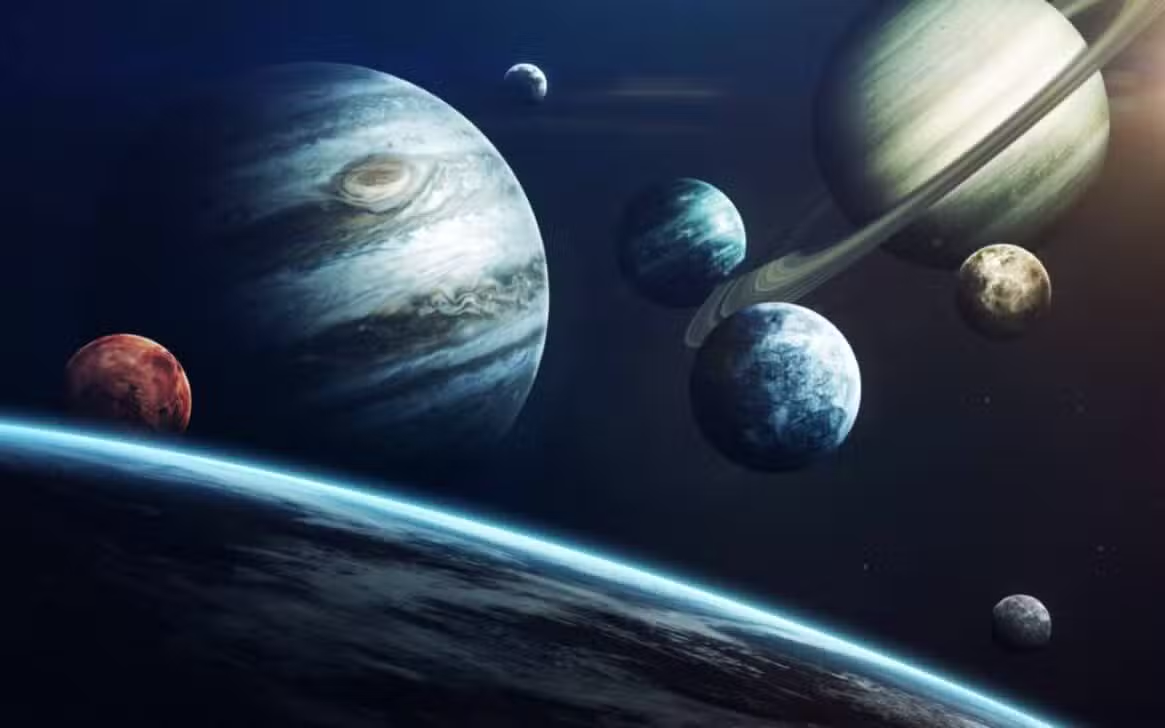
Pesquisadores have developed a new strategy for searching for life outside of Terra that ignores isolated analysis of individual worlds. The technique relies on the simultaneous observation of multiple exoplanets to identify anomalous statistical patterns. The method does not require prior knowledge about alien biology. The central premise establishes that living organisms gradually modify the environments in which they live.
The detailed study on this innovative approach was published in the April 15, 2026 issue of The Astrophysical Journal magazine. The work uses complex computer simulations to test how biological activity can spread through space. Cientistas seek to overcome frequent errors generated by natural geological processes. The new metric prioritizes accuracy in selecting targets for future space telescopes.
Foco on agnostic biosignatures reduces false positives
The research introduces the concept of agnostic biosignatures into contemporary space exploration. Essa strand of study does not require exact definitions of the metabolic functioning of possible organisms. The traditional search focuses on detecting specific gases in the atmosphere. The new model only assumes that life tends to expand between nearby planets and changes chemical conditions in a measurable way.
Harrison B. Smith, Earth-Life Scientist Science Institute of Science Tokyo, led the development of the research. Lana Sinapayen, researcher of National Institute for Basic Biology, served as co-author of the project. Experts argue that life forms completely different from terrestrial biology would still leave traces on a large scale. Ongoing biological activity transforms the planet in ways that pure geology cannot replicate.
Reliance on single signals often results in misinterpretations when analyzing astronomical data. Processos Volcanics or photochemical reactions can generate methane and oxygen without any presence of living beings. The statistical method attempts to mitigate this confusion. Spatial cluster analysis provides an extra layer of verification before targeting expensive observation resources.
Simulações map biological propagation in stellar systems
The team of astrobiologists used an agent-based model to simulate the spread of life across entire stellar systems. The results demonstrated the emergence of quantifiable connections between the spatial position of the planets and their atmospheric characteristics. Active biology creates clusters of worlds with similar properties. The phenomenon occurs even when the individual signals of each star remain weak or ambiguous.
The mechanism for transferring biological material between neighboring celestial bodies underlies part of the theory. Researchers have established clear parameters for how these environmental changes manifest on a planetary scale:
- Spread occurs through physical processes such as panspermia.
- Induced climate change resembles natural terraforming processes.
- Padrões mathematicians emerge in the absence of definitive chemical detections.
- The strategy prioritizes the drastic reduction of abiotic false positives.
Grouping exoplanets based on spatial proximity and chemical similarity guides the next phases of exploration. State-of-the-art Telescópios have extremely limited observation time. The rigorous selection of promising targets optimizes the use of this billion-dollar equipment. The technique does not replace traditional spectroscopy. Ela acts as a highly efficient preliminary filter.
Limitações of traditional approaches in astrobiology
Conventional searches for biosignatures face significant technological and conceptual obstacles. The exclusive dependence on atmospheric composition generates endless debates in the scientific community about the origin of the detected gases. A rocky planet with a high concentration of oxygen could simply be the result of oceans evaporating under intense stellar radiation. Biology is not the only force capable of unbalancing the chemistry of a world.
The search for technosignatures faces even greater challenges due to the assumptions embedded in the methodology. Detecting radio waves or industrial pollution requires the existence of a technologically advanced civilization. Essa premise adds a layer of deep uncertainty to the search process. The vast majority of life in the universe may be made up of just simple microorganisms.
Shifting the analytical focus to the population level of planets resolves part of this methodological impasse. Técnicas statistics applied to large catalogs of exoplanets can highlight anomalies that escape isolated observation. The network of interactions between neighboring worlds tells a richer story than analyzing a single point of light. Modern astrobiology is moving towards a systemic view of the galaxy.
Necessidade of detailed catalogs about lifeless worlds
The practical application of the new statistical method depends on a deep understanding of the natural diversity of dead planets. Variações in atmospheric composition and surface temperature serve as a baseline for identifying biological biases. Scientists need to know exactly how a barren star system behaves. The contrast between abiotic chemistry and biological anomaly validates the discovery.
Current climate models already capture a fraction of this vast planetary diversity. The authors of the study published in The Astrophysical Journal recommend the inclusion of more realistic simulations of galactic evolution. Dados details about the formation of planetary systems strengthen the algorithm’s detection ability. Separating purely physical variations from biological patterns requires absolute mathematical precision.
The evolution of exoplanet catalogs in the coming years will provide the volume of data necessary to test the theory in practice. The universe is home to billions of worlds with unique geological characteristics. The research consolidates an important step towards methods that consider the large-scale impacts of life in the cosmos. The measurable interconnection between multiple planets redefines search protocols for inhabitants outside the solar system.