Interstellar comet 3I/ATLAS reveals 12 anomalies that defy natural explanations
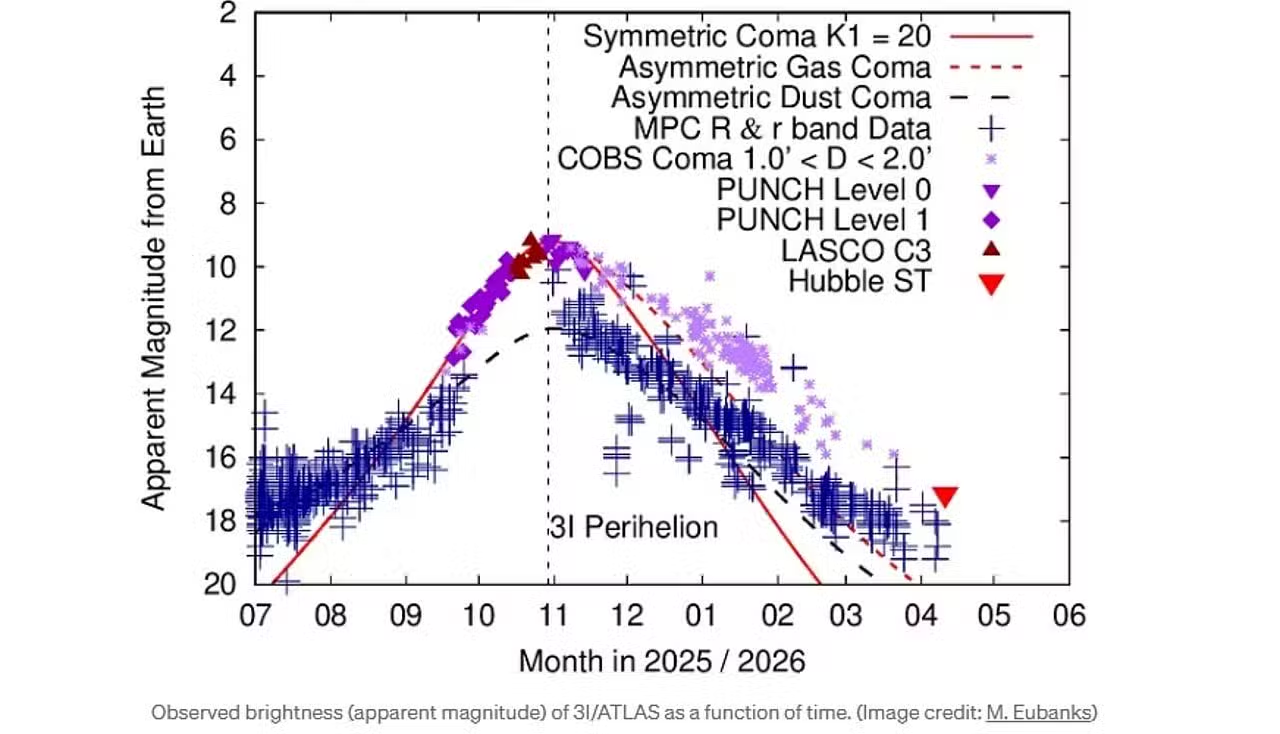
Interstellar object 3I/ATLAS continues to intrigue the scientific community as it moves away from Sistema Solar. Atualmente one billion kilometers from Terra, the celestial body has already surpassed the orbit of Júpiter and is following its return trajectory to interstellar space. Recent Observações images from April 10, 2026, capture the object as a fuzzy dot in images that reveal unprecedented phenomena. Seu brightness remains high during separation, a phenomenon attributed to excessive outgassing and dust release in the vicinity of Sol. NASA’s Juno probe collected crucial data on March 16, 2026, when 3I/ATLAS reached its closest proximity to Júpiter.
Composição chemistry with anomalous proportions
Analysis of the composition of 3I/ATLAS revealed features that deviate significantly from known patterns on celestial bodies. The proportion of deuterium, an isotope of hydrogen, was detected at levels a thousand times higher than the average cosmic abundance in water and thirty times higher in methane, surpassing values found in comets and meteorites from Sistema Solar.
The 12C/13C isotope ratios for carbon dioxide and carbon monoxide also exceed typical observed values. The abundance of organic molecules in the gas phase, such as methanol and methane, after perihelion intrigues researchers. Survival of these molecules during a billion-year interstellar journey would require them to be buried beneath a thick layer of material, suggesting an unusual layered composition or even a biological origin.
- Deutério at levels a thousand times above the cosmic average in water.
- Metano thirty times more abundant than the standard in comets.
- Superabundância of nickel in relation to iron, characteristic of aerospace industrial alloys.
- Organic Moléculas detected after perihelion, functioning as biomarkers.
Trajetória with probability of just 0.2%
The trajectory of 3I/ATLAS presents a geometry that generated great surprise among scientists. The object followed a retrograde trajectory, aligned with the orbital plane of Sistema Solar’s planets, with a probability of just 0.2%. Via Láctea’s disk is misaligned by approximately 60 degrees relative to the ecliptic, making this coincidence extraordinarily rare.
The object’s arrival time appeared to be adjusted to optimize its passages close to other celestial bodies. Ele reached minimum distances of 29 and 54 million kilometers from Marte and Júpiter, respectively. The perijove distance, Júpiter’s closest approach on March 16, 2026, was 53.6 million kilometers, very close to Hill’s radius of Júpiter, which is 53.5 million kilometers. The alignment of the 3I/ATLAS rotation axis is also remarkable, with only a 0.5% probability of occurring by chance.
Fenômenos of unprecedented gas and dust
Telescópio Espacial Hubble images have revealed complex phenomena that defy conventional explanations for comets. The object’s anti-tail, observed before perihelion, appeared to be a collimated jet toward Sol, about ten times longer than it was wide. Essa feature is similar to the collimation seen in images after perihelion, with the jet extending hundreds of thousands of kilometers.



A system of symmetrical jets was identified in dozens of images of Hubble, captured between November 2025 and February 2026. Processadas through the Larson-Sekanina filter, these images revealed three symmetrical mini-jets separated by 120 degrees from each other. Tal symmetry is associated with technological thrusters, possibly used to stabilize the three-dimensional movement of the object. 3I/ATLAS also exhibited extreme negative polarization, unprecedented for all known comets.
Características physics and mysterious origin
The 3I/ATLAS stands out for its notable physical characteristics. Seu nucleus is more massive than that of 1I/Oumuamua and 2I/Borisov, other interstellar objects already observed, and moves at a higher speed. Próximo at perihelion, the object shone faster than any known comet and presented a bluer color than Sol, which could indicate artificial lights or charging of a technological device using sunlight.
The arrival direction of 3I/ATLAS coincides, within 9 degrees, with the origin of the famous “Wow!” radio signal, with a probability of just 0.6%. Essa coincidence raises questions about possible common origin. The multiple anomalies suggested by Professor Avi Loeb, Universidade and Harvard’s team defy purely natural explanations. The possibility that 3I/ATLAS is a “Horse of Troia”, a natural comet that was used by a technological civilization to navigate to the habitable zone of Sistema Solar, remains among the most daring theories. The object remains one of the greatest enigmas in modern astronomy, with continued observations essential to unraveling its true nature.
See Also em Latest News (EN)

PlayStation Plus May 2026 brings EA Sports FC 26, Wuchang Fallen Feathers and Nine Sols
30/04/2026
EA Sports FC 26 arrives on PlayStation Plus along with Wuchang Fallen Feathers
30/04/2026
Copy Fail vulnerability allows escalation to root on Linux distributions
30/04/2026
Capcom’s space adventure arrives in April 2026 with versions for new generation and Switch 2
30/04/2026
Nintendo defines launch of new generation of console with complete recreation of classic Zelda
30/04/2026
Creators confirm destruction of original dolls used to promote the classic Star Fox
30/04/2026
Epic Games platform consolidates catalog with twelve free games to attract audiences on PC
30/04/2026
Capcom leak confirms release of Resident Evil Code: Veronica remake for 2027
30/04/2026
Android from the game Pragmata comes to life as a virtual influencer in an unprecedented action from Capcom
30/04/2026
EV dealership: Automakers could lose billions with the return of 800,000 used electric vehicles to the market by 2028
30/04/2026
Yoshi franchise gets new game in 2026 focusing on biological research and magical book exploration
30/04/2026