Interstellar visitor 3I/Atlas surprises scientists with extreme speed as it crosses the solar system

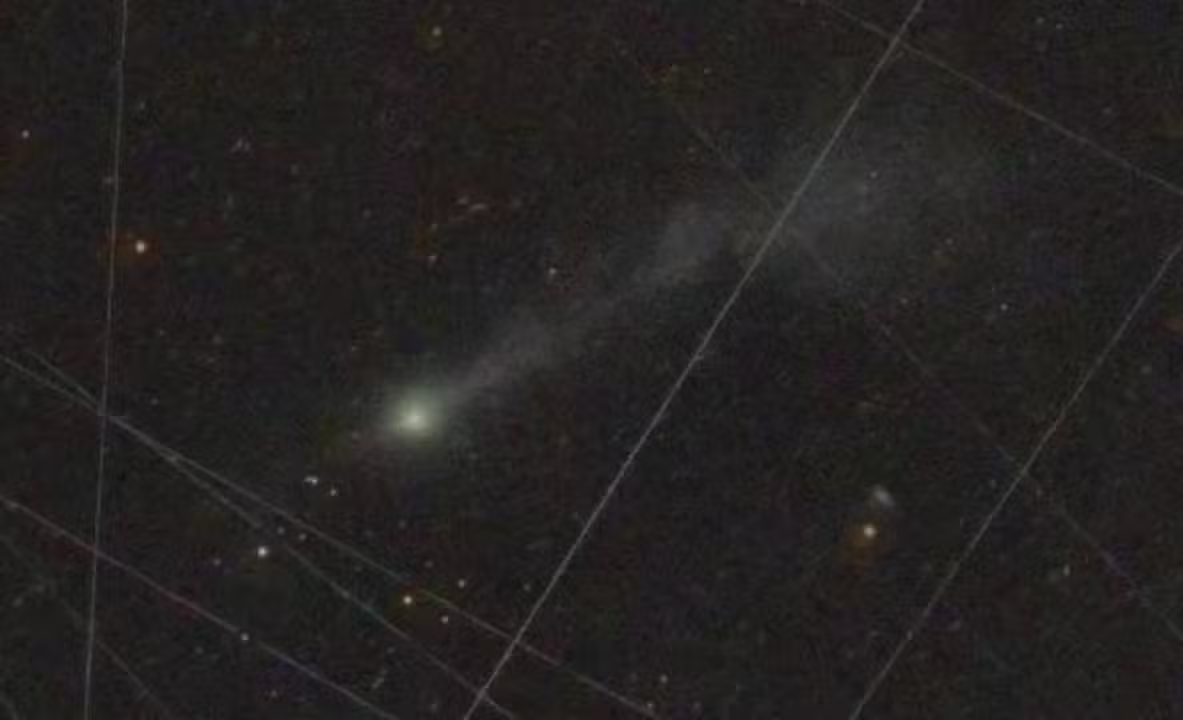
A celestial body from outside the solar system crosses the vicinity of Terra on an unprecedented journey. Comet 3I/Atlas travels at 57 kilometers per second, setting a new speed record among interstellar objects ever observed. The space rock follows a hyperbolic trajectory that prevents its capture by solar gravity, ensuring that this will be its only passage through the region. Astrônomos from different continents monitor the phenomenon with maximum attention. The event represents a historic milestone in understanding the formation of worlds in other regions of the galaxy.
The passage offers a rare opportunity to study materials preserved from the formation of the early universe. The comet carries chemical elements that originated in a distant molecular cloud, long before the solar system existed. The closest approach with Sol acted like a gravitational slingshot, further accelerating the rock towards deep space. Especialistas prepare batteries of tests to decipher the secrets hidden in the cosmic dust before the visitor completely disappears from Earth’s range.
Descoberta on Chile and confirmation of hyperbolic orbit
The official detection of the distant visitor occurred on July 1, 2025, when the ATLAS project telescope system, installed in the mountains of Chile, captured a faint glow in the night sky. The research team immediately noticed an unusual movement pattern that did not correspond to the traditional elliptical paths of local asteroids. Confirmation of the external origin came after weeks of complex orbital calculations carried out by international astrophysics centers.
Buscas in image files revealed that the celestial body was already present in previous records. The TESS satellite, operated by North American space agencies, had photographed the comet’s activity in May 2025. The retrospective analysis made it possible to calculate the eccentricity of the orbit with absolute precision, confirming the hyperbolic nature of the trajectory. Isso means the object will pay just one visit before disappearing into cosmic darkness forever.
The perihelion, the point of closest proximity to Sol, occurred at the end of October 2025. The intense radiation heated the frozen surface of the nucleus abruptly, generating a vast cloud of gas and dust around the rock. The luminous tail stretched millions of kilometers into dark space. Observatórios on land recorded the visual spectacle with high-resolution photographic equipment.
Composição chemistry reveals age before the solar system itself
Spectroscopic measurements have brought surprises to the scientific community. The comet’s solid nucleus has an estimated diameter of between 320 meters and 5.6 kilometers. The most striking characteristic is the strong emission of greenish light, resulting from the abundant presence of diatomic carbon in its internal structure. The substance reacts violently when exposed to solar ultraviolet radiation during approach.



The most striking piece of information concerns the estimated age of the solo traveler. Modelos physicists suggest that the space rock could be up to 7 billion years old, far exceeding the age of the Earth’s planetary system. The object’s formation occurred in a distant molecular cloud, long before Terra existed. The ice and dust contained in the core function as a perfectly intact time capsule, preserving chemical elements from the galaxy’s earliest era.
Comparativo with previous interstellar visitors
The arrival of 3I/Atlas consolidates a new era in global astronomical observation. Humanity now has a growing catalog of visitors from other stars, each displaying unique characteristics that challenge established theories. Comparing them helps to map the chemical diversity of the galaxy and understand how habitable worlds form in other constellations. Scientists organize the data into three fundamental landmarks of contemporary astronomy:
- Object 1I/Oumuamua opened the list with its elongated shape and speed of 26 kilometers per second, without a visible tail.
- Comet 2I/Borisov crossed the system at 33 kilometers per second, exhibiting a reddish color and a high concentration of carbon monoxide.
- The current 3I/Atlas breaks records by reaching 57 kilometers per second, standing out for its intense green color and core rich in organic compounds.
The joint analysis of the three celestial bodies indicates that the ejection of planetary material is a common process in the universe. Sistemas forming stars often fling trillions of fragments of ice and rock into interstellar space. Most travel through the void for billions of years without encountering any stars along the way, making passage through solar territory a statistically unlikely event.
Trajetória future and observations planned for 2026
The astronomical calendar predicts crucial times for collecting additional information. The closest approach to Terra occurred on December 19, 2025, when the comet passed at a safe distance of 27 million kilometers. From that point, the object began its long journey back to the extreme cold of deep space.
The flight schedule indicates that 3I/Atlas will cross Júpiter’s orbit in March 2026. The increasing distance will make observation increasingly difficult for amateur telescopes, but Telescópio Espacial James Webb will take the lead in capturing data during this critical phase. The equipment’s infrared sensors will attempt to read the thermal signature of waste gases and identify water molecules and rare organic compounds. The definitive farewell to the solar system is projected for mid-2027, when the comet will surpass the boundary of Sol’s magnetic influence and dive back into the interstellar medium. Astronomers will spend the next few decades analyzing the data collected during this brief visit, rewriting the astrophysics textbooks with the discoveries of the ancient cosmic traveler.
See Also em Latest News (EN)

Arc Raiders revamps Trials system in Season 4 with more accessible progression
28/04/2026
ChatGPT Images 2.0 arrives with visual reasoning and improved text generation
28/04/2026
New DRM limits digital games on PlayStation 5 without regular connection
28/04/2026
Reports indicate changes to PlayStation digital licenses with checks every 30 days
28/04/2026
German research reveals that beer provides relevant levels of vitamin B6
28/04/2026
Users notice connection requirement every 30 days in PS5 digital titles
28/04/2026
GTA 6 gains realistic pursuit system with real-time search area
28/04/2026
Astronomers prepare to observe the longest solar eclipse on land in the 21st century
28/04/2026
Baby born on Delta flight minutes before landing in Portland
28/04/2026
Samsung releases AI assistant to filter calls on Galaxy S25 with One UI 8.5
28/04/2026
Samsung begins distribution of stable One UI 8.5 for Galaxy S25 in South Korea
28/04/2026