

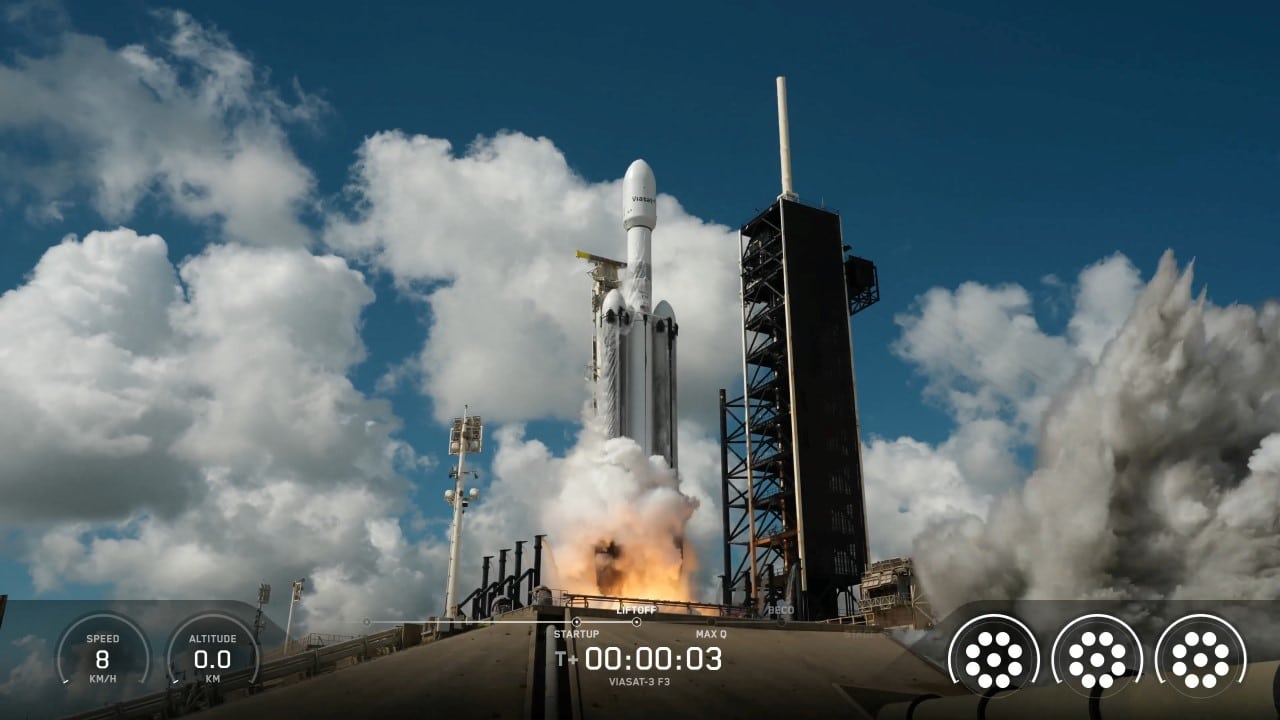
A SpaceX Falcon Heavy rocket blasted off from Flórida on Wednesday in a launch that marked the return of the company’s most powerful booster after a months-long hiatus. The mission placed the third ViaSat-3 internet satellite into orbit, part of a global fleet of high-speed broadband relay stations. The flight also demonstrated the company’s precision by recovering two of its side thrusters in simultaneous landings on separate platforms.
The launch took place at 10:13 am EDT from historic platform 39A on Centro Espacial Kennedy. Impulsionado by 27 Merlin engines distributed in three first stage boosters, Falcon Heavy roared from Flórida offering a dazzling spectacle to locals and tourists from Costa Espacial. Dois minutes and 25 seconds after liftoff, the side thrusters separated and returned to Cabo Canaveral. The core stage, on its first and only flight, burned all of its fuel as planned and crashed into Oceano Atlântico.
Recuperação thruster marks operational accuracy
The two side boosters of the Heavy rocket, both veterans of previous flights, performed precision landings in sequence on the Estação of Força Espacial of Cabo Canaveral. The simultaneous recovery of the thrusters was announced by the competing sonic booms that echoed throughout the region. Câmeras pointed down at the boosters captured images of the rockets moments before landing, while the lower images showed each one as seen from the ground.
Este was the 12th flight of an Falcon Heavy rocket since the booster’s inaugural launch in 2018. The last flight had taken place in October 2024, when SpaceX sent NASA’s Europa probe toward Júpiter. The company has consistently demonstrated its ability to recover and reuse side thrusters, significantly reducing the operating costs of its launches.
ViaSat-3 satellite in geosynchronous orbit
Foram required three upper stage engine ignitions to position the ViaSat-3 Flight 3 satellite into an elliptical orbit. Propulsion aboard the relay station will place the spacecraft in a circular geosynchronous orbit 35,888 kilometers (22,300 miles) above the equator. Once fully operational, the satellite will provide internet access to customers throughout the Ásia and Oceano Pacífico region.
The powerful ViaSat satellites are equipped with huge solar panels that generate 25 kilowatts of power. Capazes can process up to 1 terabyte of data per second, they incorporate the largest satellite dish ever launched on a commercial satellite. The massive reflector will unfold on a 24- to 27-meter-long telescopic rod, based on technology developed for the Telescópio Espacial James Webb and built by a division of Northrop Grumman.
https://twitter.com/SpaceX/status/2049492378499633469?ref_src=twsrc%5Etfw
Estratégia different from global connectivity
ViaSat takes a different approach than the competition by placing larger, more sophisticated satellites in geosynchronous orbit. Diferentemente of low-orbit satellites that constantly rotate and move, geosynchronous satellites rotate in sync with the planet below, appearing stationary in the sky. Isso allows ViaSat to provide global satellite internet access on a hemispheric scale with smaller infrastructure.
In contrast, SpaceX is actively building a constellation of Starlink low-orbit Terra satellites. Essa approach provides internet access by routing user data to satellites that pass overhead, which relay the signals to ground stations. Até To date, the company has launched nearly 12,000 Starlink satellites in nearly 400 launches over the past seven years.
Blue Origin is also building a planned constellation of about 3,200 low-orbit broadband satellites, with 270 already launched. Amazon’s satellites will eventually compete directly with SpaceX’s Starlinks. Essa proliferation of satellite systems marks a fundamental transformation in the global telecommunications sector.
Histórico Challenges and Program Success
The first ViaSat-3 satellite was launched in May 2023, but faced a critical technical problem. The antenna did not unfold properly, and the spacecraft was only able to achieve about 10% of its designed capacity of 1 terabyte of processing per second. A second ViaSat-3 satellite was launched aboard an Atlas 5 rocket from United Launch Alliance in November last year to provide service across América.
ViaSat, based at Califórnia, built the relay station’s communications equipment. Boeing provided the satellite that carries the equipment. The first ViaSat satellite will be positioned in orbit, allowing limited coverage of Europa and África. Essa strategic deployment of three geosynchronous satellites will position the fleet to cover virtually all terrestrial regions.
Dave Abrahamian, vice president of Sistemas of Satélite at ViaSat, reflected on the program in statements to Spaceflight Now. “It’s like the end of an era. Estamos has been working on this program for over 10 years,” he said. “So a good portion of the program’s lifespan has passed.”
Transformação of the satellite internet market
Abrahamian noted that the world has changed significantly since the start of the ViaSat-3 program. “At that time, we only had a few satellites in orbit. Desde so, we launched the two ViaSat-3, we fused with Inmarsat and we already have the third ready to be launched”, he said. “It’s a completely different world, a different feeling, and it’s really cool to have been a part of it all.”
The satellite communications industry now faces intense competition between different technologies and providers. Enquanto SpaceX dominates the low orbit segment with the Starlink, ViaSat offers an alternative based on more powerful geosynchronous satellites. Essa diversity of approaches benefits consumers and companies seeking connectivity in remote and difficult-to-access regions.
The successful launch of the ViaSat-3 Flight 3 consolidates ViaSat’s position as a global satellite internet provider and demonstrates the reliability of the Falcon Heavy rocket as a means of placing heavy payloads into high orbit.