

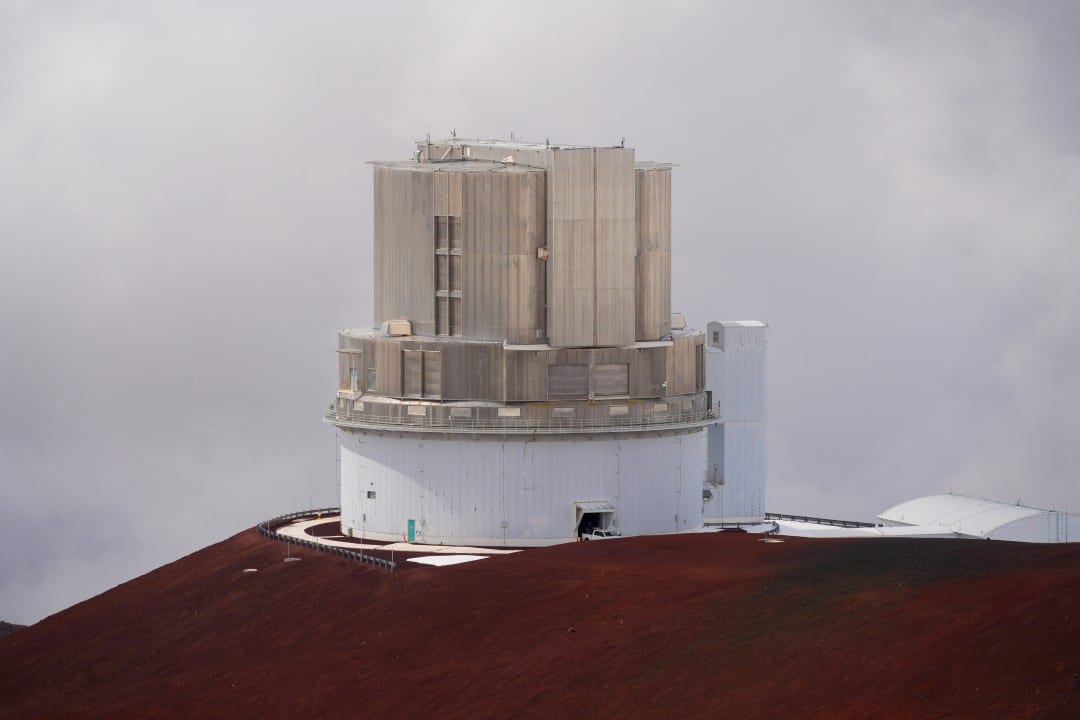
The interstellar comet 3I/ATLAS passed through the closest point to Sol in October 2025. Later Observações with Telescópio Subaru, in Havaí, recorded a change in the composition of the coma, the gas cloud that surrounds the nucleus. The ratio of carbon dioxide to water has decreased relative to measurements taken before perihelion.
Astrônomos led by Yoshiharu Shinnaka of Universidade Kyoto Sangyo analyzed the object on January 7, 2026. The result contrasts with data collected in August 2025 by space telescopes. Naquela occasion, the coma was very rich in CO₂. Agora, the CO₂/H₂O ratio appears lower, although still above the Sistema Solar comet average.
Mudança observed after perihelion
Comet 3I/ATLAS was discovered in July 2025. Ele travels on a hyperbolic trajectory and is expected to leave Sistema Solar forever. Antes from the closest pass to Sol, instruments such as James Webb indicated high carbon dioxide emission compared to water vapor.
Após perihelion, which occurred on October 29, 2025, the Japanese team used Subaru to measure the gases again. The method was based on prohibited atomic oxygen emission lines, which serve as a reference for estimating water production. The proportion of CO₂ fell significantly.
Essa variation did not occur randomly. Solar heating appears to have exposed different layers of the core.
- Surface Camadas, rich in CO₂ and carbon monoxide, dominated the initial activity.
- Deeper Material, with greater presence of water ice, contributed more after perihelion.
- The change is consistent with radial heterogeneity within the comet’s interior.
The object also developed unusual behaviors, such as an anti-tail at times. Ele differs from local comets in several aspects.
Internal Estrutura suggested by data
Astrônomos consider that the comet is not uniform. The surface, exposed for billions of years to interstellar radiation, may have accumulated a crust with altered composition. Cosmic Raios could have converted some of the carbon monoxide to carbon dioxide over time.
Quando the comet approached Sol, the heat removed the most volatile outer layer first. Depois, gases from the interior began to escape. Essa sequence explains the observed reduction in the CO₂/H₂O ratio.
The ratio measured in January 2026 is close to that recorded in the second known interstellar visitor, 2I/Borisov. Ainda thus remains elevated compared to most comets originating from our Sistema Solar.
The study accepted for publication in The Astronomical Journal reinforces the idea that interstellar objects carry unique records of planetary formation in other stellar systems.

Comparação with comets from Sistema Solar
Cometas formed close to Sol lose volatiles more easily over multiple passes. Já visitors like 3I/ATLAS preserve primordial material from its place of origin.
The initial high concentration of CO₂ suggests that the comet formed in a cold region where carbon dioxide ice naturally separates. Exposição prolonged galactic radiation may have further modified the surface.
Future Observações at different heliocentric distances will help refine the models. Astrônomos plan to combine spectroscopic data with thermophysical simulations.
The Telescópio Subaru, installed on the Observatório Mauna Kea, made it possible to capture details of the coma even after the comet had moved away. Imagens registered in December 2025 already showed the active object.
Implicações for studies of interstellar objects
Detection of chemical changes paves the way to directly compare comets internal and external to Sistema Solar. Técnicas developed for local comets now applies to these rare visitors.
With the increase in survey telescopes, more interstellar objects are expected to be discovered in the coming years. Cada one offers clues about the diversity of planetary systems in Via Láctea.
The 3I/ATLAS continues on the escape route. Ele has already passed through Júpiter’s region and continues to accelerate outward.
The analysis of volatile composition contributes to understanding processes that led to the formation of planetesimals and planets in different stellar environments.