

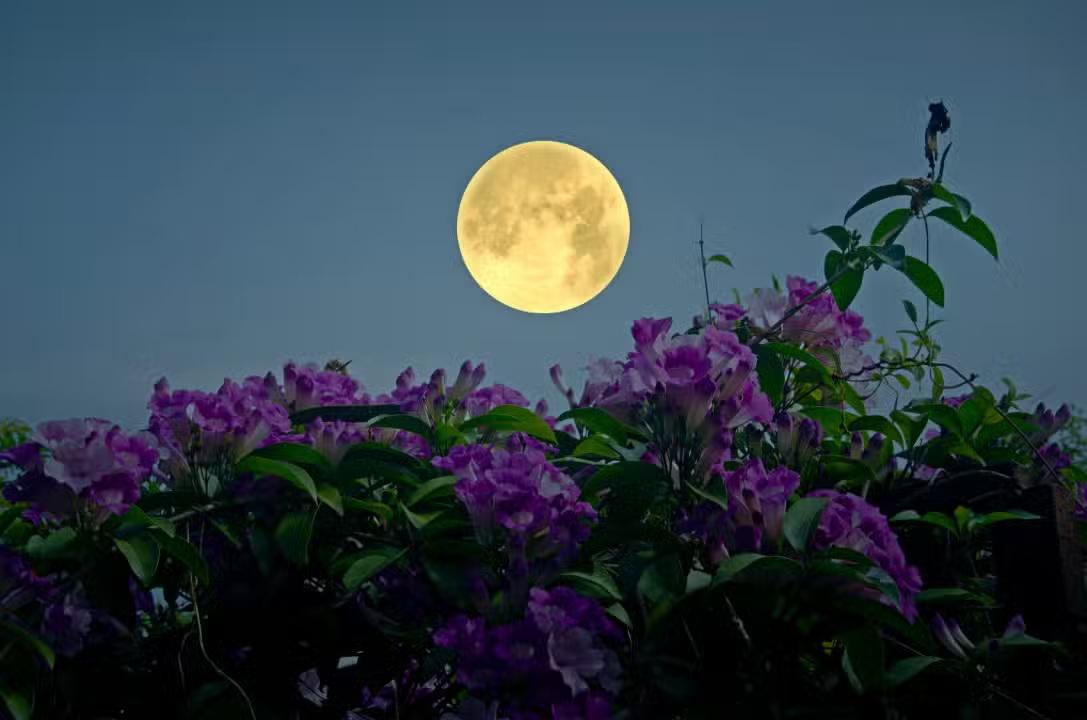
2026 Maio marks an unusual astronomical event. Duas full moons will light up the Earth’s sky in the same month, a phenomenon that occurs only seven times every nineteen years. The first, known as Lua of Flores, will reach its maximum peak at 1:23 pm ET on Friday, while the second, called the calendar blue moon, will culminate at 4:45 am on May 31. Para observers from the northern hemisphere, the show offers two distinct opportunities to appreciate Lua in its entirety.
Lua of Flores will appear full for three consecutive nights, Thursday, Friday and Saturday, creating an extended window for observation. Noah Petro, scientist on the Artemis III project who intends to return humans to Lua for the first time since 1972, explained that there will be an exact moment when Lua will be full, but twenty-four hours before and twenty-four hours after, to human eyes, it will appear full as well. The favorable positioning will make viewing easier during Friday night, when the satellite will be low in the east at sunset, reach its highest point in the sky around midnight and descend in the west before dawn Saturday.
The first full moon of May marks a series of micromoons
Lua of Flores will begin a sequence of three micromoons, events that occur when the new or full Lua reaches its apogee, its greatest distance from Terra. Durante during this period, the satellite will be 401 thousand and 17 kilometers away, compared to its average distance of 384 thousand and 399 kilometers according to NASA data. Essa difference of approximately 17 thousand kilometers results in a slightly smaller appearance in the sky, contrary to what the term “micromoon” would suggest. The phenomenon represents a decrease in the apparent size of the satellite when observed from Terra.
The series of three micromoons that began in May will continue over the next few months. Essa rare sequence offers unique opportunity for amateur astronomers to track subtle changes in lunar distance over time. The specific dates and characteristics of each micromoon have been documented by observatories and citizen science platforms. The visual impact of these variations remains imperceptible to the casual observer, but represents important data for ongoing lunar studies.

Segunda full moon of the month marks rare calendar phenomenon
The May blue moon occurs when a month begins and ends with a full moon, a situation that happens seven times every nineteen years according to EarthSky records. The term “blue moon” does not indicate a change in the satellite’s color, but originates from a 16th century expression that meant something impossible. In 1883, after the eruption of the volcano Krakatoa in Indonésia, observers reported strangely colored sunsets and sightings of a “blue moon”. Embora Rare, this phenomenon can occur when the Earth’s atmosphere contains dust or smoke particles with a diameter slightly larger than 900 nanometers.
The second full moon of May should not be confused with supermoons. Enquanto supermoons occur at perigee (shortest distance from Terra), micromoons occur at apogee (greatest distance). Essa technical distinction matters to dedicated observers who want to document and photograph these events. The 2026 calendar offers multiple opportunities to track these variations across months.
Origem from the name “Lua das Flores” in indigenous traditions
The nickname “Lua das Flores” comes from the Comanche tribe and represents an appropriate name for the May event. The full moon arrives at a time when wildflowers begin to bloom in much of América and Norte, especially in Grandes Planícies, the region of origin of Comanches. Indigenous tribes, however, use different names for this same full moon, reflecting natural characteristics observed in their respective territories.
The Potawatomi and Shawnee people call this moon Lua from Morango, while the Choctaw and Creek call it Lua from Amora. Essas denominations coincide with periods of ripening and harvesting of strawberries and blackberries in their traditional territories. The Tlingit people call it the “pre-pregnancy moon,” while the moon following in June is appropriately named Lua from Nascimento. Essas traditions demonstrate deep knowledge of natural cycles and their integration with celestial phenomena.
Recomendações practices for optimal observation
Noah Petro recommends that viewers avoid bright streetlights, tall buildings, and trees to get the best view of the full moon. The choice of observation location significantly influences the visual quality of the show. Segundo the scientist, Lua will rise just in time for sunset, requiring initial patience that will be rewarded with spectacular views. Posicionar located in an elevated location, away from urban light pollution, considerably improves the observation experience.
Telescópios and binoculars are not necessary to appreciate the phenomenon, although optical equipment reveals interesting surface details. Fotografar full moon requires specific camera settings, with emphasis on low ISO, moderate aperture and adequate shutter speed. Aplicativos mobile astronomy aids in the exact location and ideal observation timing according to the observer’s geographic position.
Conexão with first full moon and equinoxes
The first full moon of May coincides with Dia of Trabalho at Estados Unidos, a date that marks the midway point between the March equinox and the June solstice. Essa coincidence connects astronomical events with the cultural calendar, illustrating how celestial phenomena have influenced human traditions over the centuries. The March equinox represents the beginning of spring in Hemisfério Norte, while the June solstice marks the beginning of summer.
Essa temporal alignment provides significant context for understanding why diverse indigenous cultures chose nomenclatures based on flowers that bloom during this specific period. The observation of lunar cycles was mixed with agricultural and harvesting activities, creating a lunar calendar system that lasted through generations.
Sequência of remaining full moons in 2026
Após the two full moons in May, observers will have the opportunity to observe seven more full moons in 2026, including the supermoons of November and December. Esse calendar offers variety of astronomical events throughout the year.
- June 29: Strawberry Lua
- July 29: Deer Lua
- August 28: Sturgeon Lua
- September 26: Corn’s Lua
- October 26: Hunter’s Lua
- November 24: Beaver’s Lua
- December 23: Lua cold
The June strawberry Lua should not be confused with the nomenclature Potawatomi and Shawnee. The designations follow traditions of lunar calendars established centuries ago. The November and December supermoons will offer enhanced visual spectacle, with Lua showing increased apparent size in the sky.
Post-Artemis II astronomical Contexto
Lua of May’s Flores represents the first full moon since the Artemis II mission, which took four astronauts on a ten-day journey around the far side of Lua in April. Commander Reid Wiseman, Victor Glover, Christina Koch and Jeremy Hansen, of Agência Espacial Canadense, accomplished a historic feat by executing the first gravity assistance maneuver around Lua in more than fifty years. Eles traveled further into space than any previous human, culminating in Califórnia’s peaceful water landing April 10 off the coast.
The astronauts used the expression “Lua joy” to describe their feelings during the mission, a term that captures the emotion experienced when observing the satellite from a proximity never achieved before. Para terrestrial observers who still feel reverberations from this historic mission, Lua’s observation of Flores offers connection with the experience lived by the crew of Artemis II.
Mesmo From more than 200,000 miles away, skywatchers can appreciate Lua in the same way the crew experienced it during their journey around the satellite. Noah Petro mentions that it is possible to observe features on the western limb of Lua, such as the Aristarco impact crater, which the crew described during their mission. Embora ground observers are a little further away, this shouldn’t stop them from trying to capture some of the emotion the astronauts felt during their historic flight around Lua.