
Is there oil on Mars? Avi Loeb hypothesis gains strength with water history
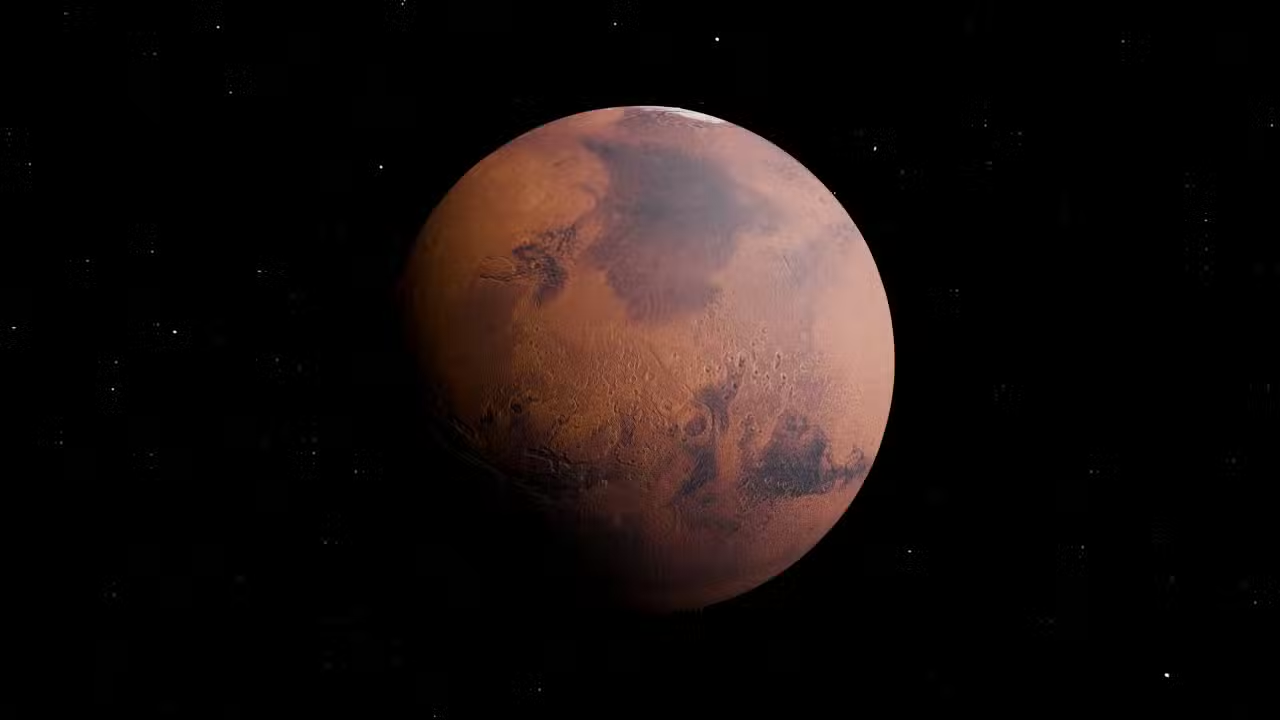
Evidências Geological findings suggest that Marte had suitable conditions for the formation of petroleum billions of years ago, raising questions about the possible existence of hydrocarbons on the Red Planet. Pesquisadores examine whether microbial life that may have flourished in the ancient Martian oceans left remains that turned into fossil fuels, as occurred in Terra during Período Arqueano.
Comparison between the processes that generated terrestrial oil and the historical conditions of Marte paves the way for deeper investigations into the origin of life on Sistema Solar. Geólogos documented evidence that Marte maintained liquid water on its surface more than 3 billion years ago, creating potentially habitable environments for single-celled organisms.
Formação of oil in Terra and Archean evidence
Terrestrial oil originated mainly from the remains of ancient marine microorganisms plankton, algae and bacteria accumulated at the bottom of primitive oceans. Esses organisms were buried beneath layers of sediment and transformed into hydrocarbons through extreme heat and pressure over millions of years. Most of the known deposits date from the Mesozoica era, between 66 and 252 million years ago.
Estudos led by geologist Birger Rasmussen, of Universidade of Austrália Ocidental, revealed much older oil. In 1998, his team discovered microscopic droplets of oil preserved in mineral grains within rocks more than 3 billion years old in the Pilbara region. Cinco Years later, in 2005, Rasmussen presented evidence that oil in 3.2 billion-year-old rocks was generated from decomposed organic matter.
Rasmussen’s analyzes of two well-preserved sequences of black shale 2.63 and 3.2 billion years old identified thin streaks of kerogen, a waxy precursor to fossil fuels formed from organic matter. Ambos shales contained microscopic nodules of bitumen, a tar-like residue left when oil migrates from the shale. Esses findings indicate that an ancient ocean was teeming with single-celled life 3.25 billion years ago, generating widespread oil.

Vida microbial and fossil records of Arqueano
Período Arqueano, which lasted approximately 4 billion to 2.5 billion years ago, marked the critical era in which Earth’s crust solidified, oceans formed, and life emerged. The first simple single-celled organisms, such as cyanobacteria, thrived during this period, leaving fossils known as stromatolites.
In 2021, Rasmussen and colleagues reported the discovery of ancient oil in stromatolites and microfossils from Gunflint, dating back 1.88 billion years. Thermally altered petroleum was found filling pores and fractures, originating from algae and bacteria in ancient Pré-Cambrian seas. The presence of fluid inclusions containing petroleum and pyrobitumen in Archean rocks suggests that a large biomass existed in Terra as early as 3.25 billion years ago.
Abundant microbial activity has been preserved in 3.4 billion-year-old colloidal pyrite grains from Archean sedimentary environments. Esses records demonstrate that early life was abundant enough to leave fossiliferous remains on a geological scale.
Condições history of Marte and presence of water
Há 3.25 to 3.4 billion years ago, Marte was already a wet planet. Características surface geological surveys suggest that liquid water has existed in Martian rivers, lakes, oceans, and aquifers for more than 3 billion years. The existence of large volumes of liquid water has been corroborated by seismic and gravity data obtained at depths of up to 20 kilometers near NASA’s InSight lander.
Marte lost the persistent bodies of liquid water on its surface after most of its atmosphere escaped into space. Ancient surface water was subsequently incorporated into Martian minerals, buried as ice, sequestered as liquid in deep aquifers, or lost to space. Apesar from this loss, geological evidence indicates that Marte maintained conditions suitable for microbial life for a significant period.



Life may have arisen in Marte before Terra. Isso occurs because the heat trapped during planetary formation is proportional to the planet’s volume, but escapes through its surface. The surface-to-volume ratio of Marte is 1.87 times greater than that of Terra, implying that the planet cooled to temperatures capable of supporting the chemistry of life before Terra reached this stage.
Possibilidade of Martian oil and scientific implications
If plankton, algae and bacteria lived in Martian rivers, lakes, oceans and aquifers, their remains could have been subjected to processes similar to those that produced ancient oil in the Archean rocks studied by Rasmussen. The temporal sequencing and geological conditions suggest that Marte would have provided an environment conducive to the generation of fossil hydrocarbons.
The discovery of oil at Marte would have profound implications for understanding early life at Sistema Solar. Esse oil would provide a unique record of how early life may have begun on Marte and whether it resembled life on Terra. If the chemical composition of early Martian life were similar to that of life in Earth’s ancient Precambrian oceans, this discovery would suggest that the two planets share a common ancestry.
The main evidence supporting this investigation includes:
- Água liquid in Marte more than 3 billion years ago, confirmed by surface geological features
- Condições atmospheric and temperature conditions that enabled biological processes
- Proximidade temporal gap between potential Martian life and early Earth life
- Mecanismos known geological methods for transformation of organic matter into hydrocarbons
Panspermia and connections between the planets
Durante o Grande Bombardeio Tardio, between 4.1 and 3.8 billion years ago, a shower of asteroids and comets cratered both Terra and Marte, potentially exchanging microbial life within rocks transferred between the two planets. Como Marte cooled first to habitable temperatures, this process of panspermia was more likely to bring Martian life to Terra sooner than the other way around.
Early contact between the planets could have resulted in identical primitive microbes on both celestial bodies. Essa possibility suggests that life on both planets may share a common ancestor or have been transferred through interstellar space. Documentation of ancient oil in Marte would provide concrete evidence of this cosmic connection.
Aplicações Futures in Martian Exploration
Caso oil is discovered in Marte, it would boost a future Martian economy. The oxygen needed for combustion or respiration can be produced by electrolysis of water using sunlight. Underground Depósitos could be explored using techniques adopted in Terra, including seismic and gravimetric surveys, followed by deep well drilling.
NASA’s InSight lander has recorded more than 1,300 Martian tremors, data that could help locate hydrocarbon deposits. The discovery of ancient Martian oil would have immeasurable scientific value, revealing how primitive life began on another planet and whether it shares fundamental chemical characteristics with terrestrial life. Essa investigation represents a search for the cosmic roots of life on Sistema Solar.
Veja Tambem em Latest News (EN)

Yuki Yamada posts photo with beard and grimace on Instagram and surprises fans

Costco sees record demand at U.S. gas stations with lower prices

Passenger tries to enter cockpit and forces diversion of United Airlines flight to Madison
Astronomer explains white light recorded after meteor falls near volcano in Philippines

Comedian Sakamoto-chan reveals type 2 diabetes remission after lifestyle changes

Avi Loeb says discovery of alien intelligence can unite humanity amid global crises

Police investigate death of Hilde Ann Lynn Helphenstein in room at Rosewood São Paulo
Avi Loeb suggests that dark comet 1998 KY26 could be Soviet probe Phobos 1
Typhoon Chan-mi approaches Okinawa and Amami with strong winds this Tuesday

Bad smell in children’s feet has specific causes and can be controlled by parents

Google releases Android 17 Beta 4.1 for Pixel devices
