

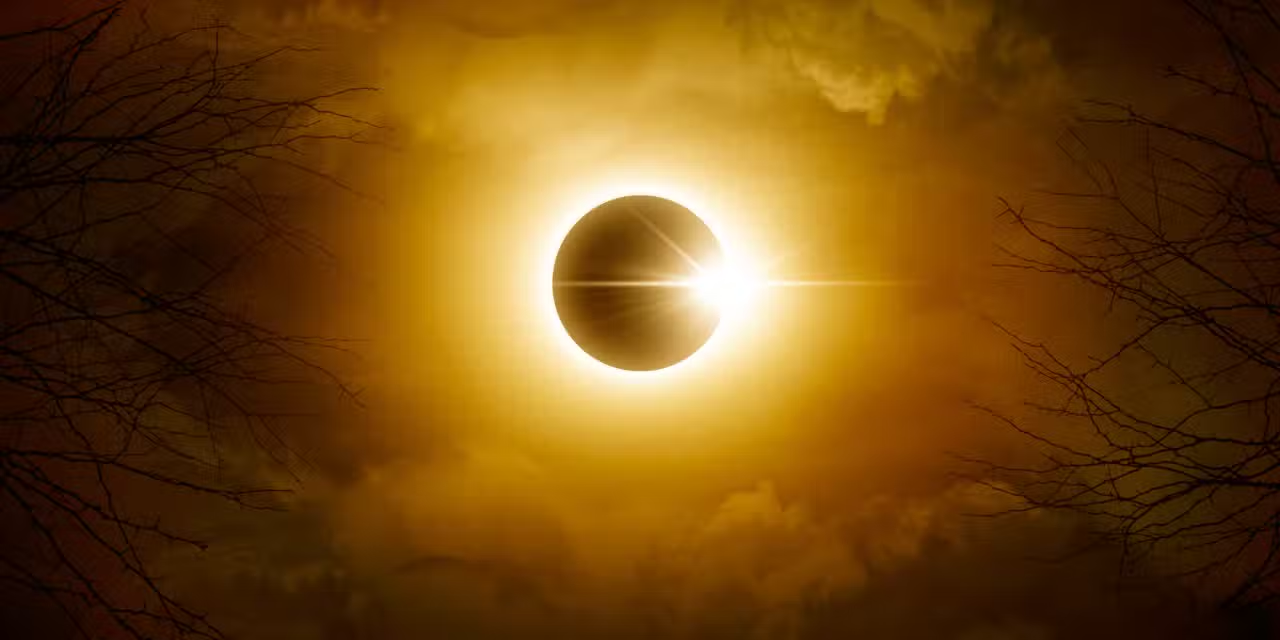
One of the most impressive celestial spectacles in recent history is preparing to mobilize observers around the world. The rare opportunity to see day turn into night for an extended period is generating great anticipation among enthusiasts and the scientific community.
The astronomical event, a total solar eclipse, already has a confirmed date for August 2, 2027. Sua’s particularity lies in its exceptional duration, which could reach a maximum time of approximately six minutes and 23 seconds in specific regions of the planet, making it the longest in the 21st century and one of the most notable in more than a century and a half.
The most anticipated astronomical phenomenon of the 21st century
The long-awaited total solar eclipse of 2027 represents a milestone for astronomy and the general public. The imminence of seeing Lua completely cover Sol, creating an artificial twilight in the middle of the day, is an experience that transcends science, touching on the human fascination with the universe. Este phenomenon not only provides a unique observation opportunity, but also catalyzes interest in space science. The projection of its visibility and the rarity of its duration already position it as one of the most important events of the decade.
Preparativos and expectations are growing, especially in countries that will be on the path to totality. The ability to witness the stars and some planets in broad daylight, an effect of intense darkness, is one of the many factors that enhance the uniqueness of this event. Diversas astronomical and tourist organizations are already planning expeditions and events to guarantee the best observation experience for the millions of interested parties who must travel.

Duração record and perfect celestial alignment
The prolonged duration of the 2027 eclipse is what distinguishes it from other solar events. With up to six minutes and 23 seconds of totality, it surpasses most eclipses, which generally only last a few minutes or seconds. Essa extension is the result of a precise combination of orbital factors. Terra, Lua and Sol need to be in almost perfect alignment, with Lua at a point in its orbit that places it relatively close to Terra, making its apparent diameter in the sky large enough to completely cover the solar disk.
Especialistas point out that an event of comparable magnitude and duration is unlikely to occur for more than 157 years. Essa rarity amplifies the scientific and cultural value of the eclipse. Tais alignments are complex and depend on multiple celestial cycles. Detailed study of these events allows astronomers to improve prediction models and better understand the dynamics of the Sol-Earth-Moon system. The solar corona, normally obscured by Sol’s brightness, becomes visible during totality, revealing details that are crucial to heliophysics research.
Onde the darkness will turn the day into night
The band of totality, where the eclipse will be visible in full, is geographically restricted, but covers areas of great cultural and tourist interest. The most privileged observers will be in regions that lie directly in the path of Lua’s shadow. Esta specific route ensures that Sol is completely hidden, providing the full experience of the phenomenon. Espanha, particularly País Basco and the province of Álava, is identified as one of the most favorable places for observation in European territory.
Outras regions with high visibility intensity include significant portions of Norte of África, areas of Oriente Médio, and portions of Península Ibérica.
- Norte from África: Egito, Líbia, Argélia
- Oriente Médio: Arábia Saudita, Iêmen, Omã
- Europa: Espanha, Marrocos, Tunísia
- Outras regions: Groenlândia and Islândia (with shorter duration of totality)
Esses locals are already predicting a significant increase in tourism, with travelers and researchers planning their stays well in advance. Local infrastructure is preparing to meet demand, with special packages and observation guides being developed.
Luzes and shadows: the visual details of the eclipse
The totality phase of a solar eclipse is a spectacle of light and shadow, punctuated by visual phenomena that leave an indelible mark on observers’ memories. Quando to Lua begins to cover Sol, the ambient light gradually decreases, and the temperature may drop significantly. Nos final seconds before totality, the famous “Pearls of Baily” appear. Estes are bright points of sunlight that “leak” through the valleys and craters on Lua’s irregular surface, creating an image that resembles a string of sparkling pearls around the lunar dark edge.
Logo after Pérolas of Baily, a last intense beam of sunlight manifests, forming what is known as the “Ring of Diamante”. Este effect occurs when only a small portion of Sol is still visible, shining like a diamond in a dark ring, before being completely covered up. Durante the minutes of totality, the solar corona, the outer atmosphere of Sol, reveals itself in all its splendor, with its delicate rays and plumes stretching across the dark sky. The view of the corona, normally hidden by the brightness of the solar disk, is one of the most anticipated and scientifically valuable moments of the eclipse. The corona offers crucial information about solar activity.
Recomendações security and legacy event
Apesar of the beauty and rarity of the total solar eclipse, observing the phenomenon requires rigorous precautions to avoid permanent damage to vision. Especialistas and ophthalmologists emphasize the need to use specific eclipse glasses, certified with appropriate solar filters. Estes goggles must be worn during all phases of the event, except for the brief period of totality, when the Lua completely covers the Sol. Fora of this period of totality, direct exposure, even for a few seconds, can cause retinal burns.
Observation with homemade equipment or ordinary sunglasses is extremely dangerous and should be avoided. The legacy of the 2027 eclipse goes beyond the individual experience. Ele will serve as a reminder of the magnificence of the cosmos and the importance of science education. The event inspires new generations to astronomy and encourages research. Embora astronomical calendar predicts other events, such as a partial eclipse in 2028, the combination of duration and visibility of the 2027 phenomenon solidifies it as one of the most important records of the century for the scientific community and global popular culture.