
Comet PanSTARRS reaches maximum proximity and may shine brighter than Sirius in May

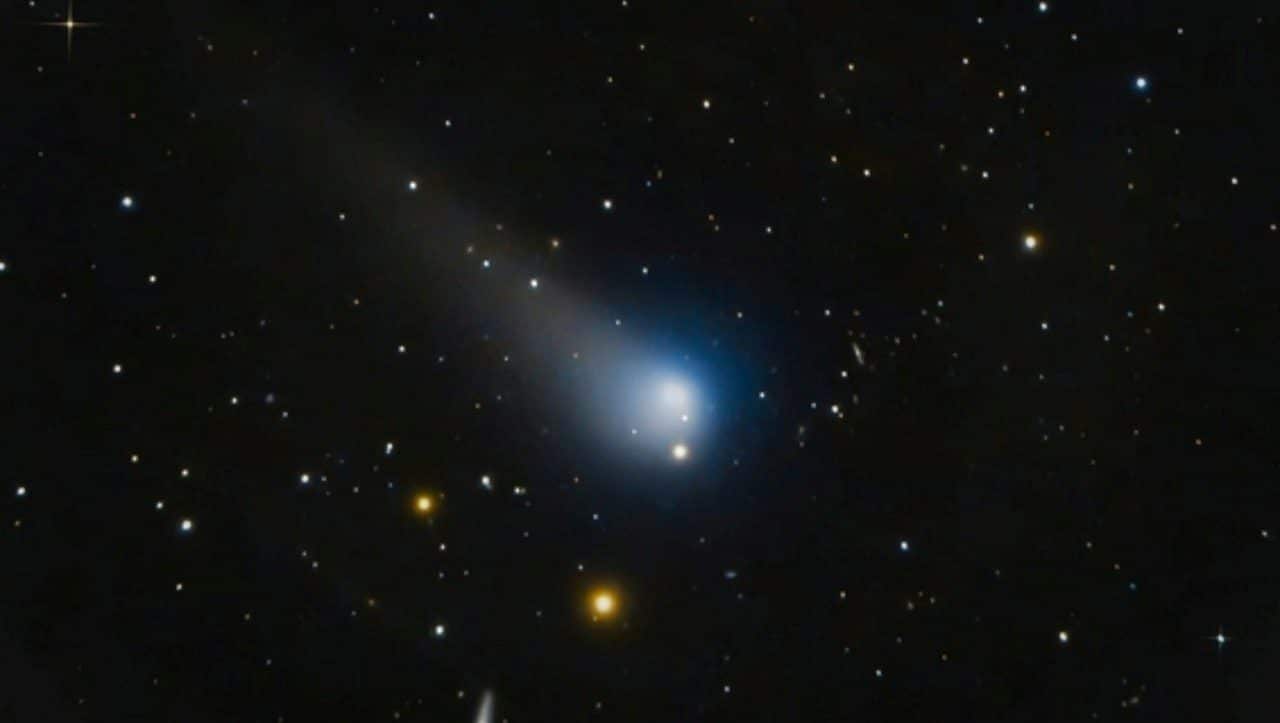
Comet C/2025 R3 (PanSTARRS) completed its closest approach to Terra on Sunday, April 26, passing 72 million kilometers from the planet. The celestial object survived Sol’s closest pass on April 19 and has since gained brightness by releasing significant amounts of gas and dust. Astrônomos indicate that the phenomenon could make PanSTARRS one of the most notable astronomical events of 2026, with the potential to surpass the brightness of Sírius, the most luminous star in the night sky.
Distância safe and nucleus intact after perihelion
Perigee, the point of closest proximity to Terra, occurred as predicted on Sunday. The comet traveled 0.49 astronomical units from our planet, a distance that represents complete safety against any risk of impact. Astrônomos used data from telescopes and the SOHO space observatory to track the object’s movement accurately. The images confirmed that the icy core withstood the intense heat of perihelion, a critical event that fragments many comets. The released material formed a coma and tail that were visible under suitable observation conditions.

The current position places the object close to the Baleia constellation. Observadores noted magnitude around 4 to 5 in recent days, a value that indicates possible visibility with binoculars in dark places, away from urban light pollution. The SOHO space telescope, operated by NASA and ESA, monitored the comet with the LASCO instrument as it passed through perihelion. The coronagraphic cameras recorded the object close to Sol and allowed the trajectory and material release rate to be calculated with great precision.
Front Dispersão can raise brightness to exceptional levels
The luminosity potential of PanSTARRS draws the attention of experts around the world. Estimativas conservatively points to magnitude 3, sufficient for naked-eye vision in dark skies. In an optimistic scenario, the comet could reach magnitude -2 due to the forward scattering effect, a rare phenomenon that occurs when dust from the comet reflects sunlight directly onto Terra. Essa dispersion acts as a natural glare-amplifying lens. Marcelo Zurita, from Associação Paraibana from Astronomia, highlighted this possibility in recent reviews, noting that the brightness would significantly surpass that of Sírius.
- Poeira released forms a curtain that multiplies the reflection of sunlight towards the planet.
- Favorable Geometria between comet, Sol and Terra amplifies the forward scattering effect.
- Magnitude -2 would allow vision even in twilight or skies with moderate light pollution.
- Comparação with Sírius reinforces the chance of a rare astronomical spectacle for observers.
Descoberta and extremely long period orbit
The comet was discovered in September 2025 by the PanSTARRS system, an astronomical surveillance project that identifies moving celestial objects. Sua’s long-period orbit means the current pass is the first in about 170,000 years. Essa feature makes the event even more special as it represents a unique opportunity for current human generations. The ice and dust preserved in the core reveal pristine Sistema Solar conditions from billions of years ago, offering valuable data for scientific research.
Desafios observation and visibility window in May
The angular proximity to Sol made direct vision difficult on Sunday. The comet was just 6 degrees from the star, a configuration that left it practically invisible during the day and on the horizon close to sunset. Quem tried to observe, needed binoculars and a western horizon free of obstacles. Locais away from cities offered better conditions, while urban light pollution drastically reduced the chances of detection by the naked eye.
Sol’s angular separation increases in the first few days of May, opening the main window of visibility. The comet should appear low on the western horizon just after dusk, a position that favors Hemisfério Sul observers. Recomendações include checking the exact sunset time in each location. Binóculos or small telescopes help identify the coma and possible tail clearly. Clean Céu and no full moon significantly increase the chances of successful observation.
Perspectivas for the next few weeks
Brightness should peak in the first nights of May, a period when amateur astronomers throughout Brasil will have the best opportunity to follow. Depois, the comet heads towards outer space, and the magnitude tends to fall as the distance from Sol increases. Previsões indicate that PanSTARRS remains visible for several more weeks, with the exact period depending on factors such as core activity and local atmospheric conditions. Entusiastas from the sky should mark the calendar for May nights, as the combination of recent proximity and possible high brightness makes this one of the most anticipated comets of the year. Observadores that manage to register the comet can share images with astronomy networks, contributing to global monitoring of the object.





