Flores Moon appears smaller in the sky on May 1st with rare micromoon

Lua of Flores reaches its maximum illumination tonight, May 1st, at 1:23 pm (Brasília time), bringing an unusual visual phenomenon. The satellite will be positioned at its apogee, its furthest point from Terra, resulting in a “micromoon” with a reduced size compared to usual. Este event marks the advance of spring in the northern hemisphere, a period in which flowers bloom in profusion, originating the traditional name of the full moon.
Reduced Tamanho and visual characteristics
The lunar disk will measure 29.72 arcminutes, an astronomical unit for measuring distances in the night sky, versus its average size of approximately 31 arcminutes. Embora although the difference may seem subtle to the inattentive eye, it represents a reduction of approximately 4% in the satellite’s visual diameter, quantifiable through appropriate instrumentation. Esta variation occurs because the distance between Terra and Lua varies continuously due to the elliptical nature of its orbit.
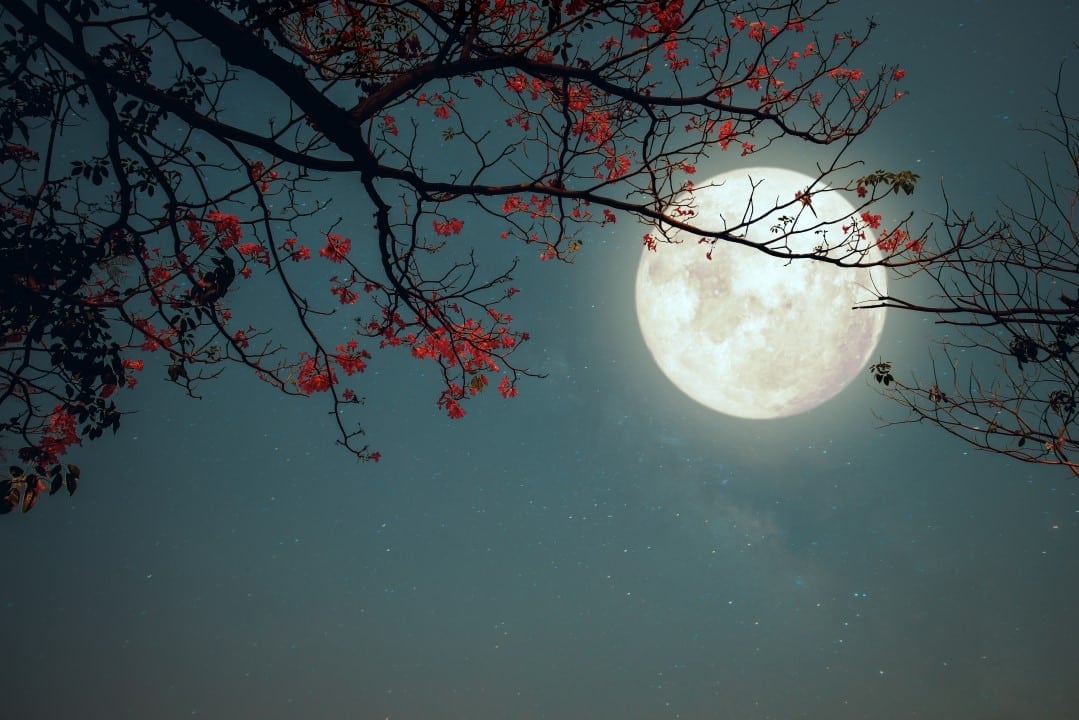
At apogee, the satellite moves approximately 405 thousand kilometers away from the Earth’s surface, while at perigee, the closest point, this distance is reduced to approximately 356 thousand kilometers. Quando to full Lua coincides with the apogee, its angular size reduces, creating the illusion of a smaller disk. The opposite phenomenon, called “supermoon”, occurs when the full Lua coincides with perigee, presenting the satellite in its largest apparent dimension.
Melhor observation schedule and conditions
The phenomenon will be best appreciated at sunset, when Lua slowly rises over the southeastern horizon. Neste initial moment, the satellite will present the characteristic yellow-orange hue, a result of the dispersion of Rayleigh, a process in which sunlight reflected by the lunar surface is filtered by the denser Earth atmosphere in the lower layers. Observadores should exit into the open sky as soon as Sol descends over the western horizon.
Lua will progressively acquire its usual color as it rises, losing its initial reddish tone. Durante throughout the night, the satellite will trace a low, arching path over the southern horizon, reaching its highest point before gradually descending toward the southwest, where it will disappear at dawn on May 2. Sunrise and sunset times vary depending on the observer’s geographic location, making it advisable to consult local ephemerides for maximum accuracy.
Astros that accompany Lua of Flores
The May sky will offer more than just Lua of Flores. Bright Estrelas will complement the nighttime spectacle, creating a celestial composition worthy of observation. Spica and Arcturus, the third brightest star in the night sky, will shine above the blinding brightness of the full Lua, although the fainter stars in the Libra constellation, located close to the satellite, will remain invisible due to the lunar light intensity.


- Vênus will display its intense brightness during solar twilight on the western horizon.
- Júpiter will remain suspended just above Vênus, the brightest planet.
- Castor and Pólux shine in the constellation of Gêmeos, higher in the sky.
- Arcturus shines as the third most luminous star in the night sky.
Esta’s confluence of celestial bodies gives the month a rare visual complexity, offering multiple opportunities for photographers and observers interested in recording or simply appreciating the vastness of the visible universe. Experienced Observadores recommend waiting for complete darkness to fully appreciate the lunar hue and the surrounding stars.
Lua Azul arrives at the end of May
Maio closes with a second significant lunar event. On May 31, a second full Lua, known as Lua Azul to certain observers, will appear in the night sky. Este phenomenon, rarer than Lua of Flores, occurs when two complete lunar cycles cross the limits of a single calendar month. Lua takes approximately 29.5 days to go through its four main phases.
Como this period is approximately the length of a Gregorian calendar month, generally 12 full moons are recorded in a solar year. However, every 2.5 years, subtle variations in the lunar calendar result in 13 full moons in a single year, with two of them in the same month. Convencionalmente, the first full Lua of the month receives the traditional name of that period, in this case, Lua of Flores, while the second is designated Lua Azul. The name “blue” refers to the rarity of the event, not the observed visual color, keeping the lunar disk its usual color.
Significado astronomical and cultural
Lua of Flores marks the transition between spring and summer in the northern hemisphere, symbolizing biological renewal and cosmic cycles that have governed human calendars for millennia. Seu emergence connects contemporary observers with ancient astronomical traditions, when lunar appointments followed agricultural and seasonal phenomena in the Earth’s environment. Telescópios and binoculars will reveal details of craters and selenographic formations with increased clarity, while photographers will find ideal opportunities to capture quality images during the first few hours after Lua rises.
Veja Tambem em Latest News (EN)

King Charles III’s cancer progression accelerates transition of power to Prince William and Kate

Samsung changes Galaxy S26 Ultra design and restricts fast charging for thermal safety

Steam platform releases four independent games for free for permanent redemption on computers

PlayStation 5 users redeem Ark and 2XKO for free without PlayStation Plus plan

Rockstar Games changes Grand Theft Auto VI release date to second half of 2025

Chinese probe Tianwen-1 records interstellar comet 3I/ATLAS from Mars orbit

Samsung confirms Galaxy devices that will receive update to One UI 7 with Android 15 this year

National Toyota Yaris Cross hits stores for R$130,000 with 30 km/l flex hybrid engine

Capcom plans unprecedented expansion for the Resident Evil franchise and new remakes by 2028

Yuliia Starodubtseva eliminates Elena Rybakina as Novak Djokovic advances at Roland Garros 2026

Galaxy S23 users are left without AirDrop support in Samsung’s new One UI 8.5 update