
M5.7-class solar flare shoots particles toward Earth

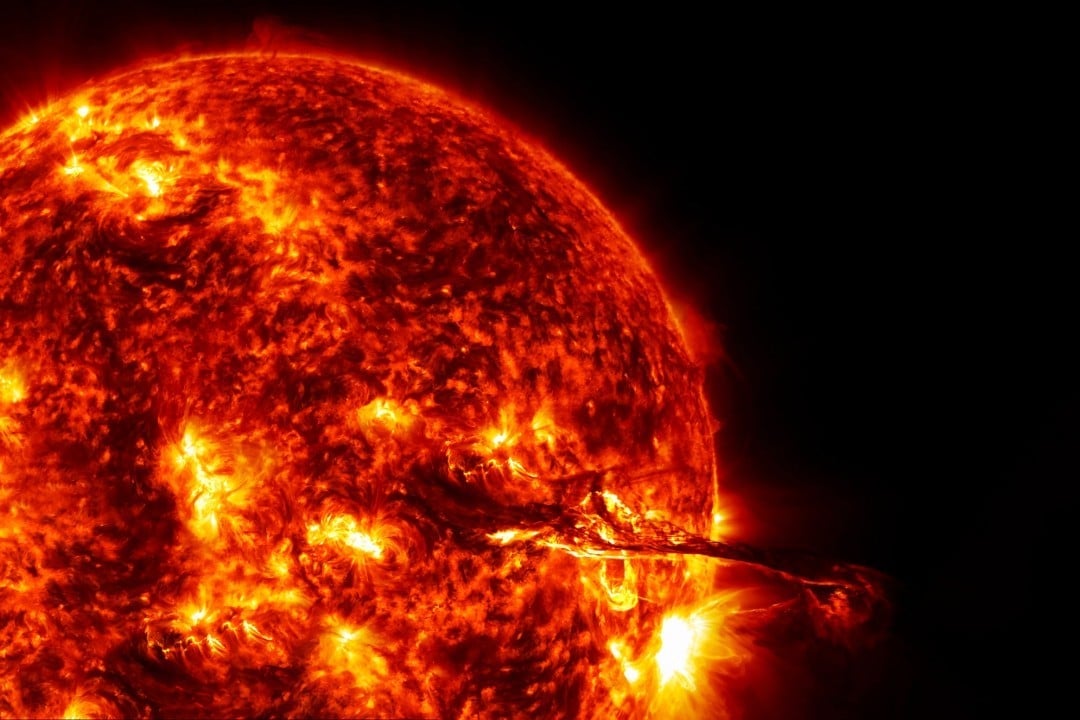
A powerful explosion at Sol launched a wave of energetic particles toward Terra this week. The M5.7 class solar flare was recorded by space monitoring satellites and marks a significant increase in solar activity. The event occurs during a period of intensification of solar magnetic cycles, with direct implications for telecommunications, satellite systems and electricity networks across the planet.
Características of the eruption and magnitude scale
The M5.7 classification places this event in an intermediate, but significant, range on the scale that measures the power of solar flares. Eruptions are categorized by letters — A, B, C, M and X — with X being the strongest. Dentro of each category, numbers 1 to 9 indicate increasing intensity. This week’s recorded eruption reached almost the upper limit of class M, demonstrating a massive release of magnetic energy accumulated on the solar surface.
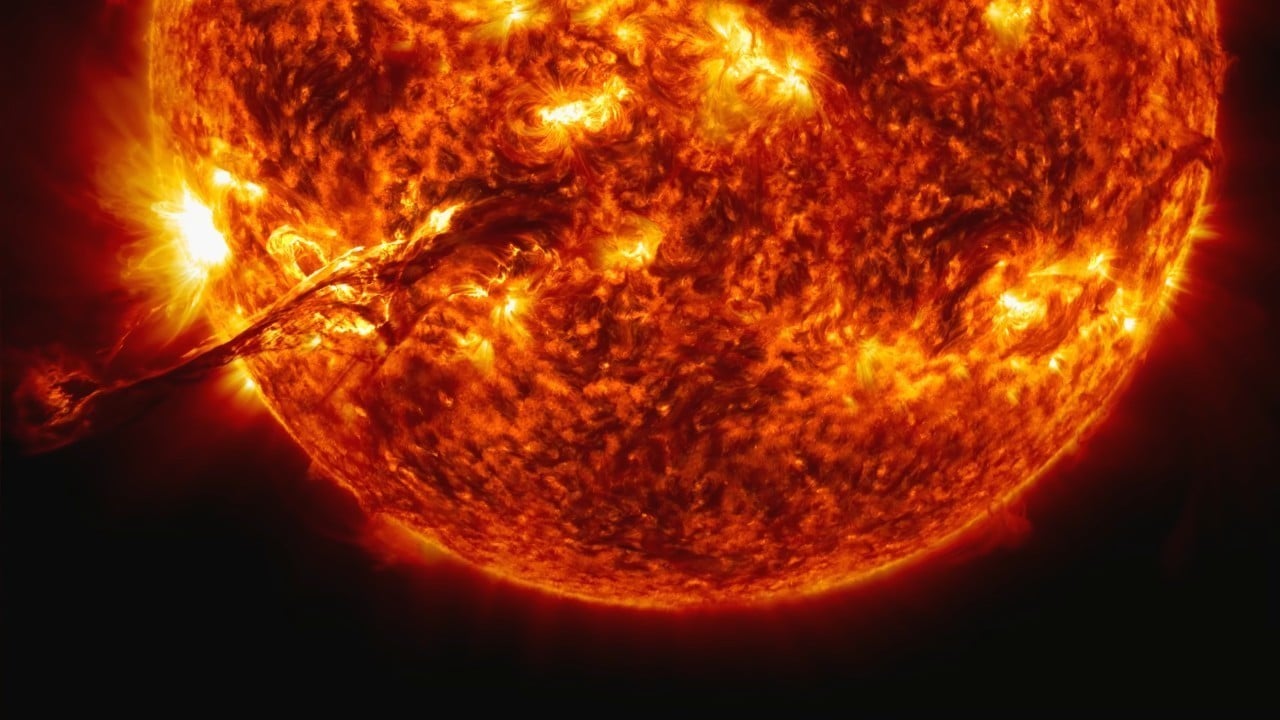
The phenomenon was accompanied by a coronal mass ejection (CME), a process in which billions of tons of plasma and magnetic fields are launched into space. Esta particle cloud travels at speeds exceeding 1,000 kilometers per second, significantly reducing the time to reach the Earth’s magnetosphere. Orbiting solar Observatórios, like Solar Dynamics Observatory (SDO) of Nasa, captured detailed images of the event at multiple wavelengths.
Impactos potentials in the magnetosphere and infrastructure
The effects of an eruption of this magnitude can last for several days after the initial event. Ondas geomagnetic shocks tend to shake the Earth’s magnetic field, creating geomagnetic storm conditions that affect large-scale technological systems. Operadoras telephony, energy transmitters and satellite managers are already on high alert.
Erupções class M solar panels may interfere with:
- Sinais GPS and satellite navigation in high latitude regions
- Transmissões radio on commercial and military frequencies
- Sistemas of transformers in hydroelectric and thermoelectric plants
- Satélites operational communication and broadcast
- Voos transpolar on long-distance routes
Agências spacecraft continuously monitor the trajectory of the coronal mass ejection. Administração Nacional Oceânica and Atmosférica (NOAA), linked to the US government, issued warnings to operators of critical infrastructure. Preliminary Análises indicates arrival of solar plasma at Terra within 24 to 48 hours after the initial detection of the eruption.
Ciclo solar activity and forecasts
The current solar cycle, called Ciclo 25, began in 2020 and is in a growth phase. Cientistas predicted that this cycle would be more intense than the previous one, and recent observations confirm this trend. M-class Erupções have become more frequent, as have sightings of giant sunspots.
The next decade will be marked by increased volatility in space weather. Instituições researchers warn that infrastructures dependent on satellite technology — including financial, meteorological and defense systems — need urgent investment in protection against extreme solar storms. An X-class eruption could paralyze entire sectors of the global economy within hours.
Pesquisadores of Nasa and Agência Espacial Europeia (ESA) continue to improve forecast models to anticipate solar events with greater accuracy. Dados histories show that periods of maximum solar activity tend to be concentrated in 2- to 3-year windows, suggesting that significant new eruptions are likely to occur by 2026.
Observações and scientific records
Telescópios ground-based solar and specialized satellites provided raw data on the geometry and velocity of the ejected plasma cloud. The event was cataloged in international spatial climatology databases, allowing comparisons with historical eruptions of similar magnitude. Registro from 2003, for example, caused blackouts in Canadian provinces and economic losses estimated at billions of dollars.
The international scientific community uses events like this to validate computer simulations and refine understanding of solar physics. Observatórios collaborate in real time, sharing images and measurements of energetic particles detected by probes in heliospheric orbit. Dados collected feeds knowledge banks that support investment decisions in technological resilience by governments and companies.





