Myth or truth: 220V voltage saves more than 110V on your energy bill?
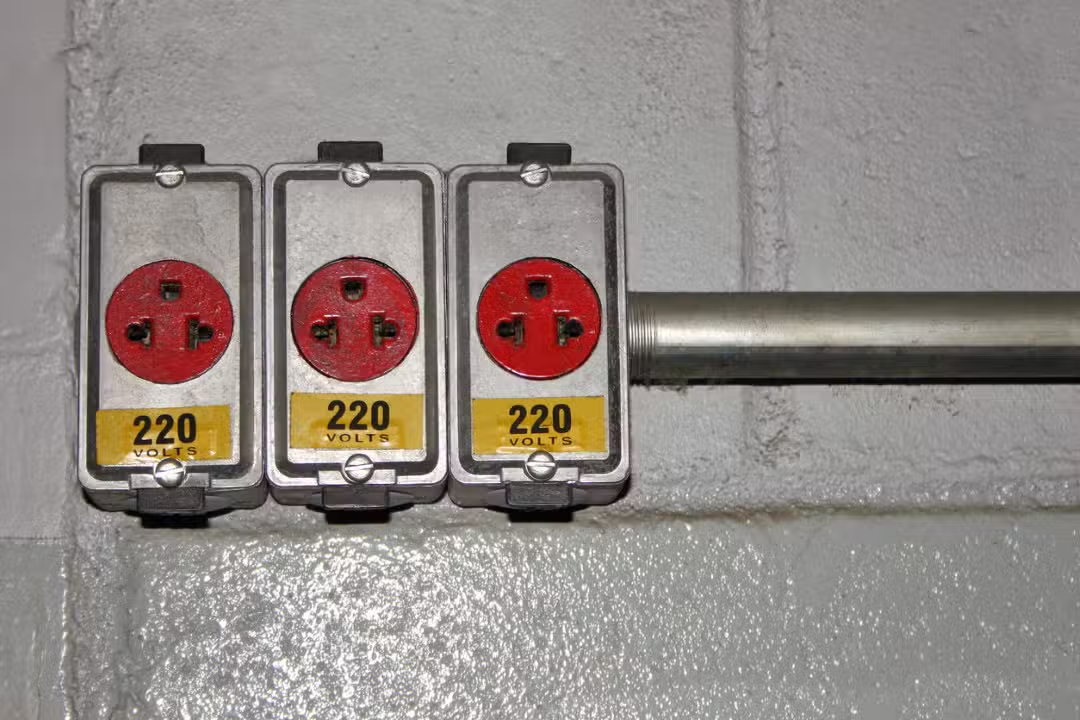
A 5,500-watt electric shower consumes exactly the same amount of energy when connected to 110 volts or 220 volts. Essa is the conclusion of electrical engineering experts who demystify one of the biggest misconceptions about energy consumption in Brazilian homes. What really determines how much you will pay on your electricity bill is the power of the device measured in watts and the time it remains on, regardless of the outlet voltage.
The energy company records kilowatt-hours (kWh), a unit that measures the work done by the device without considering the voltage used. A 5,500-watt device will deliver this same load at both 127 volts and 220 volts. The confusion arises because many people believe that the grid voltage directly influences consumption, when in fact what changes is just the way in which this energy is transported to the device.
The real difference is in the electrical current, not the consumption
The critical point of the technical difference between the two systems is the intensity of the current required to transport the same power. A 5,500-watt shower head operating at 127 volts requires approximately 43 amps of current. Esse even shower at 220 volts needs only 25 amps to deliver the same power. A smaller current circulating through the wiring generates significantly less heat during its journey, reducing thermal losses in the electrical installation.
Essa greater efficiency at 220 volts allows distributors to use thinner wires in residential installations, reducing the cost of works and increasing the safety margin against overheating in the home’s internal network. In ordinary homes, this efficiency saving is practically imperceptible on the electricity bill, and is only relevant in large industrial installations that operate at much higher powers.
The mathematical relationship that explains this is simple: power (watts) is equal to voltage (volts) multiplied by current (amps). Essa fundamental formula of electrical physics guarantees that devices of the same power will consume identical amounts of energy, regardless of the voltage chosen for their operation.

Tensão, current and power: concepts that define consumption
Compreender these three basic concepts of electricity are essential to eliminate myths about energy consumption. The simplest analogy uses a water pipe: the electrical voltage measured in volts works as the pressure inside the pipe, representing the force necessary to push the electrons through the circuit. The electric current measured in amps is equivalent to the flow rate, that is, the number of electrons that pass through the conductor every second.
The power measured in watts represents the total work done by the device and is calculated by multiplying the voltage by the current. Essa direct relationship explains why the same power can be obtained with different combinations of voltage and current. A 1,000-watt appliance can operate on 127 volts with 7.87 amps of current, or on 220 volts with just 4.55 amps. Ambas combinations result in exactly 1,000 watts of power and will generate the same energy consumption in kilowatt hours.
What really matters for the amount charged on the electricity bill is exclusively the power printed on the device’s technical label. Essa specification defines how much it will cost to operate over a set period of time. Tensão and current are simply the means by which this power is delivered to the equipment.
Why Brasil has two different electrical standards
The coexistence of 127 volts and 220 volts in the Brasil was not the result of centralized planning. Surgiu of the fragmented electrification that occurred during the 19th century, when foreign companies installed their networks following the standards adopted in their countries of origin. São Paulo and Rio of Janeiro received investment from Canadian companies such as Light and Power, which adopted the North American 110 volt standard developed by Thomas Edison.
Simultaneamente, Nordeste and parts of the Brazilian Norte received infrastructure from European companies that implemented the 220 volt standard. Essa geographic duplicity has been consolidated over the decades. Unificar the Brazilian electrical system today would be economically unviable, requiring millions of people to replace incompatible appliances and for distributors to replace transformers throughout the national territory.
The term 127 volts is the correct technical standard for what we popularly call 110 volts. The pure 110 volt standard was discontinued on the Brasil decades ago for efficiency reasons in three-phase electricity distribution. Portanto, when an appliance manual mentions 127 volts or when someone refers to 110 volts in common vocabulary, both designations indicate the same standard low voltage residential outlet.
Identificando the voltage at your home
The quickest and most reliable way to find out your home’s voltage is to check the electricity bill provided by your utility company. The invoice specifies the type of electrical supply, stating whether it is single-phase, two-phase or three-phase, in addition to the nominal voltage of the connection. Essa information appears in the technical data fields of the document and reflects exactly what the distributor delivers at the entrance of the residence.



Outra practical option is to observe the circuit breaker panel installed on the wall. 127 volt Circuitos use single pole circuit breakers. Já 220 volt sockets in 127 volt regions, such as those intended for showers or air conditioning, use bipolar circuit breakers that are double and turn off two phases simultaneously. The presence of these dual models indicates that there are working 220 volt circuits in the installation.
Para who wants absolute precision, the use of a multimeter is recommended. Inserindo the test leads into the socket with the device set to alternating voltage, the reading will show the actual voltage in real time. The Agência Nacional of Energia Elétrica (ANEEL) allows operational variations: 127 volt sockets can operate between 116 and 133 volts, while 220 volt sockets can vary between 201 and 231 volts without this being considered a defect in the electrical network.
Escolhendo between 110V and 220V for different devices
- High Power Aparelhos (electric showers, air conditioners, furnaces): work best at 220 volts, allowing for thinner wires and greater safety
- Eletrônicos portable and low-power appliances (TVs, notebooks, mixers): 127 volts perfectly meets the needs
- Geladeiras, washing machines and fans: can run on both voltages, but prefer 220 volts for greater efficiency
- Equipamentos modern bivolt: eliminate worries about voltage during purchase
Most modern homes have both voltages available simultaneously: 127 volts in sockets for general use and lighting, and 220 volts in dedicated circuits for showers, air conditioning and other high-load appliances. Essa hybrid configuration takes advantage of each system without requiring the entire residential installation to operate on a single voltage.
Automatic and manual bivolt Aparelhos: critical differences
Aparelhos automatic bivolts such as cell phone chargers and notebook power supplies automatically detect the socket voltage and adjust themselves between 100 and 240 volts without the need for user intervention. Esses equipment will work perfectly in any outlet, regardless of the available voltage.
The manual bivolt, in turn, has a selector switch, usually red, which must be positioned correctly before inserting the plug into the socket. If the switch is set to 110 volts and you connect the device to 220 volts, the equipment will burn instantly, causing irreversible damage to the internal components. That’s why it’s essential to always check the technical label: if it says “100-240V”, it’s automatic, but if it says “127V/220V”, look for the physical key and confirm the position before turning it on.
Entendendo shock risks at 127V and 220V
Ambas tensions are dangerous for the human body, but produce distinct physiological effects. The 220 volt shock has greater potential to overcome the skin’s natural resistance and cause instantaneous cardiac arrest. The muscular contraction caused by the 220 volt shock is so violent that it generally throws the victim away from the wire, quickly breaking contact.
The 127 volt has an alarming characteristic called sticking effect. The muscular contraction produced by a lesser tension may be insufficient to make the person involuntarily release the wire they are in contact with. Quando this contact lasts beyond a few seconds, the risk of death from asphyxiation or heart failure increases progressively, even with a nominally lower voltage. Esse is an important reason why shock at 127 volts should not be underestimated: the widespread perception that it is less dangerous often leads to delay in breaking contact.
The most effective protection against electric shock at any voltage is the DR device (Diferencial Residual), installed in the home’s electrical panel. Ele instantly detects any leakage current and shuts down the circuit in milliseconds, stopping the flow of electricity long before the current reaches levels capable of causing damage to the human body.
Ligando 220V appliances in 110V sockets: practical consequences
Sim, it is technically possible to plug a 220 volt device into a 127 volt outlet because the pin pattern is identical on both. However, the device will not work as intended and may be damaged. Equipment designed for 220 volts receiving only 127 volts operates with approximately 58% of the pressure necessary for its correct operation.
Lâmpadas incandescent lights will be noticeably dim, delivering only a fraction of the expected luminosity. Aquecedores and electric showers will barely heat up, offering insufficient temperatures for their intended use. The real risk lies in appliances with motors such as refrigerators, fans and washing machines. Esses equipment may stall due to lack of sufficient torque to rotate the motor, generating progressive overheating in the internal coils and resulting in complete engine burnout.
The safe solution for these specific cases is to use an autotransformer of adequate power, a device that raises the voltage from 127 to 220 volts in a stable and safe way, allowing the device to receive the correct voltage for its operation.
Veja Tambem em Latest News (EN)

Xiaomi Smart Band 10 Pro hits the global market with brighter screen and battery life of up to 21 days

Study proposes new planetary formation: most sub-Neptunes do not have a core or mantle like Earth

South Korean manufacturer advances testing of the One UI 8.5 interface and expands access for new cell phones

Apple releases watchOS 26.4 and macOS Tahoe 26.4 with native support for AirPods Max 2

OnePlus Ace 6 Ultra details indicate 8500mAh battery and 165Hz screen for heavy gaming

Entry-level version of the Caoa Chery Tiggo 5X Sport goes against the market and increases in value in the Fipe table
Oura Ring 4 offers detailed health monitoring in a discreet format for technology users

INSS sends proof of life alert via WhatsApp to beneficiaries with pending issues

War Robots, a 2014 action game, is released by surprise for free on PS4 and PS5

Samsung Galaxy A57 arrives thinner with IP68; check price comparison and technical sheet with A56

New adaptation of Harry Potter arrives in the Max catalog at Christmas with a new cast and eight chapters