
Magnitude 5.7 solar flare increases chances of aurora borealis this week


A magnitude 5.7 solar flare occurred on May 10, 2026, releasing a powerful coronal mass ejection (CME) toward Terra. The space weather event, while not representing the largest category of solar flares, was significant enough to cause radio blackouts over Oceano Atlântico. Cientistas warn that the lateral impact of the CME could trigger small geomagnetic storms starting on May 13, creating favorable conditions for viewing aurora borealis in regions not typically associated with this phenomenon.
Erupção solar released intense radiation and charged particles
The explosion on the surface of Sol classified as M5.7 occurred when sunspot regions released massive bursts of radiation and ionized material into space. Essa intense radiation caused temporary high-frequency radio blackouts in the illuminated portion of Terra at the time of the eruption. The radio signals used by aviators, sailors and radio amateurs were disrupted by the ionization of the Earth’s upper atmosphere.
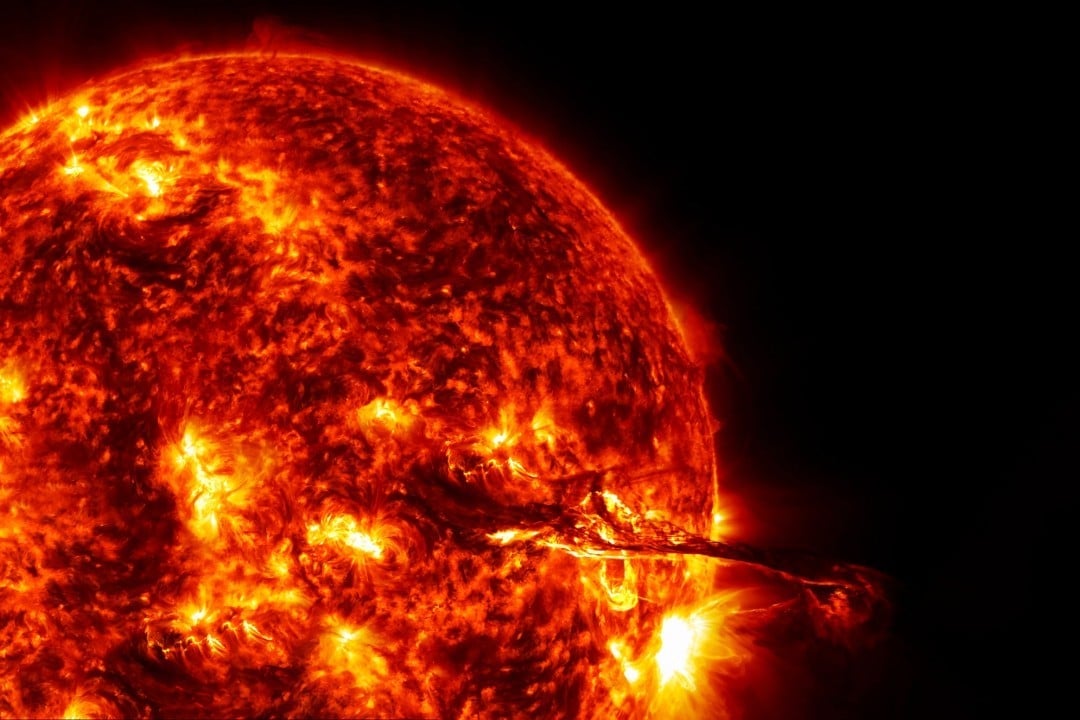
Solar flares follow a classification scale that goes from A to X, with class X being the most powerful. This week’s M-class eruption, although less intense than the maximum category, remains strong enough to disrupt the planet’s communications systems. NOAA’s Centro of Previsão of Clima Espacial confirmed the registration and follows additional developments.
Impacto expected in Earth’s atmosphere will be moderate
The coronal mass ejection directed mainly away from Terra could still hit the planet sideways, as space meteorologists project. Esse impact, although relatively mild, could significantly intensify the northern lights over the next few nights. Previões indicate that the phenomenon will be observable especially between May 13 and 14, particularly in regions north of Estados Unidos, Reino Unido and north of Europa.
Skywatchers should direct their attention to the nighttime hours on these days. Não there is a guarantee that auroras will reach lower latitudes, as visibility will depend on the final intensity of the geomagnetic storm and local atmospheric conditions. NOAA and Reino Unido’s Serviço Meteorológico maintain active alerts for real-time updates.
Manchas solar panels continue to evolve and may generate new events
Duas sunspot regions identified as AR4436 and AR4432 remain evolving and present the potential for new eruptions in the coming days. As they rotate toward Terra’s line of sight, their ability to affect the planet increases. Cientistas does not rule out the possibility of class X solar flares, the maximum category, in the next 72 hours.
Essas sunspots represent areas of intense magnetic activity on the solar surface. Cada flare provides valuable data for understanding the behavior of Sol as it approaches solar maximum predicted for the next few years. With this cycle of intensification underway, experts expect more frequent and dazzling aurora borealis events to emerge in the coming months.
Diferença with May 2024 solar storm
The May 2024 G5 geomagnetic storm was significantly more extreme, producing auroras visible even in México and southern Flórida. Aquele event left unprecedented marks in regions rarely affected by such a phenomenon. The current eruption, although considerable, is projected to be of lesser comparative intensity.
Mesmo Thus, this week’s event promises remarkable light spectacles for observers in high latitudes and polar regions. Canadá, Alasca and Escandinávia will face the best viewing conditions. Moradores from the north of the USA and Europa have a concrete chance of witnessing the phenomenon, albeit with less historical intensity.
Caçadores of auroras position themselves for observation
Entusiastas of space weather and scientists are eagerly awaiting the coming days with equipment prepared. The northern lights result from the interaction between charged solar particles and the Earth’s magnetic field, creating bands of vibrantly colored light. The phenomenon is more frequent near the poles, where the magnetic field is more intense and channels these particles.
Observadores at lower latitudes has a chance of seeing the phenomenon only during periods of intense solar activity, such as the one approaching. Condições clear skies and lack of light pollution are essential for a complete visual experience. Aplicativos real-time northern lights forecasting helps locate the best observing windows as updated data arrives from space forecasting centers.
Continuous Monitoramento keeps scientific community attentive
NOAA’s Centro of Previsão of Clima Espacial and Met Office of Reino Unido release daily bulletins on the evolution of solar activity. Regiões sunspots are tracked continuously to identify signs of potential future flares. Essa surveillance protects communications satellites, power systems and global technological infrastructure from damage caused by severe geomagnetic storms.
Cientistas also takes advantage of these events to collect data on how Sol interacts with Earth’s magnetosphere. Cada solar flare contributes to more accurate prediction models. Solar activity follows cycles of approximately 11 years, and the current period marks the transition to a cycle of greater activity, increasing the frequency of events such as the one observed on May 10th.
Resumo’s next steps:
- Erupção M5.7 on May 10 sent EMC in a sideways trajectory to Terra
- Impacto expected between May 13th and 14th will generate small geomagnetic storm
- Auroras boreals visible at high latitudes, possible in northern US and Europa
- Manchas solar AR4436 and AR4432 continue to be monitored for new events
- NOAA and Met Office update forecasts daily
- Céu clean essential for observation in the coming days




