

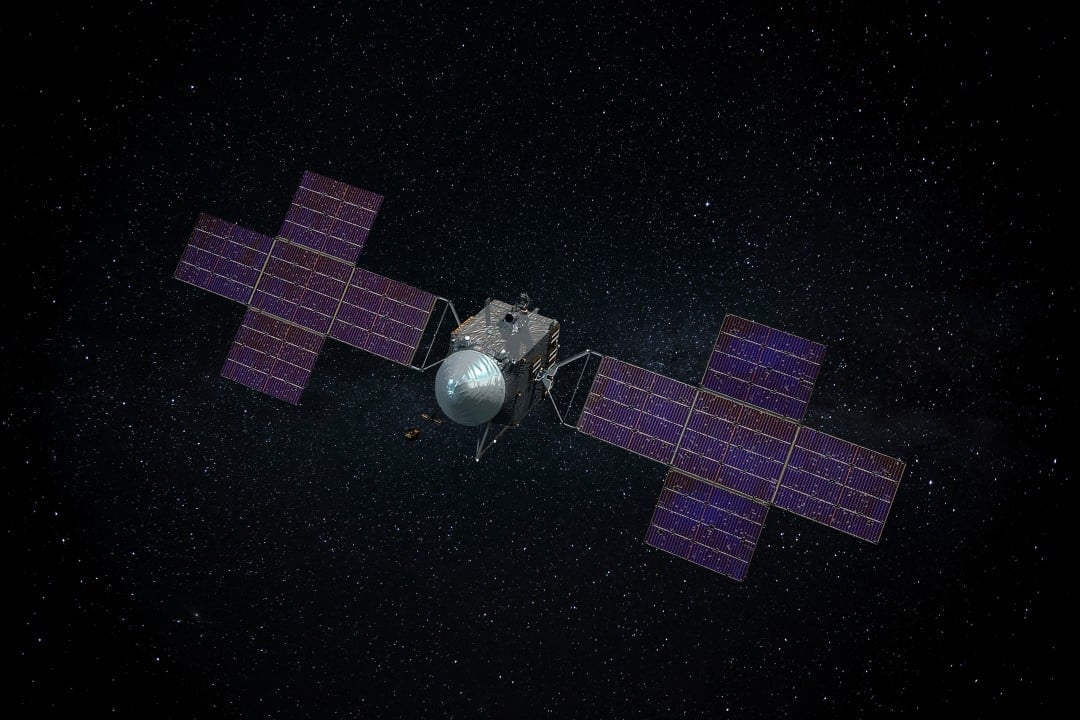
NASA’s Psyche spacecraft completed a strategic gravitational boost as it passed Marte on Friday, accelerating toward its final destination in the asteroid belt. The robotic probe traveled through the Martian atmosphere at 19,848 km/h, less than 4,500 kilometers from the red planet, equivalent to the distance between the east and west coasts of Estados Unidos. Durante passed, all scientific instruments were activated, capturing thousands of photographs that will serve as a technical rehearsal for the main encounter with the asteroid Psyche scheduled for 2029.
The spacecraft’s cameras documented different perspectives of the planet. Quando the probe approached, Marte appeared as a crescent; at the moment of closest proximity it transformed into an almost complete sphere in the rear view mirror. Essas images enable dual functions: precision adjustments to scientific instruments and visual material of exceptional quality for subsequent analysis. Jim Bell, leader of the Universidade Estadual imaging team of Arizona, highlighted the importance of the photographs obtained during the approach.
Coordenação of simultaneous observations
NASA’s two Marte rovers, plus a small fleet of American and European orbiters, performed surface and atmospheric observations simultaneously during Psyche’s flyby. Esse coordinated monitoring allows direct comparisons of collected data, enriching scientific knowledge about the red planet. The collaboration between multiple probes in orbit or on the surface of Marte represents the level of sophistication of contemporary space operations.

Trajetória mission and timeline
The spacecraft was launched in 2023 and is halfway through its six-year journey to the asteroid Psyche. The destination is located on the outskirts of the asteroid belt, at a distance three times greater than Terra in relation to Sol. Psyche is expected to enter orbit around the asteroid in 2029 to begin two years of detailed studies. The vehicle, the size of a van, runs on solar electric propulsion, using xenon gas thrusters as a maneuvering system.
The asteroid and its scientific importance
The asteroid Psyche has unique characteristics in the asteroid belt. Possui is roughly shaped like a potato, measuring approximately 278 kilometers long and 232 kilometers wide. Embora the asteroid belt contains millions of objects, most are composed of rock or ice. Apenas A small percentage of the asteroid population has a metal-rich composition, making Psyche an extraordinary target for scientific research.
Scientists suspect the asteroid could represent the exposed nickel and iron core of a forming planet, fragmented by cosmic collisions billions of years ago. Essa hypothesis raises fundamental questions about the emergence of the solar system:
- Formação of primordial planets 4.6 billion years ago
- Planetary Differentiation Processos and Metal Core
- Colisões cosmic and orbital reconfigurations
- Origem of life in Terra and initial conditions of the solar system
- Composição mineralogical of primitive celestial bodies
Relevância for Understanding the Solar System
Estudar an object like the closely spaced asteroid Psyche could provide critical information about the emergence of the early solar system and about the mechanisms by which conditions favorable for life arose in Terra. Detailed analysis of a possible exposed planetary core offers a unique opportunity to examine the internal structure of celestial bodies without the need for excavation or drilling. The mission represents significant investment in understanding the cosmic processes that have shaped not only our planet, but the entire architecture of the solar system.
The passage by Marte marks a critical point in the contemporary space exploration schedule, consolidating NASA’s technological capacity to perform precision gravitational maneuvers. Data collected during this approach will provide important validation for the navigation systems and sensors that will operate near Psyche in the years to come, ensuring successful scientific investigation when the probe finally reaches its destination in 2029.