

Apple intensifies a convergence strategy between its products with the launch of the MacBook Neo for US$599 and the highly anticipated iPhone Fold, expected in September 2026. Esses new devices share hardware and software features that were previously exclusive to different categories, significantly changing the positioning of the iPad in the company’s portfolio. The move reinforces a debate about the future of tablets in the Apple ecosystem.
MacBook Neo arrives to compete with entry-level iPad
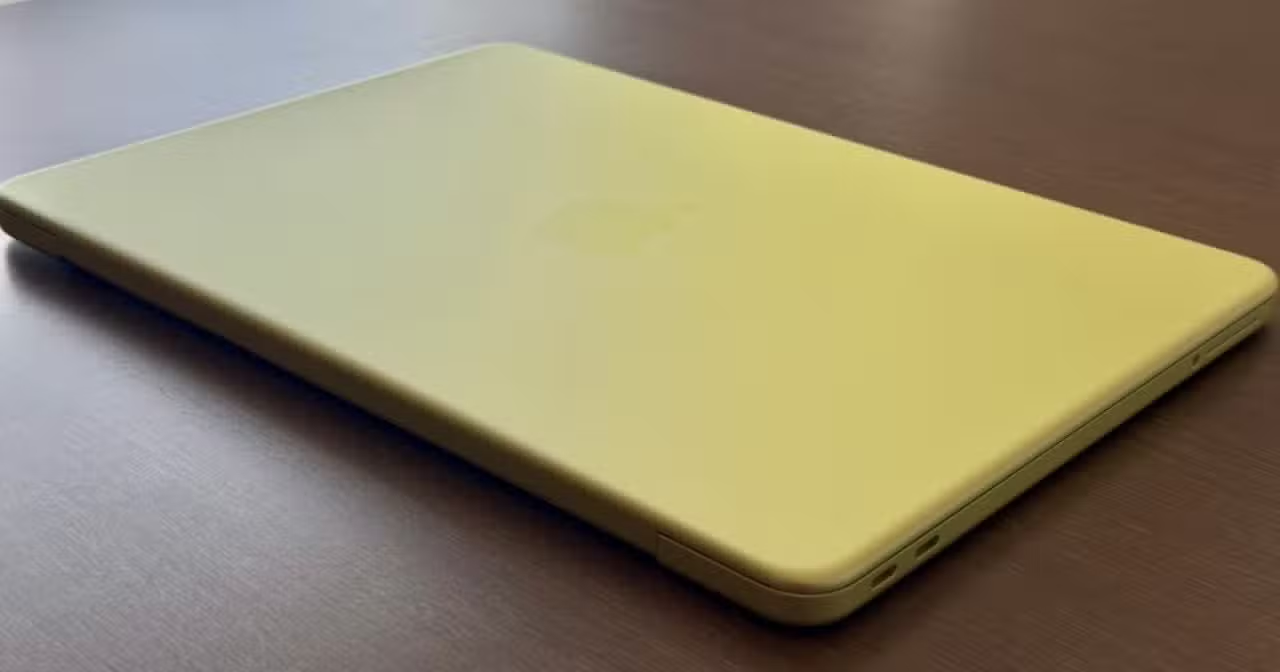
Lançado in March 2026, the Neo MacBook offers a starting price of US$599 for consumers and US$499 for students, equipped with an A18 Pro chip, 8 GB of unified memory and storage starting at 256 GB. The lightweight design with vibrant colors such as blush, indigo, silver and citrus aims to attract young users and those in the educational segment. The battery promises up to 16 hours of continuous use.

The model puts direct pressure on the entry-level tablet market. Consumidores who previously considered an iPad Air as their first device now evaluate the MacBook Neo in the same price range. The laptop offers a full operating system with desktop app support, robust file management, and native software execution that iPadOS still limits. Essa direct choice especially affects the entry-level tablet segment.
- MacBook Neo starts at $599 ($499 for education)
- Chip A18 Pro with 6 CPU and 5 GPU cores
- Bateria with up to 16 hours of autonomy
- Disponível in vibrant colors to attract young audiences
- Foco in students and basic task users
Embora does not have a touch screen, the MacBook Neo works as a gateway to more advanced models. Apple continues to sell MacBook Air with M5 and MacBook Pro with M5 Pro and M5 Max. Rumores indicate that the next MacBook Pro, scheduled for late 2026 or early 2027, should include an OLED screen with touch support and Dynamic Island, further expanding convergence.
iPhone Fold threatens iPad mini’s niche
Apple’s first foldable iPhone is expected to arrive in September 2026 with an internal screen measuring approximately 7.8 inches in book format, a 4:3 aspect ratio similar to tablets. Quando closed, the external screen is around 5.5 inches. The thickness reaches approximately 4.5 mm when opened, with a titanium structure for greater durability. The estimated price exceeds US$2,000, positioning it as a premium product.
The design seeks to reduce the visible fold on the screen as much as possible, while the iOS interface must adapt to offer multitasking closer to iPadOS. Usuários looking for a compact device for reading, note-taking or consuming content may prefer the Fold iPhone rather than carrying a separate iPad mini. Extreme portability combined with a large screen when necessary represents a unique proposition on the market.
Software brings different product categories together
Durante years ago Apple maintained parallel lines for Mac and iPad with specific features. The iPad Pro uses M5 chips and works almost like a laptop with an external keyboard, while the MacBook Pro should have an adaptive touch interface with larger buttons in finger mode and classic controls in mouse or trackpad mode. macOS 27 should bridge gaps between the two operating systems.
iPadOS 26 has already brought significant advances such as an improved floating window, menu bar, more accurate cursor and desktop-level application execution. Esses features bring the tablet closer to a computer, but maintain limitations such as the lack of full support for macOS-exclusive software and restrictions on installing apps from external sources. Essa gradual evolution reduces functional differences between categories.
iPad Futuro in a converged ecosystem
Apple is not expected to discontinue the iPad in the next few years. The segment still dominates global tablet sales and generates stable revenue for the company. Porém, the strategy of sharing resources between MacBook Neo, iPhone Fold and iPad may make some models less essential for certain user profiles. The choice between devices will vary depending on specific needs and available budget.
Usuários that rely on heavy multitasking or professional applications tend to migrate to Macs with touch. Quem prioritizes lightness and media consumption, you can opt for the Fold iPhone or keep the iPad. Convergence does not mean the immediate end of any line, but reflects gradual adjustment of Apple to offer more integrated options in the ecosystem.