

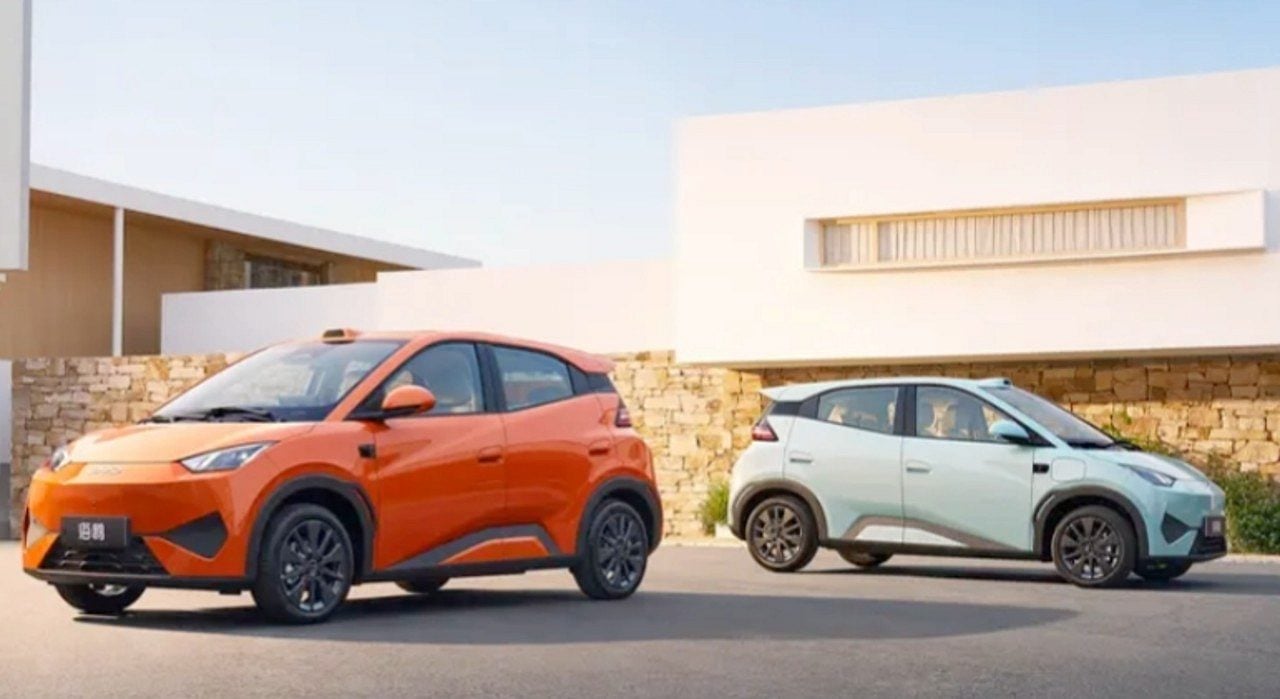
BYD introduced the 2026 version of the Dolphin Mini with a significant technological upgrade: the integration of LiDAR sensors and the DiPilot 300 advanced autonomous driving system. The Chinese electric compact, which was already a reference in the entry-level segment, now receives navigation and obstacle detection capabilities that were previously exclusive to premium models. The change reinforces the manufacturer’s strategy of democratizing autonomous technologies in lower-priced vehicles, intensifying competition in an increasingly competitive market.
LiDAR sensor revolutionizes security capabilities
The LiDAR sensor added to the Dolphin Mini works like a laser radar, mapping the environment in three dimensions using infrared pulses. The technology allows precise navigation in urban centers, traffic sign recognition, highly accurate lane reading and real-time obstacle detection. Essa sensory capability significantly transforms the active safety features available in the compact segment.

The DiPilot 300 system integrates multiple environmental perception technologies: high-resolution cameras, millimeter-wave radar, ultrasonic sensors and precision 3D mapping. Na China, the system is offered as an option for 15,300 yuan (approximately 11,000 reais). The Dolphin Mini starts at 69,900 yuan (about 50,500 reais) and reaches 85,900 yuan (62,100 reais) in the top-of-the-line version.
- Frenagem automatic emergency response (AEB) with obstacle detection.
- Monitoramento real-time driver fatigue.
- Câmera 360-degree vision for safe operation.
- Central DiLink 150 multimedia with 12.8 inch screen.
- Carregamento 50W wireless for mobile devices.
- Ar-bidirectional conditioning with independent heating and cooling.
Redesenho visual and design update
The Dolphin Mini 2026 has received a complete aesthetic overhaul. The new front bumper, 16-inch wheels and redesigned headlight give the compact a modern look. The rear also got a new logo, making the look more striking. The interior follows the trend of simplicity and clarity, with a beige instrument panel and a steering wheel with a discreet logo in neutral tones.
The electric motor remains unchanged, generating 75 horsepower and 13.8 kilogram-force of torque. The China offers two interchangeable battery options. Segundo data from local tests, the version with a 30.08 kWh battery achieves a range of 305 kilometers, while the 38.88 kWh battery achieves a range of 405 kilometers.
Posicionamento competitive in Chinese market
The implemented updates reflect BYD’s strategy of strengthening the model in the entry-level segment. The Dolphin Mini reached peak sales in April 2025 with 34,005 units, but numbers declined in the following months. In June, it sold 30,708 units, without surpassing the previous peak. The competitor Geely Emgrand EX2 sold 465,775 units in 2025, while the Dolphin Mini totaled 319,956 units in the same period, a difference of 150 thousand vehicles.
The incorporation of LiDAR into the Dolphin Mini represents a deliberate differentiation strategy. Fora from China, ADAS systems with this technology rarely appear in vehicles in this price range, making BYD’s proposal competitively attractive. The company maintains a significant global presence in the electric vehicle market and continues to invest in safety and autonomous technology, consolidating its reputation as an innovative manufacturer.
Contexto global and future prospects
No Brasil, Dolphin Mini has not yet received the same updates as the Chinese version, maintaining the previous configuration. The spread of technologies such as LiDAR into compact segments represents significant transformation in the global automotive industry. Funcionalidades that were previously exclusive to premium models now migrate to the mass segment, reflecting the fierce competition from China in the industry. Essa trend demonstrates how Chinese technological innovation is redefining active safety standards across all price ranges, driving the global automotive industry towards increasingly accelerated transformations.