

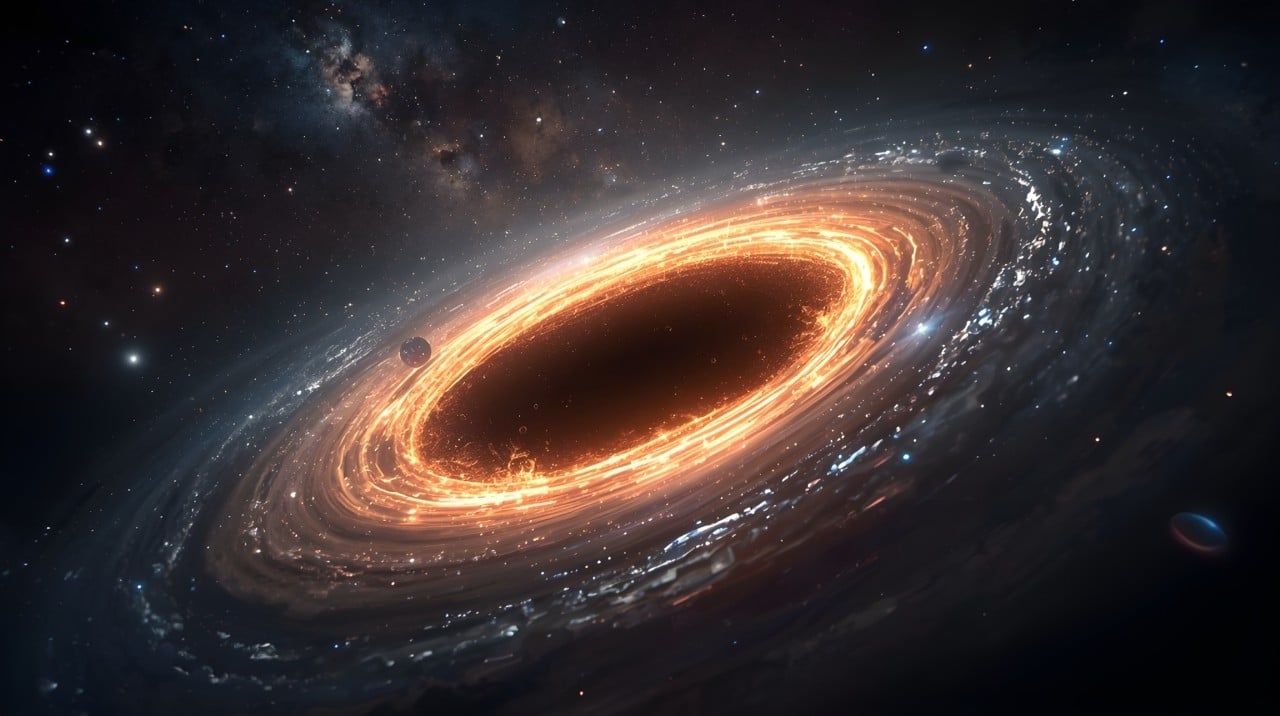
A team of astronomers, led by Vasily Kokorev of the University of Texas at Austin, has revealed substantial evidence that the object GLIMPSE-17775, observed as a small red dot in the cosmos, is actually a black hole surrounded by a layer of dense gas.
The investigation, whose results were released by NASA last Wednesday (10), examined the most detailed spectrum ever captured of a tiny red dot in space. The fundamental discovery was made using the James Webb Space Telescope.
This advanced space equipment, responsible for the original identification of this type of celestial body in 2022, now offers a more in-depth analysis of GLIMPSE-17775. The new mapping not only improves the understanding of these stars, but is also crucial for unraveling mysteries of the formation and evolution of the primordial universe.
“I believe that part of the scientific community is converging on a singular view: that the small red dots can be explained by models of stars with black holes. But none of the previous small red dots had all the evidence in the same place,” commented Kokorev, the study’s lead author.
The scientist added that, “With GLIMPSE-17775, we can test these models due to the depth and incredible extension of the spectrum of this source.”
Webb’s detailed revelations about celestial bodies with black holes
Shortly after beginning its scientific operations, the James Webb Telescope identified an enigmatic new type of celestial body: an abundance of red objects that formed approximately 600 million years after the Big Bang.
Since then, researchers have investigated several hypotheses for the existence of these small reddish dots, including the possibility that they are stars that harbor black holes in their cores.
A set of favorable conditions allowed the detection of this new and intricate spectrum of the red dot, called GLIMPSE-17775, which is more distant than the galaxy cluster and has its image magnified by the effects of gravitational lenses.
The recent study of this unprecedented object resulted in the identification of more than 40 spectral lines originating from this small red source, configuring the most detailed spectrum of a red dot ever recorded.
“When we first saw the spectrum, it was like having all the pieces of a puzzle spread out on the floor,” described Kokorev. “We took each piece of the puzzle, measured the lines, and started combining the different pieces into a mosaic. Maybe some pieces didn’t look like anything at first, but then some of them came together and we realized there was something there.”
The spectroscopic information obtained by Webb presents multiple pieces of evidence supporting the conclusion that the red dot GLIMPSE-17775 is, in fact, a star with a central black hole.
Reflecting on the future, the research author expressed his anticipation: “Looking ahead, I’m eager to dig deeper and learn about what powers the central engines of these little red dots. While we believe it’s a black hole, there are other interesting theories being proposed, which is exciting. Maybe in a year or two, we’ll have the definitive answer about what powers these sources.”