James Webb Telescope reveals never-before-seen cosmic structure with 164,000 galaxies
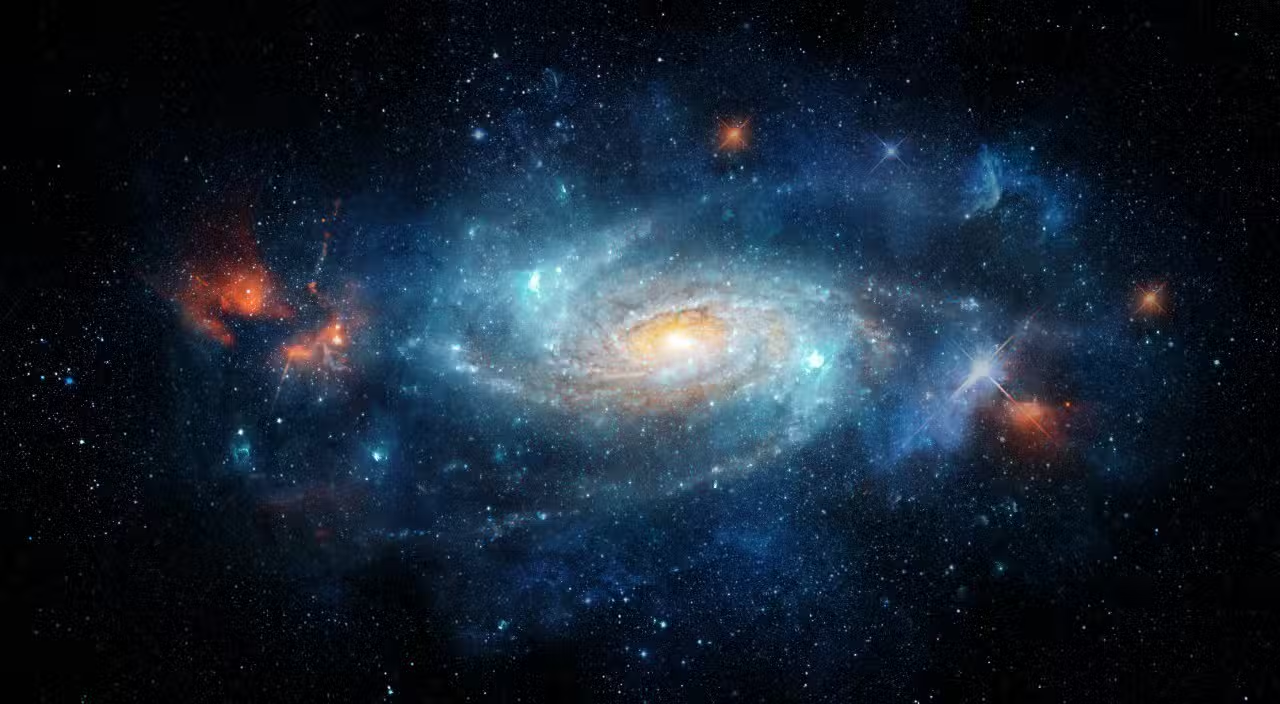
Telescópio Espacial James Webb (JWST) has produced the sharpest map ever obtained of the cosmic web, the immense network that connects galaxies across the universe. The COSMOS-Web survey, the instrument’s largest general observation program to date, analyzed more than 164,000 galaxies and dates back almost to the infancy of the cosmos, showing structures from when it was just a billion years old. The research was published in the magazine The Astrophysical Journal with the participation of experts from ten countries.
JWST’s sensitive infrared instruments detect faint galaxies invisible to previous telescopes and penetrate dense clouds of cosmic dust. Desde its launch in 2021, the observatory has dramatically expanded astronomers’ ability to study the distant universe. Pesquisadores of Universidade of Califórnia, Riverside, conduct the survey with collaborators from Estados Unidos, Dinamarca, Chile, França, Finlândia, Suíça, Japão, China, Alemanha and Itália.
Detalhes Unpublished Structure of the Universe
The cosmic web forms a skeleton-like structure composed of filaments and layers of dark matter and gas that surround vast voids. The COSMOS-Web survey covers an area of the sky roughly equivalent to three full moons and was specifically designed to reveal the distribution of matter throughout cosmic history. Bahram Mobasher, professor of physics and astronomy at UCR, highlights the progress made: previous observations by Hubble confused many structures that now appear as multiple distinct filaments.
“The leap in depth and resolution is truly significant. Agora we can see the cosmic web at a time when the universe was only a few hundred million years old, an era that was essentially unattainable before the JWST,” Mobasher explained. What previously seemed like a single structure now reveals itself in several layers, with details that remained hidden from previous instruments.
Hossein Hatamnia, lead author of the study, explains that JWST allows the precise positioning of galaxies in time and space. Essa capability produces a much sharper image of the cosmic web than those obtained in previous surveys. The cataloged data records how clusters and filaments evolved over billions of years.
Capacidades instrument techniques
Telescópio James Webb is distinguished by its sensitivity in the infrared range, enabling observations that cut through cosmic dust. Essa feature facilitates exploration of regions of the cosmos further back in time than had ever been possible. The instrument’s sensors capture light that has traveled billions of years to reach Earth’s orbit.
The area mapped by the COSMOS-Web survey is significantly larger than previous studies of the same region of the sky. The extensive coverage allowed astronomers to track galactic distribution patterns with unprecedented precision:
- Análise of 164 thousand galaxies in detail
- Mapeamento of cosmic web filaments from the early universe
- Penetração in previously invisible dense dust regions
- Posicionamento three-dimensional accurate in time and space
- Identificação of multiple structures in regions previously considered unique
Implicações for modern astronomy
The COSMOS-Web survey represents a milestone in the observational capacity of contemporary astronomy. The analysis techniques developed during the project make it possible to identify galaxies whose light came from them when the universe was extraordinarily young. Pesquisadores can now map the fundamental architecture of the cosmos with clarity that changes previous understanding.
The data obtained by JWST reveals that the cosmic structure is more complex than previous observations indicated. The international collaborations participating in the project access information about how matter was distributed in the first billion years after Big Bang. The research provides references for theoretical models on galactic evolution and the formation of large-scale structures.
The observations made also demonstrate the strategic importance of Telescópio James Webb for future cosmological research. The instrument remains operational and programmed for new surveys that will further expand knowledge about the primitive universe. The international collaboration that produced COSMOS-Web highlights how large-scale scientific projects require globally distributed resources and expertise to achieve their objectives.
Veja Tambem em Latest News (EN)

João Fonseca x Djokovic: time and where to watch the game live at Roland Garros

Conmebol Libertadores round of 16 draw: classifieds, pots and where to watch live

United States classifies PCC and Red Command as terrorist groups with blockade of assets
United States classifies PCC and Red Command as terrorist organizations in decision from June 5th

Luxury meeting financed by Daniel Vorcaro in New York becomes the target of Federal Police investigation

King Charles III’s cancer progression accelerates transition of power to Prince William and Kate

Samsung changes Galaxy S26 Ultra design and restricts fast charging for thermal safety

Steam platform releases four independent games for free for permanent redemption on computers

PlayStation 5 users redeem Ark and 2XKO for free without PlayStation Plus plan

Rockstar Games changes Grand Theft Auto VI release date to second half of 2025

Chinese probe Tianwen-1 records interstellar comet 3I/ATLAS from Mars orbit