

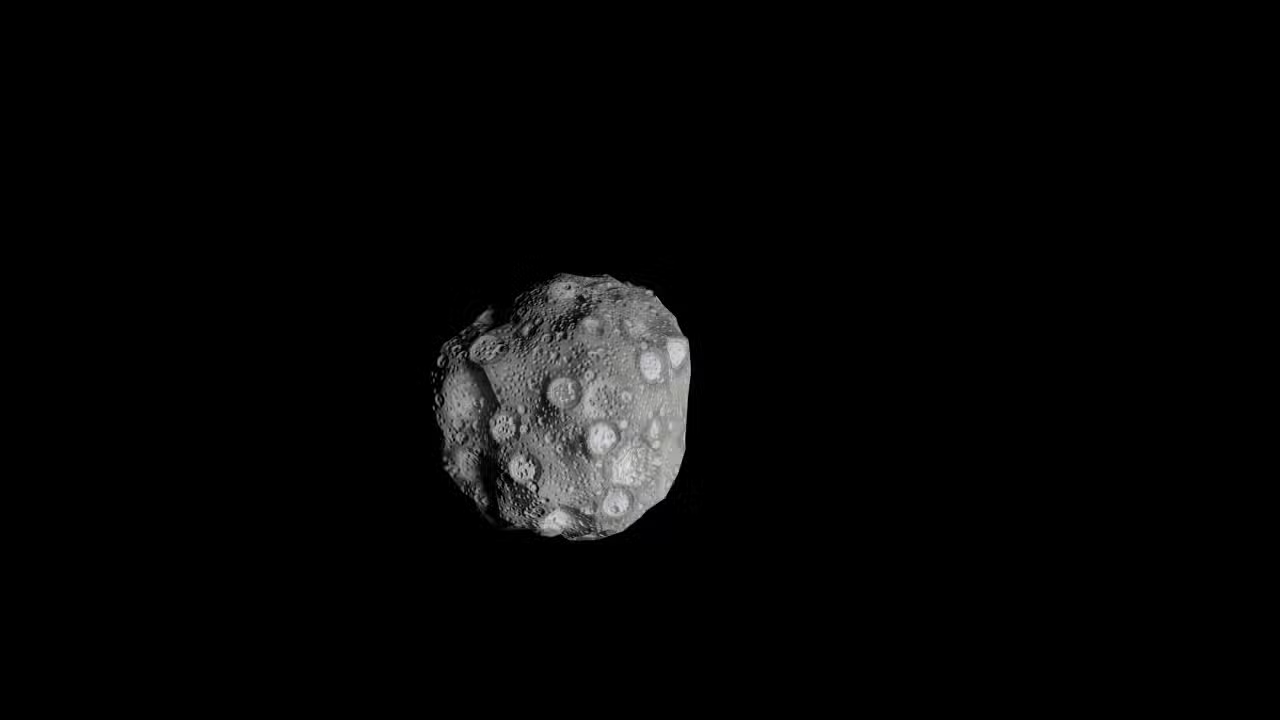
Asteroid 2024JH2 will make a close approach to Terra this Monday, May 18, at around 7pm Brasília time. With a length of around 35 meters comparable to the size of a bus or a blue whale, the object will pass 91 thousand kilometers away from the planet, equivalent to a quarter of the distance between Terra and Lua. Conforme scientists’ assessment, there is no risk of impact with the Earth’s surface.
The discovery of the asteroid occurred less than two weeks ago. On May 10, astronomers at Observatório of Monte Lemmon, at Tucson at Arizona, identified the object by analyzing space monitoring data. Estudos indicate that 2024JH2 completes an orbit around Sol every 3.7 years, with its trajectory ending close to Júpiter.
Distância places asteroid above most satellites
Apesar of the approach considered close in astronomical terms, the distance of 91 thousand kilometers keeps the asteroid well above most satellites in Earth orbit. Para context, the Satélite of Pesquisa of Exoplanetas in Trânsito (TESS), a crucial scientific observation equipment, orbits at a lower altitude and will not suffer any interference or risk of collision with 2024JH2.
https://twitter.com/Asismet_IF/status/2056367422643347701?ref_src=twsrc%5Etfw
The asteroid’s passage follows regular patterns of celestial approaches constantly monitored by international space agencies. Esses events, although rare in terms of proximity, are cataloged and tracked for research and planetary security purposes.
Tamanho comparable to historic 2013 meteorite
The asteroid has dimensions similar to those of the Chelyabinsk meteorite, which reached the Earth’s atmosphere in 2013. In the Naquele episode, the space rock exploded in the sky of Rússia in an event that marked the largest entry of an object of this size into the atmosphere of Terra in almost 120 years. Apesar of dimensional similarity, 2024JH2 does not present trajectory conditions that would lead it to enter the planet’s atmosphere.
The comparison with Chelyabinsk serves as a reference to size the magnitude of the object that will pass close to Terra. Aquele 2013 event generated significant energy release and was detected by global seismic monitoring networks. Pesquisadores uses such precedents to calibrate warning systems and better understand the risks associated with celestial bodies approaching Earth.
Observação will be possible with optical equipment
Asteroid 2024JH2 can be viewed using small telescopes during the time of its closest approach. Astrônomos Amateurs equipped with optical instruments of moderate quality will be able to follow the object’s movement across the sky. Para observers without access to telescopes, technological alternatives will be available:
- Transmissão live on the Virtual Telescope website, starting at 4:45 pm Brasília time
- Continuous Cobertura of professional observatories that perform public monitoring of astronomical events
- Citizen science Plataformas that provides real-time tracking data
- Aplicativos astronomy charts that indicate the exact position of the asteroid in the night sky
- Canais science education offering expert analysis during passage
Scientific Monitoramento anticipates new discoveries
The early detection of 2024JH2 exemplifies the sophistication of object tracking systems near Terra implemented by space agencies. Observatórios and Monte Lemmon use high-resolution digital imaging technology combined with artificial intelligence algorithms to identify asteroids before they get too close to the planet.
Essa’s early discovery capability allows scientists to accurately calculate the trajectories of celestial bodies months or years before a close approach. The time interval between the discovery of 2024JH2 and its passage allowed experts to confirm the absence of an impact risk and prepare scientific observations to study the properties of the asteroid.