
Subaru Telescope detects chemical change in interstellar comet 3I/ATLAS after approach to the Sun
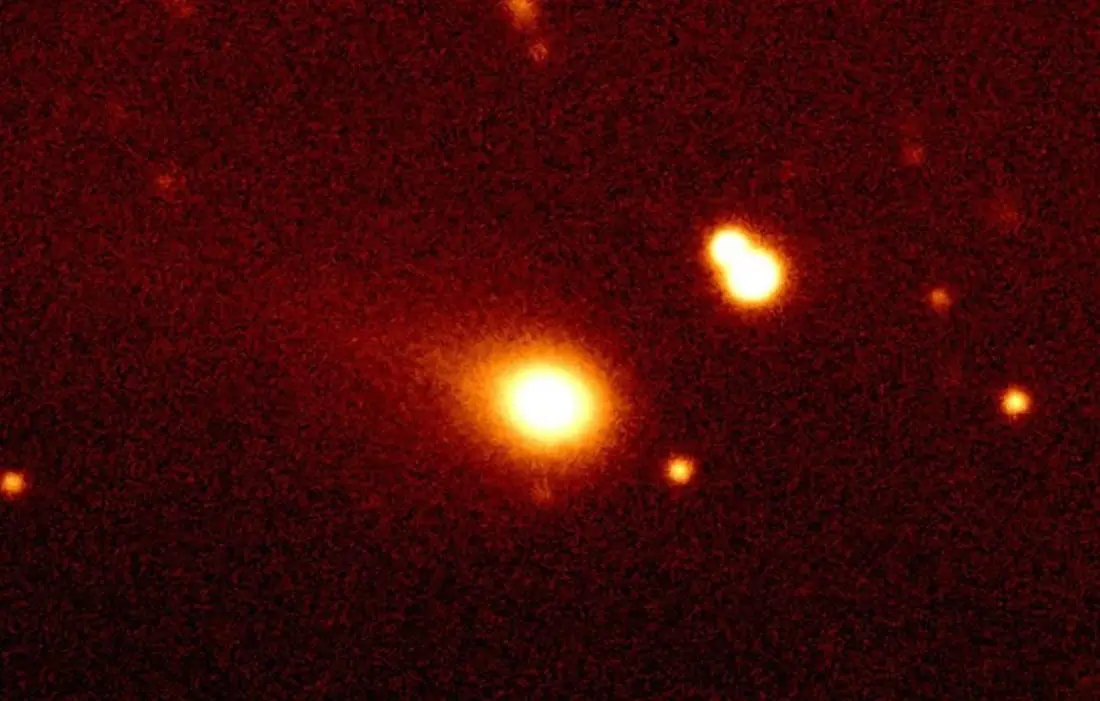
The interstellar comet 3I/ATLAS recorded a substantial change in the chemical composition of its coma after reaching the point of closest proximity to Sol. The phenomenon was captured by astronomers using Telescópio Subaru on January 7, 2026. Este celestial body represents the third object confirmed by science with an origin external to our Sistema Solar. The star’s closest approach, known as perihelion, occurred months earlier, on October 29, 2025.
Pesquisadores identified a drop in the proportion between carbon dioxide and water released by the object’s core. The indices recorded at the beginning of this year were well below those measured by space telescopes in August 2025. The complete study, conducted by an international team, is scheduled for publication on April 22, 2026 in the scientific journal The Astronomical Journal. The discovery provides unprecedented data on the internal structure of bodies formed in other regions of the galaxy.

Oxygen Lines Medição Exposes New Chemical Ratio
The team of scientists, led by researcher Yoshiharu Shinnaka of Instituto of Ciências Espaciais Koyama of Universidade Kyoto Sangyo, used advanced observation methods. The group applied techniques originally developed for the study of local comets to the analysis of this distant visitor. The Telescópio Subaru, an equipment with a primary mirror measuring 8.2 meters in diameter installed on the summit of the inactive volcano Mauna Kea, at Havaí, captured the essential spectroscopic data for the research. The observatory’s high altitude ensures a clear view of deep space.
On the same topic: Subaru Observatory records unprecedented chemical change in comet 3I/ATLAS after passing by the Sun
Astronomers focused instrument calibration on measuring forbidden oxygen emission lines present in the cloud of gas and dust surrounding the nucleus. Esse specific method allowed calculating the exact ratio between carbon dioxide and water in an indirect but highly accurate way. The final result pointed to a drastic reduction in the presence of CO2 compared to the information collected before passing through perihelion. The sudden change surprised experts involved in daily monitoring of the star.
The chemical variation suggests complex warming dynamics. Diferentes layers of the comet’s nucleus contributed to the release of volatile gases as the temperature increased. Intense solar radiation reaches the surface of the object and causes the ice to immediately sublimate. Esse physical process turns solid material directly into gas, ejecting particles into a vacuum and forming the glowing structure known as a coma.
Radiação cosmic and the internal structure of the celestial body
The discrepancy in the data indicates that the composition of the interior of 3I/ATLAS differs substantially from its outermost layer. Objetos Interstellars travel through deep space for millions or even billions of years. Durante this long journey in the dark, the surface is exposed to the constant bombardment of high-energy cosmic radiation. Esse process degrades and chemically alters the comet’s crust long before it approaches any hot stars.
Quando the celestial body finally entered the zone of thermal influence of Sol, the extreme heating removed the most volatile material accumulated on the outside. With the destruction of this primordial shell, the gases trapped in the deepest and most protected layers began to escape into space. The proportion of elements measured after perihelion reflects much more faithfully the original composition of the interior of the nucleus. The observation offers a real glimpse into the raw material of the star system where the comet was born.
Cometas originating from our own Sistema Solar often show predictable trends in releasing volatile materials as the distance from Sol decreases or increases. 3I/ATLAS, however, had already demonstrated atypically high values of carbon dioxide in the first observations made last year. The sharp drop recorded later reinforces the unique and unpredictable character of this interstellar visitor. The data challenges traditional mathematical models used in contemporary astronomy.
Read also: Heat from the Sun causes fragmentation of the interstellar comet 3I/ATLAS at 210 million km
- The observations with Telescópio Subaru occurred more than two months after closest approach with Sol.
- The ratio of carbon dioxide to water measured in January 2026 was lower than the data from August 2025.
- The scientific team compared the object’s behavior with that of comets already known from Sistema Solar.
- The full study on chemical variation will be published in The Astronomical Journal on April 22, 2026.
Histórico of detections and the role of space telescopes
3I/ATLAS consolidates a new era in astronomical observation as the third interstellar object ever detected by humanity. The pioneer in this category was 1I/’Oumuamua, discovered in 2017, which intrigued the scientific community with its elongated shape and anomalous acceleration. Dois years later, telescopes identified 2I/Borisov, which presented characteristics much more similar to traditional comets. Cada, one such celestial body, offers fragmentary clues about the physical and chemical conditions prevailing in other planetary systems.
Astronomers treat these rare visitors as free samples of materials formed in the orbit of other Via Láctea stars. The chemical evolution documented in 3I/ATLAS helps to understand sublimation processes and nuclear architecture in environments subjected to different levels of gravity and radiation. Continuous monitoring allows you to establish a pattern of behavior for objects ejected from their source systems. Science depends on these events to expand knowledge about the galaxy.
Antes From the analysis carried out on Havaí, the comet was already being tracked by a network of cutting-edge instruments. Previous Observações drives conducted by Telescópio Espacial James Webb and JUICE interplanetary probe sensors have mapped the celestial body’s early activity. Essas platforms recorded the primary release of water, carbon dioxide and several other complex organic compounds. The combination of space and ground-based data creates a complete picture of the comet’s degradation throughout its passage.
Contribuições for planetary formation models
Detailed analysis of interstellar objects allows researchers to directly compare raw materials from distinct star systems. The study focused on 3I/ATLAS provides fundamental support to improve theoretical models on how planetesimals and rocky planets form from dust and gas disks. The presence or absence of certain chemical elements dictates the potential of a system to harbor habitable worlds. Water and carbon are the building blocks of life as we know it.
The scientific community projects a significant increase in the detection of these celestial bodies over the next decade. Pesquisadores hope that the coming into operation of new large-field survey telescopes will discover dozens of similar visitors every year. Cada new observation adds crucial statistical data about the chemical diversity spread across other systems in our galaxy. Technological advancement in optical and infrared sensors makes tracking fast, dark targets much more efficient.
Understand the case: Interstellar comet 3I/ATLAS reveals chemical changes after passing by the Sun
The team responsible for the study highlighted that techniques consolidated over decades for analyzing local comets have now proven their effectiveness in interstellar targets. Isso considerably expands the possibilities of comparative analysis in modern astrophysics. Comet 3I/ATLAS continues its hyperbolic trajectory, gradually moving away from Sol towards deep space. Novas observation campaigns are already scheduled and could bring even more details about its residual activity before it completely disappears into the dark of the universe.
More news in Latest News (EN)
See more →More news on Mix Vale
- 1Saxony-Anhalt results underscore growing momentum for European far-right parties ahead of key votes
- 2Julia Louis-Dreyfus reveals intense creative clashes shaped iconic sitcom ‘Seinfeld’s’ groundbreaking humor
- 3U.S. forces dismantle sophisticated floating drug refueling station tied to Ecuadorian narco-terror group
- 4Giants make unexpected roster move, release longest-tenured player Darius Slayton as Harbaugh era begins
- 5One Nation’s superannuation proposal sparks debate over retirement security and housing affordability
- 6AfD electoral win in Saxony-Anhalt faces governance hurdles, minor party crucial
- 7Austin Reaves enjoys Labor Day weekend after pivotal Lakers contract, poised for leadership
- 8Quieter Russian nuclear submarines heighten NATO’s Arctic defense concerns, alliance boosts northern presence
- 9NTSB confirms Amazon cargo jet crew survived Miami crash, five dead and five injured in runway overrun incident
- 10U.S. diplomatic efforts confront persistent China-Peru economic ties amid rising regional tensions