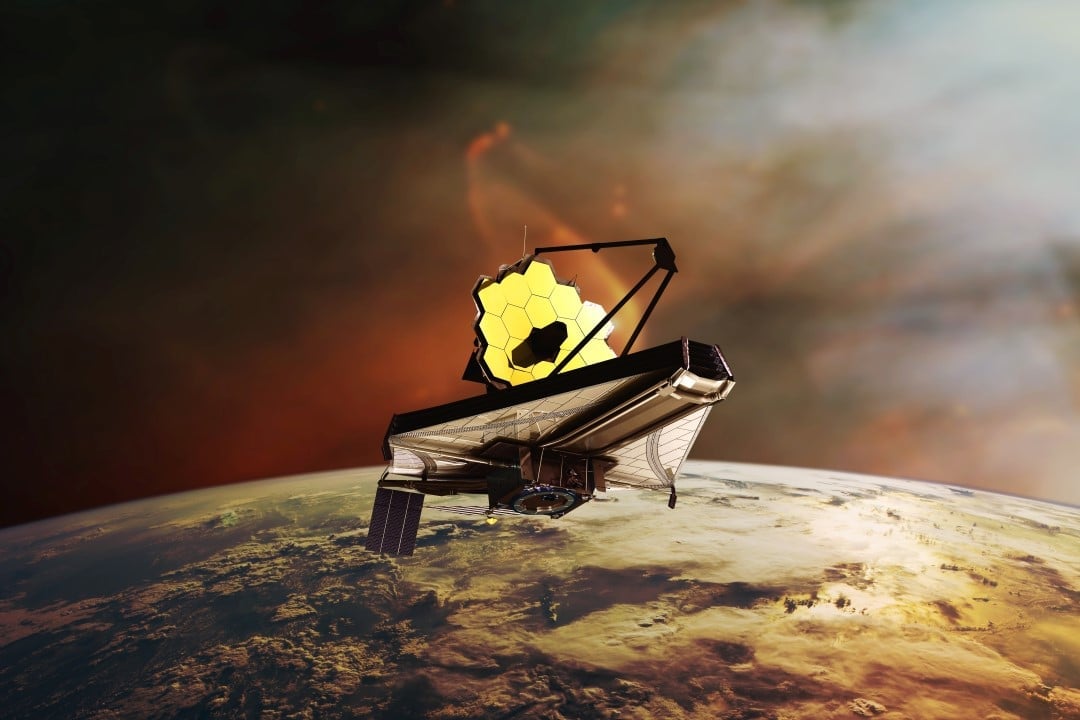
Telescópio Espacial James Webb captured never-before-seen images of the nucleus of the galaxy Messier 77, located 45 million light-years from Terra. The new records reveal hidden structures and extraordinary behaviors of a supermassive black hole never before observed with such clarity at visible wavelengths. The discovery underscores the infrared instrument’s revolutionary ability to penetrate dense layers of gas and dust that impede conventional telescopes.
The galaxy Messier 77, located in the constellation Baleia, belongs to the category of barred spiral galaxies, similar in structure to Via Láctea. Porém, a critical difference separates them: while the supermassive black hole of the Earth’s galactic nucleus, called Sagittarius A*, remains relatively inactive, the nucleus of Messier 77 exhibits extremely aggressive behavior. Este black hole has a mass approximately 8 million times greater than that of Sol.
Why does the core glow so brightly?
The black hole captures matter from its surroundings at extraordinary speeds, creating an accretion disk around it. Gás and dust orbit the central structure in accelerated motion, generating immense friction and releasing energy at inconceivable levels. The heat produced in this process produces radiation so powerful that it surpasses, in some regions, the combined brightness of all the remaining stars in the galaxy. Esse phenomenon is classified by researchers as an “active galactic nucleus”, and Messier 77 represents one of the most notable examples of this category.
The collapsing matter reaches speeds approaching that of light, heating to billions of degrees Celsius. The result is the emission of radiation in multiple spectrums, from X-rays to radio waves. Esse’s turbulent behavior contrasts sharply with the relative calm observed in typical galactic nuclei.
Revelações of the MIRI infrared instrument
James Webb’s Instrumento Infravermelho Médio (MIRI) provided the key to unlocking previously invisible structures. Infrared technology allows the telescope to pass through opaque layers of gas and dust that block visible light. Durante these observations, a central linear structure — called the “galactic bar” — emerged with stunning clarity, never captured directly at optical wavelengths.
The galactic bar consists of a linear region filled with stars that divides the spiral arms of the galaxy. Nestas zones, new star formation is reaching extraordinary rates, fueled by the vast reservoirs of dense gas present in these locations. Simultaneamente, the same material fuels the continued growth of the central black hole. The bluish hues in the images represent cooler dust, revealing the complete thermal architecture of the nuclear region.
The mystery of the orange lines
One aspect immediately visible in the images is the presence of bright orange lines emanating from the galactic center. Astronomers emphasize a crucial point: these structures have no real physical existence. Tratam is made up of optical artifacts created by the telescope’s own imaging process. São visual illusions resulting from the way the instrument processes and records extremely intense infrared radiation coming from the nucleus.
Esse phenomenon, although uninteresting from a structural point of view, does not diminish the scientific importance of the images. The presence of these artifacts attests to the extraordinary power of the system’s radioactive emissions. Apenas colossal intensity could generate such secondary optical effects.
Localização strategic for observation
Messier 77 occupies a privileged position from an astronomical point of view. Sua’s relative proximity — on a cosmic scale — and its direct visibility from Terra have made it the target of intense study for decades. Para comparison, Galáxia of Andromeda, largest among nearby galaxies, lies just 2 million light-years away. Apesar From this comparable distance, Messier 77 reveals infinitely more intriguing scientific features due to the exotic behavior of its central black hole.
Previous Observações have identified several notable components of the system:
- Disco of accretion in accelerated rotation around the black hole
- Stellar Formação active in the Galactic Bar region
- Emissões radiation in optical, ultraviolet and X-ray spectra
- Estruturas magnetic channeling high-energy plasma flows
- Abundância of molecular gas fueling both processes (star formation and black hole growth)
The paradox of gamma ray and neutrino emissions
A notable contradiction persists in the understanding of Messier 77. Conforme theoretical predictions, such active black holes should produce intense streams of gamma radiation—the most energetic photons in the universe. Porém, direct observations do not confirm such production at expected levels. The system remains dramatically deficient in gamma rays.
In radical contrast, the same system emits extraordinarily high quantities of neutrinos, the ghostly particles that pass through ordinary matter with virtually no interaction. Bilhões neutrinos pass through every square centimeter of Terra constantly, originating mainly from Sol, without leaving any detectable trace. Em Messier 77, neutrino production reaches abnormally high levels. Essa dichotomy represents a genuine challenge to current understanding of physical processes in hyperactive galactic nuclei. Astronomers are still searching for a coherent explanation for this persistent paradox, suggesting that fundamental mechanisms still remain unknown.