James Webb Space Telescope identifies mature galaxies and changes chronology of the universe
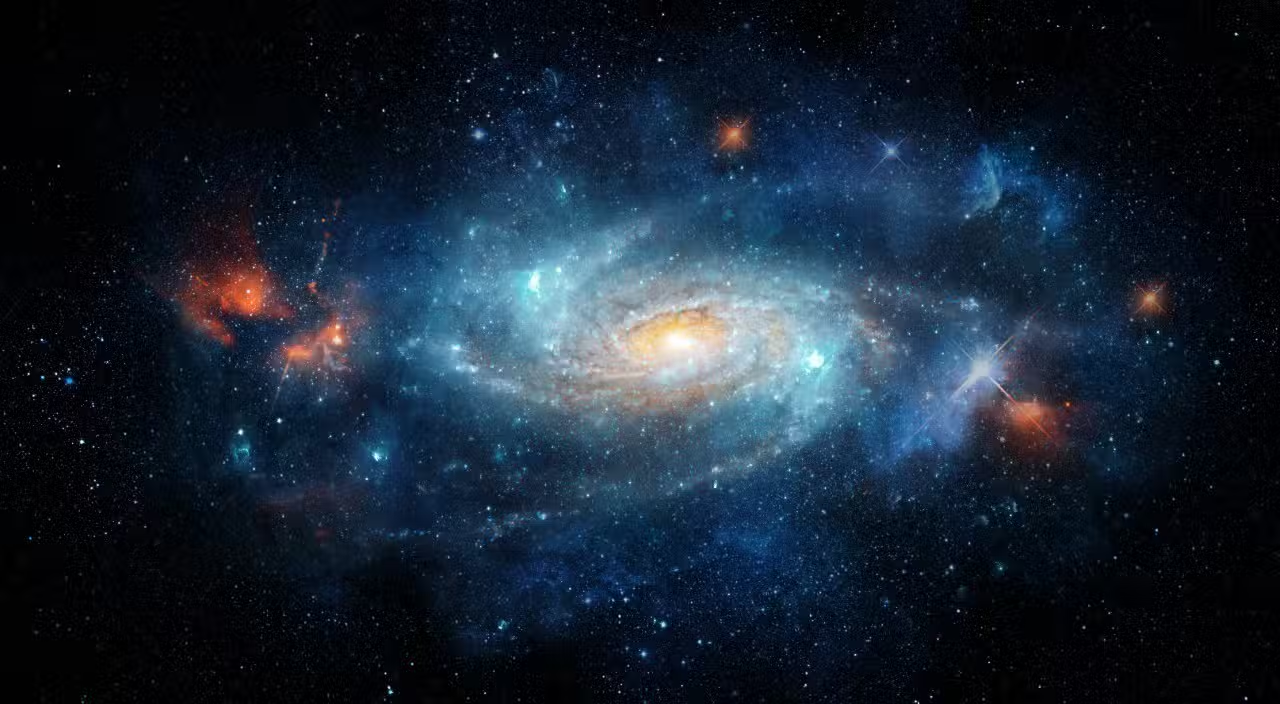
Telescópio Espacial James Webb recorded unprecedented images that question the current understanding of cosmic evolution. The captured data shows galaxies with a high degree of structural maturity at a time when the universe was only around two billion years old. The discovery surprised the international scientific community, as it changes the established chronology for the formation of large celestial bodies. The level of detail achieved by optical instruments allows for an unprecedented analysis of the light emitted in the early days of space existence.
Recent observations indicate that star formation processes and the internal organization of galaxies occurred much faster than traditional theories suggested. Pesquisadores from several institutions are now analyzing infrared recordings to understand how these massive structures consolidated so soon after Big Bang. Space equipment continues to provide fundamental information for modern astrophysics. Scientists need to reevaluate current cosmological models in 2026 to accommodate the volume of new visual evidence collected in deep space.

Estruturas barred spirals emerge ahead of theoretical predictions
One of the main findings involves the identification of a barred spiral galaxy at an advanced stage of development. Essa cosmic formation features a central band of bright stars that runs through the galactic core. The presence of this characteristic at such a remote time in the universe points to an extremely complex internal dynamic. Previous cosmological models indicated that the consolidation of these central bars would require billions of additional years to fully occur.
Especialistas from Universidade from Pittsburgh were part of the team responsible for this specific stage of the research. Scientists noted that the organization of the spiral arms and the density of the nucleus indicate an already stabilized galactic environment. Capturing these images was only possible thanks to the telescope’s high-sensitivity sensors. The equipment was specifically designed to see through dense clouds of cosmic dust that block visible light. The infrared light traveled billions of light years before reaching the observatory’s mirrors.
The realization that the young universe harbored such organized galaxies requires an immediate revision of stellar evolution timelines. The process of mass accretion and the formation of galactic disks needed to occur at an accelerated pace to justify the images received at the control bases. Astronomers are now searching for other similar examples in the mission’s vast database. The main goal is to confirm whether this pattern of rapid growth was the rule or an exception in the early cosmos.
Massive Colisões shaped the early space environment
Além of mature individual structures, the data revealed violent interactions between multiple large celestial bodies. Pesquisadores from Texas A&M have documented the simultaneous collision of at least five distinct galaxies. The catastrophic event happened approximately 800 million years after Big Bang. Essa multiple fusion generated an immense redistribution of matter in the surrounding space. The combined gravitational force altered the trajectories of billions of forming stars and planetary systems.
The impact between these stellar masses acted as a catalyst for new formations in the universe. The collision compressed gigantic clouds of hydrogen and helium. Esse process triggered the birth of countless stars in a short period of time. Elementos Heavier chemicals, forged inside the oldest stars, were ejected into the intergalactic medium during the shock of epic proportions. The dust resulting from this violent interaction served as the basis for the creation of new generations of celestial bodies.
The region where the collision occurred has very compact dimensions by known astronomical standards. The high density of galaxies in that particular sector of early space facilitated direct gravitational encounters. Informações combinations of different observational instruments confirmed the exact scale of the event. The aggressive dynamics of the early universe contrast sharply with the relative calm observed in Via Láctea’s current cosmic neighborhood.


Produção of stardust and the role of dwarf galaxies
The study of the distant universe also benefits from observing smaller, closer objects that simulate past conditions. The dwarf galaxy Sextans A has become an extremely important natural laboratory for scientists. Space equipment detected the presence of two rare types of cosmic dust in this isolated formation. The site’s simple chemical composition, dominated by light elements, closely resembles the environment that existed shortly after the creation of the observable universe.
Scientist Elizabeth Tarantino, researcher at Space Telescope Science Institute, coordinated the detailed analyzes of this dwarf galaxy. The team found that, despite its chemical simplicity, Sextans A produces dust at an impressive rate. Essas solid particles represent the fundamental raw material for the future formation of rocky planetary systems. The results of this specific study were highlighted during a recent American Astronomical Society meeting.
- Cosmic dust acts as a heat shield during the birth of new stars.
- Solid particles facilitate the clumping of rocks and the formation of future planets.
- Infrared observation allows the distribution of elements to be precisely mapped.
- The local data helps calibrate measurements made in much more distant galaxies.
In parallel to the study of stardust, a monumental discovery occurred with the identification of a colossal cluster in formation. The object, officially cataloged as JADES-ID1, began to structure itself just a billion years after everything began. The structure has a mass estimated at around 20 trillion times that of Sol. Trata is one of the largest galaxy nurseries ever recorded in this specific time window in cosmic history.
Integração data demands new parameters for astrophysics
Confirming the existence of the JADES-ID1 protocluster required a joint effort from different space observation platforms. The infrared images were crossed with data from the Chandra X-ray observatory. The emission of high-energy radiation proved the presence of immense amounts of superheated gas flowing between the cluster’s galaxies. The combined gravitational force of the structure keeps the gas confined within, fueling the continued growth of the massive system.
The accumulation of recent discoveries paints a scenario where the primordial universe was extremely active and efficient in creating complex structures. Bright Galáxias, multiple mergers and gigantic clusters emerged long before supercomputers could accurately simulate. The scientific publications of 2026 mark a turning point in the understanding of modern cosmology. Equipes researchers around the world are now working to refine the mathematical equations that govern large-scale spatial evolution.
The space observatory, operating continuously since its launch, guarantees a constant flow of raw data to partner space agencies. The ability to see the heat emitted by the first light sources in the cosmos changes the way humanity understands its own material origins. The next observation phases will focus on mapping even deeper areas of dark space. The reconciliation between established theory and new visual evidence will guide the direction of astronomy in the coming decades of scientific exploration.
Veja Tambem em Latest News (EN)

King Charles III’s cancer progression accelerates transition of power to Prince William and Kate

Samsung changes Galaxy S26 Ultra design and restricts fast charging for thermal safety

Steam platform releases four independent games for free for permanent redemption on computers

PlayStation 5 users redeem Ark and 2XKO for free without PlayStation Plus plan

Rockstar Games changes Grand Theft Auto VI release date to second half of 2025

Chinese probe Tianwen-1 records interstellar comet 3I/ATLAS from Mars orbit

Samsung confirms Galaxy devices that will receive update to One UI 7 with Android 15 this year

National Toyota Yaris Cross hits stores for R$130,000 with 30 km/l flex hybrid engine

Capcom plans unprecedented expansion for the Resident Evil franchise and new remakes by 2028

Yuliia Starodubtseva eliminates Elena Rybakina as Novak Djokovic advances at Roland Garros 2026

Galaxy S23 users are left without AirDrop support in Samsung’s new One UI 8.5 update