

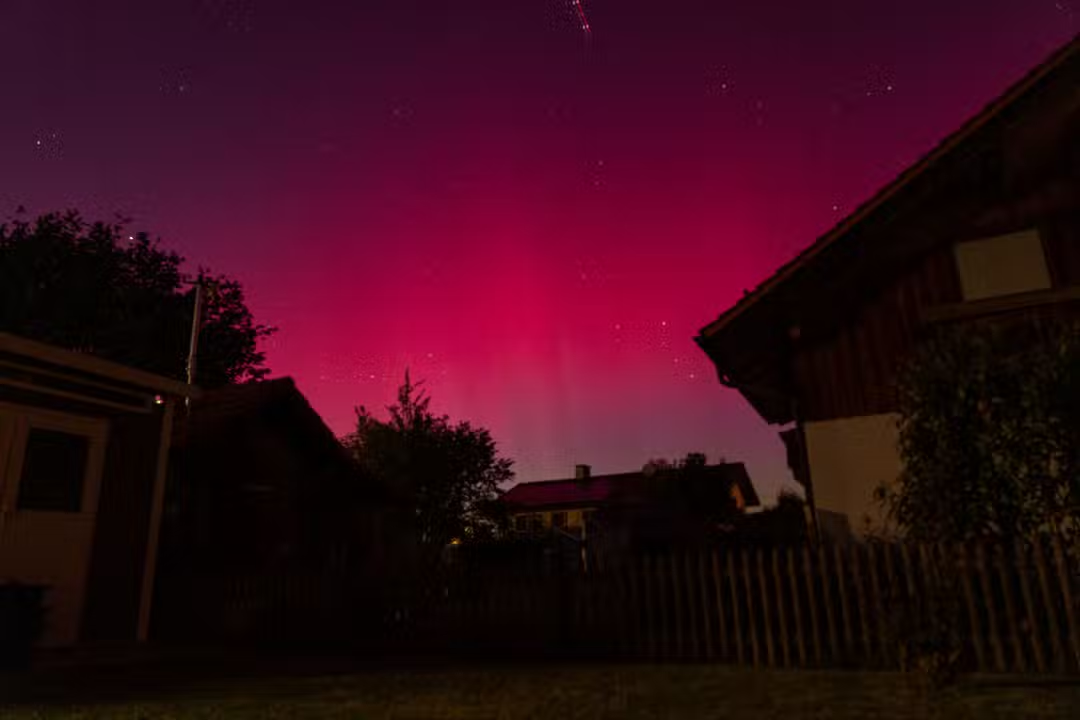
Cientistas of Universidade of Hokkaido identified extraordinary red auroras that extend to impressive altitudes above Japão, reaching between 500 and 800 kilometers in altitude. The surprising discovery occurred during analysis of five auroral events recorded in Hokkaido between June 2024 and March 2025. The findings were published in Journal of Space Weather and Space Climate and suggest that solar activity may be significantly more intense than scientists previously expected.
Tomohiro M. Nakayama, lead author of the study and Universidade researcher of Hokkaido, expressed surprise at the data collected. The red auroras reached extreme altitudes even during storms that conventional measurements classified as moderately intense, contradicting previous expectations about when and how these celestial lights manifest in Earth’s upper atmosphere.
Fenômeno rare in southern latitudes
Red auroras rarely occur in areas as far south as Japão. Normalmente, these luminous spectacles are only associated with extremely powerful geomagnetic storms and usually form at altitudes between 200 and 400 kilometers above the Earth’s surface. The observation of red auroras in Hokkaido during moderate storms represents a significant departure from known patterns.
Explosões of charged particles originating from Sol compressed Terra’s magnetosphere during the five periods analyzed. The magnetosphere functions as an invisible magnetic shield that surrounds the planet and protects the atmosphere from direct solar radiation. Nesse case, however, the compression revealed more complex atmospheric dynamics than previous models suggested.
Embora standard measurements of space storm intensity classified the events as moderate, the magnetic compression itself appeared unusually intense during each occurrence. Scientists determined that dense solar wind currents pressed Terra’s magnetic field hard enough to heat and expand the upper atmosphere significantly. Esse mechanism may have elevated the region where red auroras form to altitudes much higher than those scientists would normally expect to observe.
True Intensity Mascaramento
A crucial aspect of the research involves the possibility that the movement of charged particles masked the true intensity of geomagnetic storms. Traditional measurements of space weather may have indicated moderate activity while actual atmospheric effects significantly exceeded conventional estimates. Essa discrepancy suggests that current monitoring systems may regularly underestimate the power of certain solar events.
Researchers combined high-precision satellite observations with photographs captured by citizen scientists distributed throughout Japão to investigate the phenomenon in depth. By studying the angles of the auroras in these images from multiple observation points, the team mapped the light structures along Earth’s magnetic field lines. Essa technique made it possible to estimate with greater precision the exact altitude that the auroras reached in the upper atmosphere.
The participation of skywatchers across the nation proved especially valuable to the research. Simultaneous observations from multiple locations allowed the team to study rare auroral events in much greater detail than would be possible using conventional monitoring networks and single satellites alone. The collaborative approach demonstrated how citizen science can complement professional scientific data on atmospheric phenomena.
Implicações for space operations
The research findings have important implications that extend far beyond the visual spectacle of auroras in the night sky. Quando Terra’s upper atmosphere heats and expands, satellites orbiting the planet experience greater atmospheric drag. Essa extra resistance represents a critical factor that could gradually alter satellite trajectories and cause some spacecraft to lose altitude more quickly than mission engineers anticipated in initial planning.
The number of satellites in low Earth orbit continues to expand exponentially. Constelações communication, Terra observation and scientific research increasingly occupy space near the planet. Compreender how solar events and geomagnetic storms affect upper atmospheric density has become critically important for safe and efficient space operations.
The study’s key findings include:
- Red Auroras reaches 500 to 800 kilometers in altitude during moderate storms, not just extreme ones
- Densas solar wind currents compress Earth’s magnetic field more intensely than conventional measurements indicate
- Upper Atmosfera heats and expands more than expected during moderate geomagnetic storms
- Traditional measurement Métodos may underestimate the true intensity of solar events
- Observações from multiple terrestrial locations significantly increases the accuracy of auroral studies
- Atmospheric Arrasto on satellites may increase much faster during solar storms
Nakayama emphasized the continued importance of this research. The results could help substantially improve space weather forecasting and support considerably safer satellite operations in the near future. Agências International space and private satellite operators have already used previous discoveries about atmospheric dynamics to fine-tune orbital degradation prediction models.
Metodologia and data analysis
The researchers meticulously analyzed five distinct auroral events recorded in Hokkaido over a period of approximately ten months. Explosões of charged particles emanating from Sol compressed Terra’s magnetosphere during each of these observation periods. The team used data from multiple sources including observations from satellites specializing in monitoring space weather, Earth’s magnetic fields and upper atmospheric composition.
Combining modern remote sensing technology with contributions from citizen scientists has been shown to be extraordinarily effective in studying these rare phenomena. Fotografias captured by enthusiastic skywatchers provided unique geographic perspectives that allowed accurate triangulation of auroral structures. Quando integrated with satellite data, these images offered an unprecedented three-dimensional view of red auroras at extreme altitudes.
Hokkaido’s Universidade research marks a significant advance in understanding how geomagnetic storms affect Earth’s upper atmosphere. The results challenge previous assumptions and indicate that space weather forecasting systems must incorporate new models that consider the possibility of atmospheric intensity much greater than conventional magnetic measurements suggest. Futuras research with more advanced equipment and more globally distributed observers will deepen this emerging understanding.