Researchers confirm 15 new irregular satellites in the orbits of Jupiter and Saturn
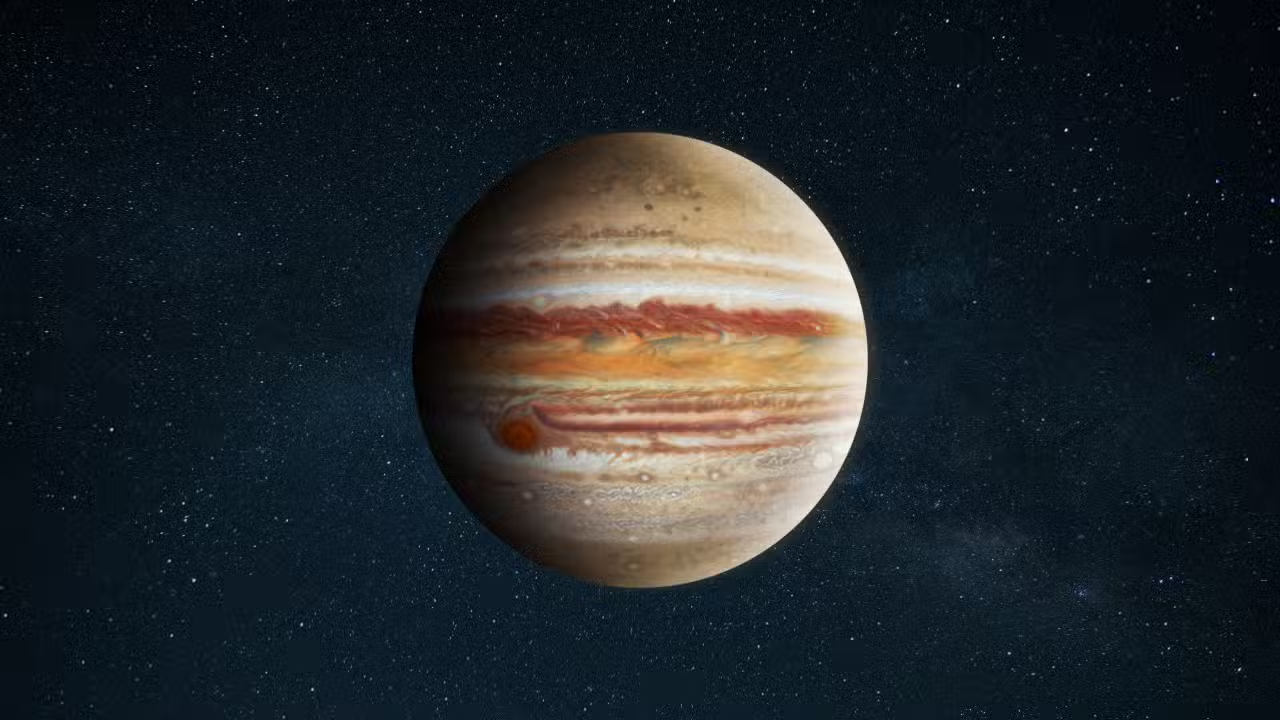
The official Sistema Solar catalog has undergone a significant update with the confirmation of 15 new natural satellites orbiting the two largest gas giants in our cosmic neighborhood. Minor Planet Center officially detected four new moons around Júpiter and another 11 in Saturno’s orbit. The recent addition brings the total number of known secondary bodies in the Jovian system to 101. Saturno, in turn, consolidates its absolute leadership position in the planetary system, reaching the mark of 285 satellites cataloged by scientists.
The newly discovered celestial bodies share specific physical and orbital characteristics, with an average diameter restricted to approximately three kilometers. Esses objects travel distant and highly inclined trajectories in relation to the equatorial plane of their respective host planets. Official confirmation, established in mid-March 2026, required extended use of large telescopes installed on Chile and Havaí. The validation process required intensive digital processing to filter out spatial noise and attest to consistent orbital displacements over multiple nights of observation.
Detalhes on the recent additions to the Jovian system
The four new moons incorporated into Júpiter’s orbit were given the temporary designations of S/2011 J 4, S/2011 J 5, S/2018 J 5 and S/2024 J 1. Astronomers Scott Sheppard and David Tholen led the observation campaigns that culminated in the identification of these dark objects. Eles orbit the gas giant at extreme distances, resulting in a long and complex orbital period. The low surface reflectivity of these bodies makes detection a considerable technical challenge for currently available conventional optical equipment.
The officialization of these four celestial bodies marks a historic moment for astronomy, allowing Júpiter to surpass the century-old barrier of known moons for the first time. Estes satellites are part of the group of irregular moons. The classification indicates that they did not form from the primordial accretion disk that gave rise to the parent planet during the early days of Sistema Solar. The data suggests that these small worlds were captured by the immense Jovian gravity at different times over billions of years.
The orbital dynamics of Júpiter’s irregular moons present patterns that intrigue planetary researchers. Muitas of these moons have retrograde orbits, moving in the opposite direction to the planet’s rotation. Continued study of these trajectories provides valuable clues about the density of gas and dust that existed in the circumstellar environment during the early stages of formation of our planetary system.
The consolidation of Saturno’s leadership in Sistema Solar
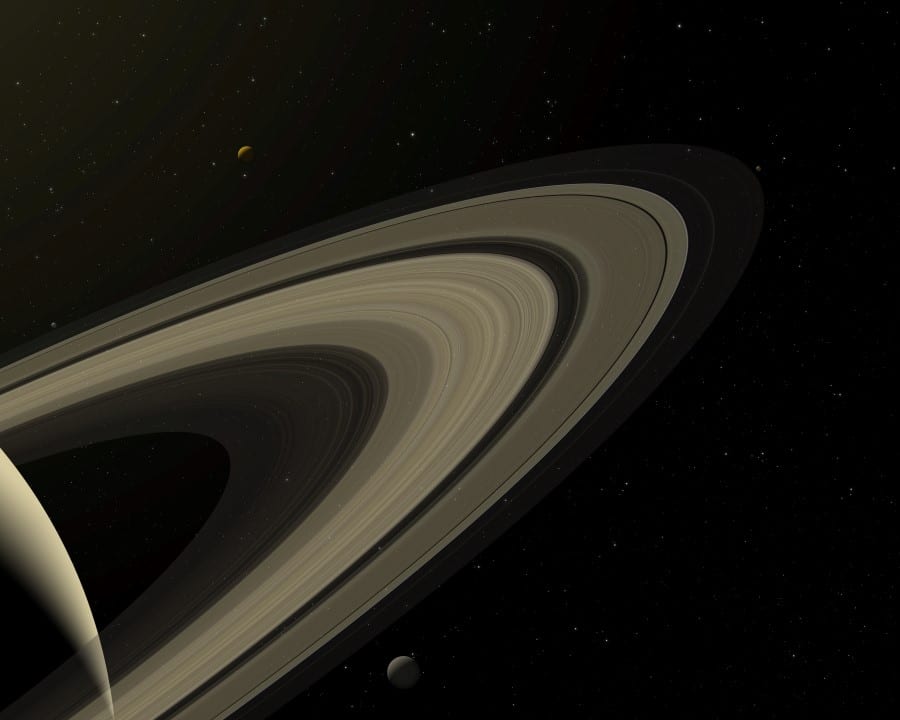
The ringed planet expanded its numerical advantage with the incorporation of 11 new celestial bodies, whose official designations range from S/2020 S 45 to S/2023 S 56. The research team led by astronomer Edward Ashton was responsible for tracking and confirming the existence of these satellites. The group used the light capture capacity of the Telescópio Canadá-França-Hawaii to record the sequential images necessary to validate the orbits. The work required extreme precision due to the visual characteristics of the targets.
Estes new Saturnian satellites are classified as small and irregular, exhibiting an extremely low brightness that challenges the limits of Earth observation. The visual magnitude of these objects varies between 25 and 27 on the astronomical scale. Such high Valores indicate that the bodies reflect a minuscule amount of sunlight, requiring long exposure times for cameras attached to the telescopes for a detectable signal to be recorded on the digital sensors.
The 11 newly cataloged objects share orbital properties that point to common evolutionary origins. The trajectories suggest that many of these satellites may be fragments resulting from ancient collisions between larger moons or impacts with invading comets and asteroids. Suas’s distant, unstable orbits contrast sharply with the well-behaved, circular trajectories of the planet’s closest regular moons, such as Titã.
Metodologia applied to detect dark celestial bodies
The identification of satellites with such small dimensions fundamentally depends on sequential captures of images of the night sky around the gas giants. The apparent motion of planets relative to background stars requires telescopes to track planetary displacement accurately. Specialized Softwares are then employed to analyze the movement patterns in the overlaid images. The central objective is to distinguish real objects orbiting the planet from fixed stars, distant galaxies or mere cosmic noise in the sensors.
- Captura of image sequences with high-resolution telescopes on clear nights.
- Aplicação of advanced algorithms for consistent orbital displacement detection.
- Filtragem rigorous analysis of light interference and artifacts generated by the Earth’s atmosphere.
- Confirmação cross-referenced the data through multiple independent observation sessions.
Modern image processing techniques have allowed astronomers to overcome the severe limitations imposed by the small size and low reflectivity of irregular moons. The confirmation process involved close collaboration between research institutions located in different hemispheres. The geographic distribution of the observatories ensures coverage of adequate visibility windows, minimizing interruptions caused by the rotation of Terra and local weather conditions.
Impacto of discoveries for understanding planetary formation
The presence of dozens of irregular satellites indicates that Júpiter and Saturno acted as true gravitational collectors of material scattered in the primordial Sistema Solar. The orbital characteristics of these new bodies provide concrete evidence about capture events and possible dynamic interactions with other celestial objects. The updated data directly enriches modern computational models that attempt to simulate the chaotic evolution of planetary systems in their first million years.
Researchers use the moon inventory to compare the gravitational environments around our system’s two largest gas giants. Diferenças in the populations of irregular moons can reveal substantial variations in the migration history of each planet. Gravitational instability Períodos, where giant planets have altered their original orbits, leaves signatures in the current distribution of these small captured satellites.
The knowledge accumulated from mapping our own cosmic backyard also finds direct application in the study of distant exoplanets. Compreender as Júpiter and Saturno captured and maintained their vast collections of moons helps astrophysicists predict the architecture of planetary systems located around Via Láctea’s other stars.
Avanços technologies in deep space observation
The use of cutting-edge equipment, such as the Subaru and Canadá-França-Hawaii telescopes, combined with highly sensitive CCD cameras, has drastically expanded the human ability to detect faint objects in deep space. Processing massive volumes of astronomical data by machine learning algorithms accelerates the identification of satellite candidates. Essas continuous improvements in hardware and software explain the increasing pace of discoveries recorded by research centers in recent years.
The confirmation of these 15 new satellites highlights that the inventory of celestial bodies in Sistema Solar remains incomplete and constantly expanding. Mesmo After decades of robotic space missions and systematic ground-based observations, small objects continue to emerge as search techniques are refined. Futuras observation campaigns should benefit from the entry into operation of even more powerful instruments, currently in the construction or testing phase.
Astronomers are constantly monitoring the distant regions around Júpiter and Saturno to locate possible additional satellites that are still evading detection. The rigorous updating of the official catalog maintained by Minor Planet Center contributes to the accurate mapping of orbital dynamics. Continued work prevents confusion in future observations of objects close to Terra and ensures the accuracy of astronomical ephemerides. The total number of known moons in Sistema Solar, including all planets and dwarf planets, now approaches the mark of 442 confirmed bodies.
Veja Tambem em Latest News (EN)

João Fonseca x Djokovic: time and where to watch the game live at Roland Garros

Conmebol Libertadores round of 16 draw: classifieds, pots and where to watch live

United States classifies PCC and Red Command as terrorist groups with blockade of assets
United States classifies PCC and Red Command as terrorist organizations in decision from June 5th

Luxury meeting financed by Daniel Vorcaro in New York becomes the target of Federal Police investigation

King Charles III’s cancer progression accelerates transition of power to Prince William and Kate

Samsung changes Galaxy S26 Ultra design and restricts fast charging for thermal safety

Steam platform releases four independent games for free for permanent redemption on computers

PlayStation 5 users redeem Ark and 2XKO for free without PlayStation Plus plan

Rockstar Games changes Grand Theft Auto VI release date to second half of 2025

Chinese probe Tianwen-1 records interstellar comet 3I/ATLAS from Mars orbit