Sonny Rollins dies at age 95 and leaves legacy as jazz saxophone colossus
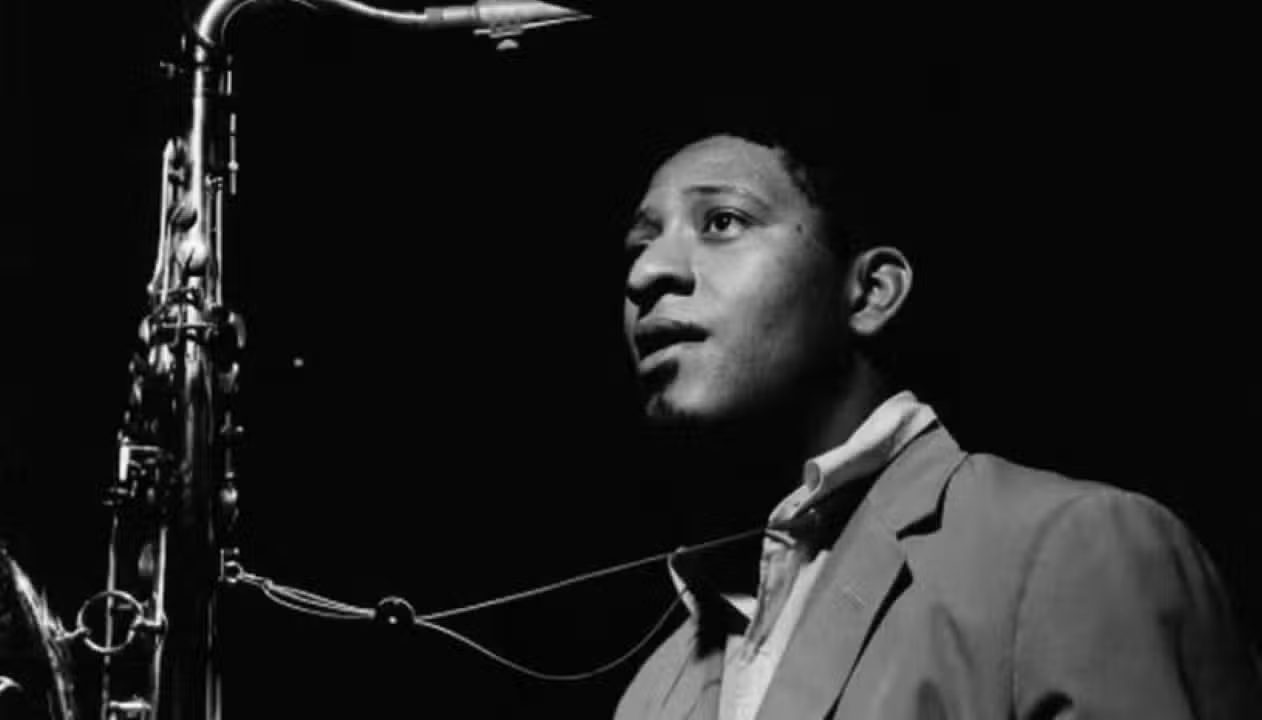
Sonny Rollins died on Monday afternoon at the age of 95 at his home in Woodstock, in Nova York’s home state. The information was confirmed by the artist’s official website and by his press officer Terri Hinte. Nenhum specific cause has been disclosed. The family’s statement highlighted their grief and love for the figure who became known as Saxophone Colossus.
Trajetória began in the 1930s Harlem
Walter Theodore Rollins was born on September 7, 1930 in the city of Nova York. Criado in Harlem’s neighborhood, he grew up surrounded by music. His sister played the piano and his brother the violin. Sonny started studying saxophone at the age of seven.
Harlem’s cultural environment at the time helped shape his talent. Ainda in high school he played with future jazz greats like Jackie McLean. Logo after leaving school, shared stages with Bud Powell and other local musicians. The city’s vibrant scene allowed him to absorb influences from Louis Jordan and Fats Waller.
- Harlem offered frequent live jazz performances
- Early Contato with professional musicians accelerated his learning
- Primeiras compositions emerged when he was still a teenager
The young musician got involved with bebop alongside figures like Miles Davis and Thelonious Monk. Ele has developed a striking sound based on strong melody and free improvisation.
Problemas personal and creative return in the 1950s
Sonny Rollins faced difficulties with chemical dependency at the beginning of his career. In 1950 he served ten months in prison for armed robbery. Depois’s period on Rikers’s island, he overcame his addiction in 1955 through a rehabilitation program.
The recovery boosted a productive phase. Entre 1953 and the end of the decade he released over 17 albums as a leader. Discos and Saxophone Colossus from 1956 became references. The St track. Thomas, inspired by her mother’s Caribbean origins, mixed calypso and jazz.
1957’s Way Out West explored a pianoless style. Freedom Suite from 1958 brought a long 20-minute composition that spoke to the civil rights movement. Colaborações with Dizzy Gillespie, Max Roach and Art Blakey marked this period.
Intervalos of study and experimentation in the 1960s and 1970s
In 1959 Sonny Rollins decided to pause recordings and shows for three years. Ele practiced up to 15 hours a day on Williamsburg Bridge’s runway. The solitary routine generated the album The Bridge in 1962.
Anos later traveled to an ashram at Índia between 1969 and 1971. Lá studied yoga, philosophy and meditation. Contact with new cultures expanded his repertoire. Ele incorporated elements of Latin music, fusion and R&B rhythms.
Nos in the 1970s recorded versions of Stevie Wonder’s compositions. Também created the soundtrack for the 1966 film Alfie, featuring Michael Caine. Musical work continued in parallel with increasingly ambitious live performances.


Reconhecimentos late and retirement in 2014
Sonny Rollins received the Grammy Lifetime Achievement in 2004. Ele won another Grammy for an instrumental solo recorded shortly after the attacks of September 11, 2001. At the time, he and his wife Lucille evacuated the apartment next to World Trade Center.
The couple lived a few blocks away. Três days after the event he played Boston. Live recording turned the disk Without to Song: The 9/11 Concert.
Problemas’s respiratory problems led him to retire from the stage in 2014. Diagnosticado with pulmonary fibrosis, he went through a period of depression before accepting the new phase. Mesmo away, he continued to be a reference for younger saxophonists.
Branford Marsalis even called him one of the greatest improvisers in the history of jazz alongside Louis Armstrong. In 2011, the then president Barack Obama handed him the National Medal of the Arts.
Legado musical and lasting influence
Sonny Rollins’s career has spanned six decades. Ele recorded more than 60 albums and played with the main names in post-war jazz. Seu’s focus has always been on creative improvisation and the constant search for evolution.
Ele avoided small clubs towards the end of his career to perform in larger venues. Participou of benefit shows linked to the climate cause. The 1998 album Global Warming reflected this concern.
Mesmo after retirement he maintained a restless spirit. In interviews he said he wanted to go beyond what he had already achieved. Sua’s direct and emotional approach has influenced generations of musicians.
Jazz has lost one of its most original figures. Sonny Rollins’s work continues to be available in recordings that still serve as study for new instrumentalists.
Veja Tambem em Latest News (EN)

King Charles III’s cancer progression accelerates transition of power to Prince William and Kate

Samsung changes Galaxy S26 Ultra design and restricts fast charging for thermal safety

Steam platform releases four independent games for free for permanent redemption on computers

PlayStation 5 users redeem Ark and 2XKO for free without PlayStation Plus plan

Rockstar Games changes Grand Theft Auto VI release date to second half of 2025

Chinese probe Tianwen-1 records interstellar comet 3I/ATLAS from Mars orbit

Samsung confirms Galaxy devices that will receive update to One UI 7 with Android 15 this year

National Toyota Yaris Cross hits stores for R$130,000 with 30 km/l flex hybrid engine

Capcom plans unprecedented expansion for the Resident Evil franchise and new remakes by 2028

Yuliia Starodubtseva eliminates Elena Rybakina as Novak Djokovic advances at Roland Garros 2026

Galaxy S23 users are left without AirDrop support in Samsung’s new One UI 8.5 update