

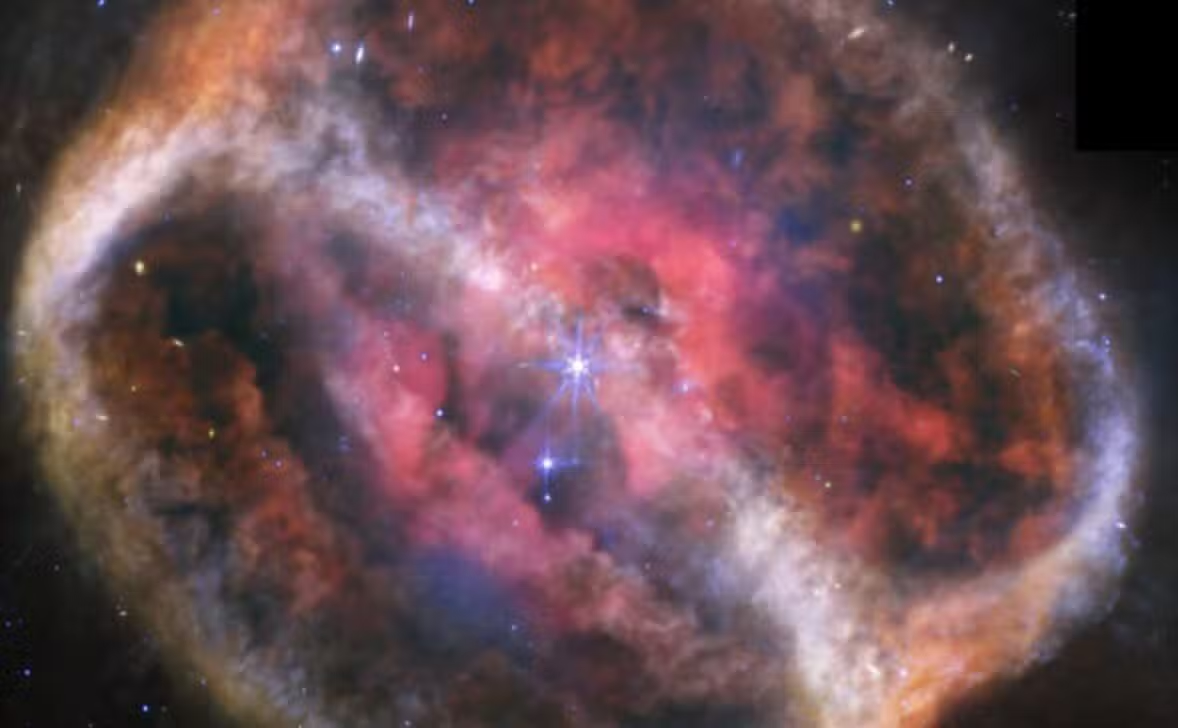
Astrônomos, using the Gemini North and James Webb Space Telescope (JWST) telescopes, captured a never-before-seen view of Nebulosa Bola from Cristal (NGC 1514). Esse cosmic spectacle, located 1,500 light-years from Terra, offers new insights into how a pair of dying stars shapes intricate celestial structures. The observations provide a rare glimpse into the complex stellar dance at the end of their lives.
The research unravels the extraordinary complexity of stellar death, showing how the interaction of stars in their final stages can create cosmic works of art. Anteriormente, the process was considered simpler. Agora, these detailed data open the way to a deeper understanding of the evolution of planetary nebulae and the enrichment of the interstellar medium with heavy elements.
Observações reveal complexity of Nebulosa Bola of Cristal
The Gemini North telescope, part of Observatório Internacional Gemini, and James Webb Space Telescope (JWST) were crucial in obtaining these stunning images. Combining the capabilities of both instruments allowed researchers to penetrate the dense layers of gas and dust surrounding Nebulosa Bola and Cristal. The observations clearly revealed the presence of a binary star system hidden in the heart of the nebula, which is mainly responsible for its unique shape.
The unprecedented Detalhes of NGC 1514, also known as Nebulosa Bola of Cristal, demonstrates complex architecture that challenges previous conceptions about the formation of these structures. Collaboration between terrestrial and space technologies has significantly expanded the ability to investigate distant astrophysical phenomena. Essa multifrequency and high-resolution approach made it possible to map the distribution of material and the dynamics of gases ejected by stars.
Papel of binary stars in cosmic sculpture
The unusual and highly structured formation of Nebulosa Bola from Cristal is directly attributed to the presence of its binary star pair. As these intermediate-mass stars reach the end of their life cycles, they interact gravitationally in ways that distort the ejection of material into space. The flow of gas and plasma is not ejected symmetrically in all directions. Isso results in the creation of complex patterns, distinct lobes and concentric rings observed in the nebula.
Previous Modelos of planetary nebulae often predicted simple spherical or elliptical shapes. However, the reality observed in NGC 1514 demonstrates a much greater complexity, where the dynamics of a double star system acts as the main shaping agent. Mass loss does not occur uniformly; instead, it is influenced by the tidal forces and stellar wind of each component of the binary. Essa turbulence and uneven mass loss are responsible for transforming initially smooth spheres into intricate, multi-lobed structures that delight scientists.
Planetary Nebulosas and the stellar life cycle
The term “planetary nebula” was coined by William Herschel in the 18th century, who observed them as round, planet-like objects through his rudimentary telescopes. Apesar of the nomenclature, these cosmic phenomena have no relationship with planets or their formation. Elas represent the final and crucial phase of low- to medium-mass stars, a stage that our own Sol will eventually reach in billions of years.
Essas Spectacular formations occur when a star runs out of its main nuclear fuel, such as hydrogen. Consequentemente, its outer layers of gas are ejected into the surrounding space, forming shells of expanding gas that can last for tens of thousands of years.
- Características from Nebulosas Planetárias:
* Descobertas by William Herschel in the 18th century.
* Não has a direct link with the formation of planets.
* Representam the final phase of low to intermediate mass stars.
* Formadas by the expulsion of the outer layers of stellar gas.
* Evoluem from smooth spheres to complex structures due to factors such as binary stars.
The evolution of these gaseous shells, which may initially appear smooth, into intricate, multi-lobed shapes is a highly dynamic process. Fatores like the rotation of the central star, magnetic fields and, as evidenced in Nebulosa Bola of Cristal, the presence of a companion star, play key roles in sculpting these shapes.
Implicações for Understanding the Death of Stars
The detailed revelation of how a pair of binary stars carves Nebulosa Bola from Cristal significantly deepens scientific knowledge about stellar death. Astrônomos can now refine models about the evolution of double stellar systems, as well as the complex impact of their gravitational and stellar wind interactions. Este specific study offers unprecedented insight into the mechanics involved in the formation of some of the most beautiful and enigmatic cosmic structures.
Understanding these nebulae is vital to accurately mapping the life and death cycle of stars in our galaxy and beyond. The way stars expel their enriched material – including heavier elements formed in their cores – into space directly influences the formation of new stars and, consequently, future planetary systems. Cristal’s Nebulosa Bola serves as a stellar natural laboratory. Ele allows scientists to study the primordial matter that makes up the universe and the complex processes by which it is recycled to generate new generations of stars.